
Christ in the House of Martha and Mary by Vermeer: His Largest Painting and Only Bible Scene (c. 1655)
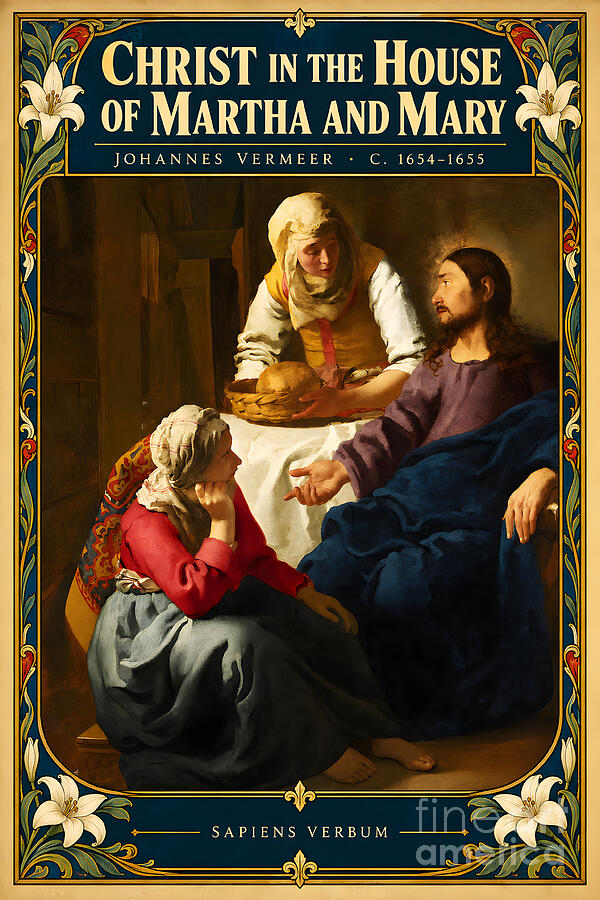
Two sisters, one guest and one loaf of bread. Martha leans in from behind the table with a basket, her sleeves rolled up, busy with the meal. Her sister Mary sits on a low stool at Christ’s feet, chin in her hand, listening. Christ turns to Martha, but his open hand points to Mary. This is Johannes Vermeer’s Christ in the House of Martha and Mary, painted in Delft around 1654–1655: his largest surviving canvas, one of his earliest, and his only known biblical subject. Here we look at it through a new frame as well: a vintage Art Nouveau poster with a border of white lilies.
🖼️ Get the Art Nouveau poster →
Artist: Johannes Vermeer (1632–1675), Delft
Title: Christ in the House of Martha and Mary
Date: about 1654–1655
Medium: Oil on canvas, 158.5 × 141.5 cm
Collection: Scottish National Gallery, Edinburgh (NG 1670), presented by the sons of W. A. Coats in memory of their father, 1927
Subject: Luke 10:38–42
Notable fact: Vermeer’s largest painting and his only known biblical subject.
The story: one thing is needful
The scene comes from a short passage in the Gospel of Luke. Jesus visits the house of two sisters. Martha is “cumbered about much serving”; Mary sits at his feet and listens. When Martha complains that her sister has left her to do all the work, Jesus answers that Martha is troubled about many things, but “one thing is needful: and Mary hath chosen that good part, which shall not be taken away from her.”
Vermeer tells the whole story with three gestures. Martha bends forward with the bread, her face turned down towards Christ, caught in the middle of her work. Christ sits back in his chair, wrapped in a deep blue mantle over a purple robe, and looks up at her; but his right hand, open, points down to Mary. Mary does nothing at all. She rests her head on her hand and looks up at him, her bare feet on the floor. As the Scottish National Gallery puts it, Christ’s gesture suggests that the spiritual matters more than the material world. ColourLex offers a gentler reading: the two sisters as two paths to salvation, contemplation and active good works.
Not the Vermeer you expect
If you know Vermeer from The Milkmaid or the Girl with a Pearl Earring, this picture comes as a surprise. It is enormous, more than one and a half metres high, while most of his later paintings are small. The figures are life-size and close to us, the brushwork is broad, and the light falls in strong contrasts of brightness and shadow. According to the Scottish National Gallery, this handling was probably inspired by the painters of Utrecht, who had learned from Caravaggio.
And yet the later Vermeer is already here. Look at the light on the loaf and on the white tablecloth, at the folds of Martha’s sleeves and Mary’s headscarf: the gallery sees in these passages the first signs of his mature work, and in the quiet figure of a woman absorbed in her task, the many interiors that would follow.
Why a religious painting?
No one knows exactly who commissioned it. Its size and subject suggest a specific commission, possibly for a clandestine Catholic church in Delft or for a Catholic patron. Around the time he painted it, Vermeer married Catharina Bolnes, whose mother Maria Thins was a Catholic, and the marriage would have required his conversion. The gallery suggests that the patron may even have been his mother-in-law.
The colours
Scientific analysis of the pigments, published by Hermann Kühn and summarised by ColourLex, found madder lake, yellow ochre and vermilion in Mary’s red blouse, lead white and yellow ochre in the tablecloth, and in Christ’s blue mantle a mixture of smalt, indigo and lead white. That is unusual: the later Vermeer is famous for his costly ultramarine, and indigo is rare in his work.
From “Raphael” to Edinburgh
For a long time the painting lost its name. In the late nineteenth century it was in an English private collection, apparently described as a work by Raphael. When it was cleaned in 1901 the signature was discovered, and scholars began to connect it with Vermeer. London dealers sold it to William Allan Coats, a director of a thread manufacturer in Paisley. After his death in 1926 his sons sold his collection, but they kept back the Vermeer and gave it to the Scottish National Gallery in their father’s memory. It has been in Edinburgh ever since. For two later Vermeers on this blog, read our essays on The Milkmaid and Girl with a Pearl Earring.
Why it works as an Art Nouveau poster
The composition is built on a strong triangle of three figures in a dark room, with almost nothing else in the way. The Sapiens Verbum version keeps the whole painting and sets it in an arched frame with a border of white lilies, a traditional symbol of purity, under a deep blue title panel that echoes Christ’s mantle. For more sacred images reimagined the same way, see Van Gogh’s Pietà, El Greco’s Christ Carrying the Cross and Holman Hunt’s The Light of the World, and for the same kitchen-and-bread world as a poster, The Milkmaid as a Vintage Art Poster.
Hang Vermeer’s Christ in the House of Martha and Mary — the bread, the pointing hand and Mary listening — as a vintage Art Nouveau poster from the Sapiens Verbum print shop.
 Choose your size and frame →
See the vintage poster collection →
Choose your size and frame →
See the vintage poster collection →Printed and shipped by Fine Art America · 30-day money-back guarantee
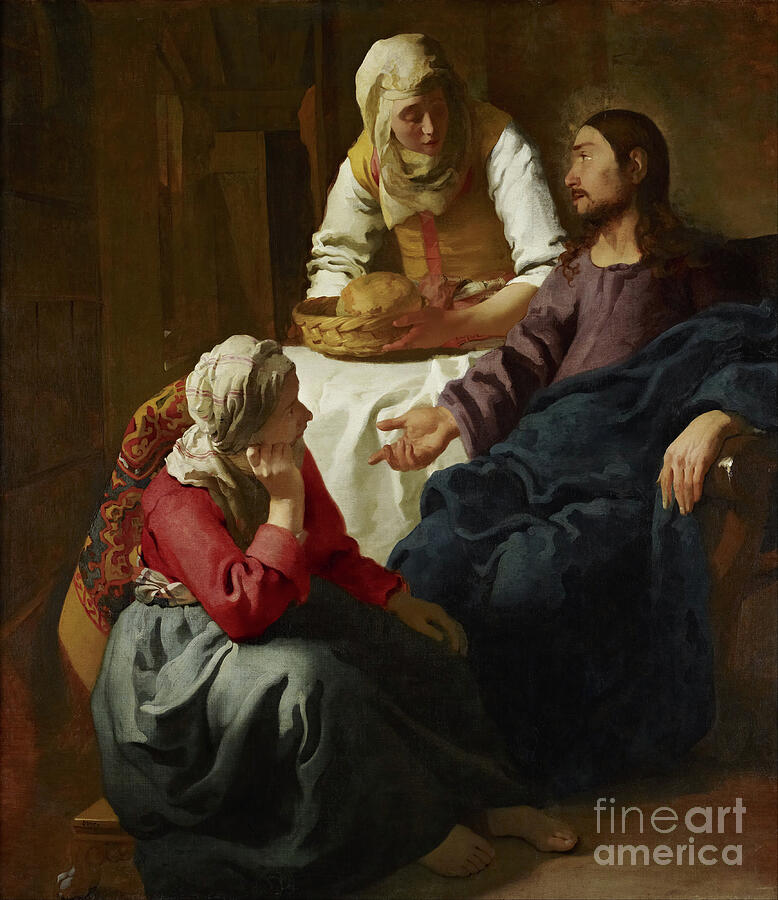
Hang Vermeer’s Christ in the House of Martha and Mary as he painted it, as a print, canvas or framed print from the Sapiens Verbum print shop.
 Choose your size and frame →
Printed and shipped by Fine Art America · 30-day money-back guarantee
💬 Over to you: Are you a Martha or a Mary? And would you have recognised this as a Vermeer? Tell us in the comments.
Sources
National Galleries of Scotland — Johannes Vermeer, Christ in the House of Martha and Mary (NG 1670)
ColourLex — Vermeer, Christ in the House of Martha and Mary (pigment analysis)
Wikipedia — Christ in the House of Martha and Mary (Vermeer)
Luke 10:38–42 (King James Version)
Comments
Post a Comment