
The Light of the World by William Holman Hunt: The Door With No Handle, as an Art Nouveau Poster (1851–1853)
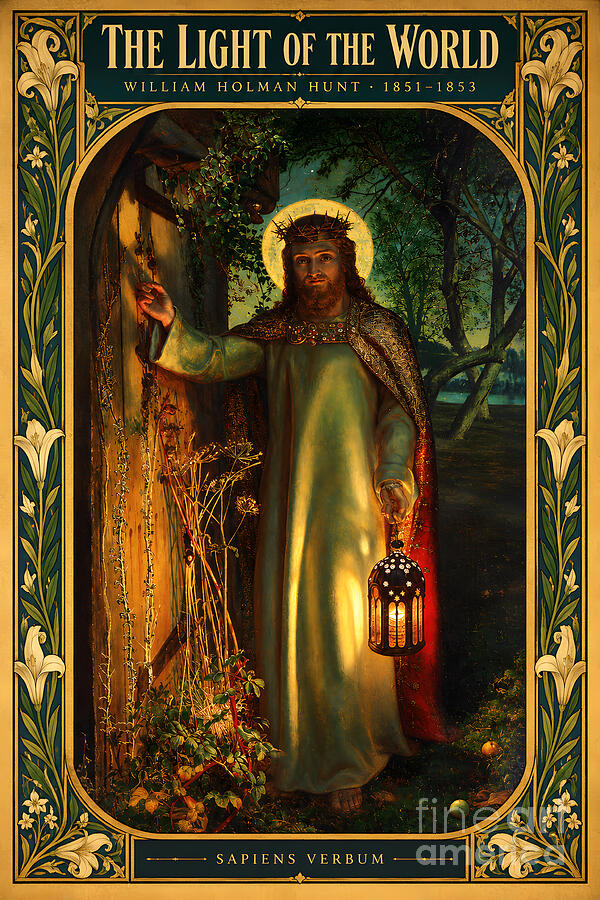
It is night in an overgrown orchard. A tall figure in a white robe and a jewelled cloak stands before a wooden door, a lantern in one hand, the other raised to knock. He wears a crown of thorns, and a soft halo glows behind his head. The door is shut, its hinges rusted and wrapped in ivy, its threshold choked with weeds. This is William Holman Hunt’s The Light of the World, painted in 1851–1853 and one of the best-loved religious pictures of the Victorian age. Here we look at it through a new frame: a vintage Art Nouveau poster with a border of white lilies.
🖼️ Get the Art Nouveau poster →
Artist: William Holman Hunt (1827–1910), founding member of the Pre-Raphaelite Brotherhood
Title: The Light of the World
Date: 1851–1853; shown at the Royal Academy in 1854
Medium: Oil on canvas over panel, arched top, 49⅜ × 23½ in (about 125 × 60 cm)
Collection: Keble College, Oxford (side chapel)
Subject: Revelation 3:20, “Behold, I stand at the door and knock”
Notable fact: Hunt painted two more versions; the largest, completed in 1904, hangs in St Paul’s Cathedral, London.
A door with no handle
The picture illustrates a single verse from the Book of Revelation: “Behold, I stand at the door and knock: if any man hear my voice, and open the door, I will come in to him.” Everything in the painting serves that sentence. The door stands for the human soul, and it has no handle on the outside: it can only be opened from within. Its rusty nails and the ivy growing over the hinges show that it has not been opened for a very long time. Christ does not force it. He knocks, and waits.
Keble College, where the original hangs, reads the rest of the symbols this way. There are two lights in the picture: the lantern, which stands for conscience, and the light around Christ’s head, which stands for salvation. The bright point in the sky behind him is the morning star, announcing a new day. The autumn weeds and the fallen fruit on the ground speak of the autumn of life. Hunt himself said that he painted the picture not because it was a good subject but because he believed he was obeying a divine command.
Painted at night
Hunt was one of the three young painters who had founded the Pre-Raphaelite Brotherhood in 1848, together with John Everett Millais and Dante Gabriel Rossetti, and he took the Brotherhood’s demand for truth to nature literally. To get the moonlight and lamplight right, he is said to have worked at night, in a makeshift hut at Worcester Park Farm in Surrey; other accounts place part of the work in the garden of the Oxford University Press. Several people sat for the head of Christ, and the poet Christina Rossetti, sister of Dante Gabriel, posed for it too. Keble College adds that Hunt wanted the dawn sky to be perfect and found the sunrise he needed near Bethlehem.
Mocked, then defended
When the painting was shown at the Royal Academy in 1854, many visitors did not know what to make of it. Hunt was travelling in the Holy Land and could not answer his critics, so John Ruskin did it for him. In a letter published in The Times on 5 May 1854, Ruskin described watching the picture for more than an hour: few people stopped, and most of those who did scoffed, above all at the idea of Christ carrying a lantern. He argued that a picture painted with such care deserved a second, more attentive look.
The picture was bought by Thomas Combe, Printer to the University of Oxford and a great supporter of the Pre-Raphaelites. After his death in 1872, his widow, Martha Combe, gave it to Keble College. The college had promised to hang it in the new chapel, but the architect, William Butterfield, made no room for it; it went first to the library in 1878 and later to the side chapel built in the 1890s, where it still hangs today. Visitors can still see it, and a button on the wall lights up the painting.
Three versions and a world tour
Keble charged a fee to see the picture, and that annoyed Hunt enough to paint a new, larger version. A smaller second version, painted in 1851–1856, is in Manchester Art Gallery. The third, life-size, was begun around 1900 and finished in 1904; by then Hunt was losing his sight to glaucoma, and the painter Edward Robert Hughes helped him complete it. Charles Booth bought it; from 1905 to 1907 it toured the world, and then it was dedicated in St Paul’s Cathedral in 1908. It drew enormous crowds; it was even claimed that four-fifths of the population of Australia went to see it. Engravings of the image hung in countless homes, schools and churches.
Why it works as an Art Nouveau poster
Hunt’s composition is already close to a poster: a single standing figure, a tall arched format, a glowing halo, and one strong source of light in the lantern. The Sapiens Verbum version keeps the painting intact and sets it in an arched frame inside a border of white lilies, a traditional symbol of purity, with a dark title panel above and below. It is the same language Art Nouveau designers used around 1900 to turn saints and seasons into images for everyday walls. For another Christ reimagined this way, see Salvator Mundi as an Art Nouveau Icon; for the movement Hunt helped found, read Pre-Raphaelitism in Painting, and for his friend Millais, Ophelia.
Hang Holman Hunt’s The Light of the World — the lantern, the closed door and the crown of thorns — as a vintage Art Nouveau poster from the Sapiens Verbum print shop, as a print, canvas or framed poster.
 Choose your size and frame →
See the vintage poster collection →
Choose your size and frame →
See the vintage poster collection →Printed and shipped by Fine Art America · 30-day money-back guarantee
💬 Over to you: Would you open the door? And which detail do you notice first: the lantern, the crown of thorns or the missing handle? Tell us in the comments.
Sources
Keble College, Oxford — The Light of the World
John Ruskin, letter to The Times, 5 May 1854 (Library Edition, vol. 12)
The Victorian Web — The Light of the World (Keble College version)
Wikipedia — The Light of the World (Hunt)
Comments
Post a Comment