
Salvator Mundi as an Art Nouveau Icon: Leonardo's Christ Reimagined (c. 1500)
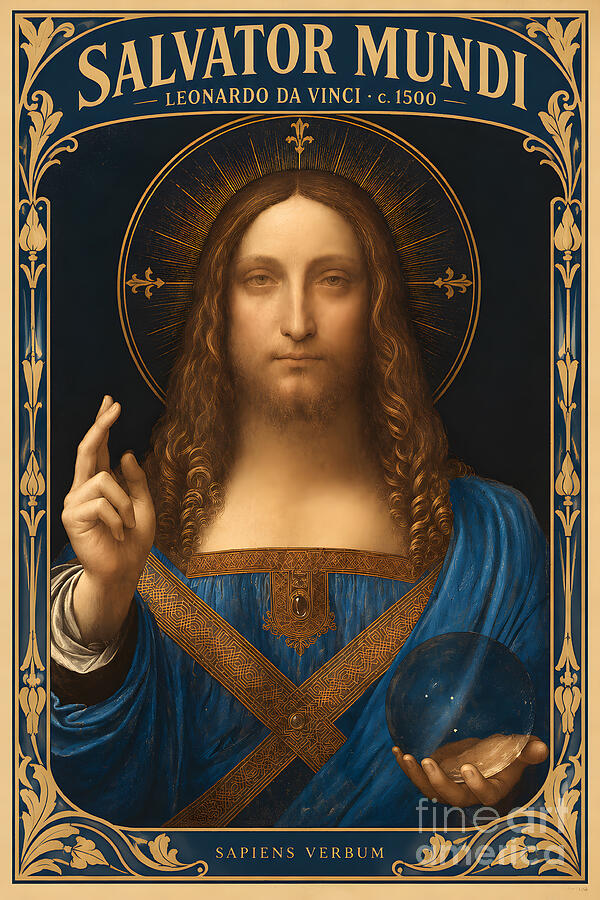
A half-length Christ faces us head-on, his right hand raised in blessing and his left holding a clear crystal sphere. His face is soft, almost dissolving into shadow; his gaze is calm and impossible to pin down. This is Salvator Mundi, “Saviour of the World”, the panel attributed to Leonardo da Vinci that sold for a record $450.3 million in 2017 and then disappeared from public view. Here we look at it from a different angle: why a Renaissance devotional image works so naturally as an Art Nouveau icon, and what remains of its mystery today.
🖼️ Get the Art Nouveau poster →
Artist: Leonardo da Vinci (1452–1519), attribution debated (workshop participation, e.g. Boltraffio, has been proposed)
Title: Salvator Mundi (Saviour of the World)
Date: c. 1500
Medium: Oil on walnut panel, about 65.6 × 45.4 cm
Collection: Private; bought at Christie’s New York in 2017, reportedly for Saudi Arabia; announced for the Louvre Abu Dhabi but never shown. Current whereabouts not publicly confirmed.
Notable fact: Sold in 1958 from the Cook collection for £45 as a follower’s copy; sold in 2017 for $450.3 million, the highest price ever paid for a painting at auction.
An old icon in a new frame
The Salvator Mundi belongs to a devotional formula that was popular in Northern Europe and Italy around 1500: Christ shown frontally, blessing with one hand, holding the globe of the world in the other. It is an image meant for contemplation, close to an icon. That is exactly why it translates so well into the language of Art Nouveau. Around 1900, designers like Alphonse Mucha built their posters on the same idea: a single, centred figure, a strong silhouette, a halo-like disc or arch behind the head, and an ornamental border that turns the image into something between a stained-glass window and an altarpiece.
The Sapiens Verbum poster version keeps Leonardo’s composition and wraps it in that vocabulary of curving frames, flat decorative bands and warm vintage tones. The result is not a copy of the panel but a reading of it: the Renaissance Christ seen through the eyes of the Belle Époque.
The gaze
Leonardo’s great invention was sfumato, the soft blending of light into shadow without hard outlines. In the Salvator Mundi it gives the face a hovering, uncertain quality: the eyes look straight at us, yet the features seem to slip out of focus, much like the Mona Lisa. In a poster, where everything else is crisp line and pattern, that blurred, inward face becomes even more striking. The ornament holds the frame; the face keeps the mystery.
The orb that does not bend the light
The most discussed detail is the crystal sphere. A solid glass ball should act like a lens, inverting and distorting whatever lies behind it, including the folds of Christ’s robe. In the painting it barely does: the drapery behind the orb appears almost undistorted, and only a few small highlights sparkle inside it. Some critics saw this as an error unworthy of Leonardo, who studied optics closely. Others argue that it was a deliberate choice, or that the sphere is meant as a hollow glass globe, which would distort much less. For a symbol of the heavens held in a calm hand, perfect physics may simply not have been the point. In a decorative poster, that clear, weightless orb reads naturally as a jewel or a sun.
From £45 to $450 million
The painting’s modern story is almost as famous as the image. It is thought to be the Salvator Mundi recorded in the collection of Charles I of England. By the twentieth century, heavily overpainted, it belonged to the Cook collection in Richmond, where it was catalogued as the work of a follower of Leonardo. It sold in 1958 for £45. In 2005 it was bought at a small auction in the United States by two dealers who suspected something more. The panel was cleaned and restored by the conservator Dianne Modestini, and in 2011 it was exhibited as an autograph Leonardo at the National Gallery in London.
On 15 November 2017 it sold at Christie’s New York for $450.3 million including fees. The buyer was later reported to be acting for Saudi Arabia. The Louvre Abu Dhabi announced it would show the work in 2018, then cancelled the presentation without explanation. Since then the painting has not been seen in public, and its exact location has never been officially confirmed.
Leonardo, workshop, or both?
The attribution remains one of the great debates of art history. Supporters point to the quality of the blessing hand, the curls of hair and the pentimento in the thumb, which suggests a mind changing as it painted. Sceptics note the damaged state of the panel, the extent of the restoration, and the possibility that Leonardo’s assistants, such as Giovanni Antonio Boltraffio, painted much of it. The Louvre did not include it in its great Leonardo exhibition of 2019–20. For a fuller account of the sale and the attribution dispute, read our earlier essay, Salvator Mundi: Leonardo’s Most Expensive — and Most Doubted — Christ.
How to read it today
Whatever its final attribution, the Salvator Mundi has become a modern icon in the literal sense: an image known far more through reproductions than through the panel itself, which almost no one can now see. In a way, that makes the poster the most honest way to live with it. Art Nouveau turned saints, seasons and muses into images for everyday walls; this Christ, hidden from the public, finds a second life the same way.
Hang Leonardo’s Salvator Mundi — the blessing hand, the crystal orb, the sfumato gaze — reimagined as a vintage Art Nouveau poster from the Sapiens Verbum print shop. The museum image and the commercial print are separate.
 Choose your size and frame →
Printed and shipped by Fine Art America · 30-day money-back guarantee
💬 Over to you: Does Leonardo’s Christ feel at home in an Art Nouveau frame? And do you think we will ever see the original again? Tell us in the comments.
Sources
Christie’s — Leonardo da Vinci, Salvator Mundi, lot essay (New York, 15 November 2017)
The National Gallery, London — Leonardo da Vinci: Painter at the Court of Milan (2011–12)
Wikipedia — Salvator Mundi (Leonardo)
Wikimedia Commons — Salvator Mundi, image file
Sapiens Verbum — Salvator Mundi, Leonardo da Vinci, vintage Art Nouveau poster
Watch: Salvator Mundi, the controversial story of the world’s most expensive painting
Comments
Post a Comment