

The Milkmaid as a Vintage Art Poster: Vermeer's Quiet Kitchen on Your Wall (c. 1658)
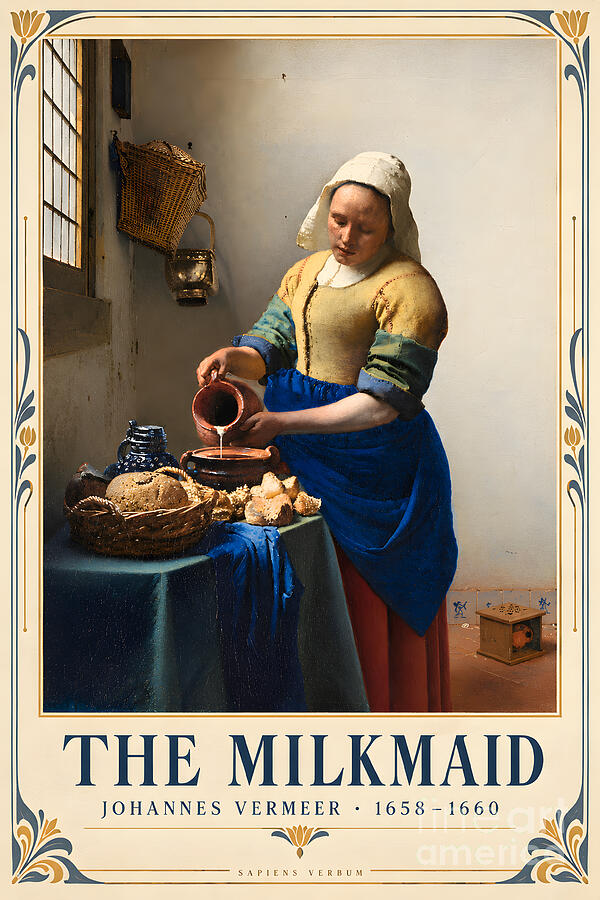
A woman stands by a window in a plain kitchen, pouring a thin stream of milk from an earthenware jug into a bowl. Nothing else happens. Yet for more than three centuries this small canvas has been one of the most loved paintings in the world. Here we look at Johannes Vermeer’s The Milkmaid from a particular angle: why a quiet Dutch interior of the 1650s works so naturally as a vintage art poster, and what the poster format reveals about Vermeer’s way of building a picture.
Artist: Johannes Vermeer (1632–1675), Delft
Title: The Milkmaid (Het melkmeisje)
Date: c. 1658
Medium: Oil on canvas, 45.5 × 41 cm
Collection: Rijksmuseum, Amsterdam (SK-A-2344), acquired in 1908 from the Six collection
Notable fact: Scans made by the Rijksmuseum revealed that Vermeer first painted a jug rack on the wall and a basket on the floor, then removed them to simplify the scene.
A painting already built like a poster
Many old master paintings resist being turned into posters: too many figures, too much depth, too many dark corners. The Milkmaid is the opposite. It has one figure, set against a bare, light wall, seen slightly from below so that she gains weight and dignity. Her shape is simple and solid, almost a column. The colours are few and strong: the lead-tin yellow of the bodice, the deep ultramarine blue of the apron, the red of the skirt, the white of the cap and the wall. That is exactly the palette and clarity a good poster needs.
The Sapiens Verbum poster version leans into those qualities. It keeps Vermeer’s composition and quiet light, but treats the image with the flatter colour, softened texture and warm, aged tones of a vintage print. The result is not a reproduction of the canvas, but a reading of it: the Dutch kitchen seen through the eyes of early twentieth-century graphic design.
What the poster keeps: light and stillness
Vermeer’s real subject is light. It falls from the window on the left, catches the rim of the jug, glints on the brass pail on the wall and breaks into tiny dots of paint on the crust of the bread and the basket. Those small highlights, sometimes compared to the effects of a camera obscura, make the still life on the table almost sparkle. Even in a simplified poster, the diagonal of daylight across the wall and the bright stream of milk remain the heart of the image.
So does the stillness. The milk is the only thing that moves, and it moves so slowly that time seems to stop. That calm is what makes the picture work on a wall at home: it is an image to live with, not just to look at once.
What the poster lets you see: the details
A poster also invites a closer look at the small things around the woman. On the floor stands a foot warmer, and the Delft tiles along the skirting show tiny figures, among them a Cupid. Some art historians read these as discreet hints of love and desire, a familiar theme in Dutch images of kitchen maids. Others see the painting as a celebration of domestic virtue and honest work. Vermeer leaves both readings open. Our earlier essay explores this question, and why the woman is in fact a kitchen maid rather than a milkmaid: The Milkmaid by Vermeer: The Maid Who Wasn’t a Milkmaid at All.
From Delft to every wall
The painting was already admired in Vermeer’s time; in a 1696 Amsterdam sale it fetched one of the highest prices among his works. It later passed through several Dutch collections and was bought by the Rijksmuseum in 1908, with support from the Dutch state, after a public debate over keeping it in the Netherlands. Since then it has become a national icon, reproduced on everything from stamps to dairy advertising. In that sense, The Milkmaid has been a poster for a long time; a vintage art print simply makes that history visible.
How to read it today
Seen today, The Milkmaid is a lesson in attention: one person, one task, one beam of light, done with complete care. The poster format strips away nothing essential, because Vermeer had already removed everything that was not essential himself. What remains is a woman, a jug, a window and a moment of calm, which may be exactly what a modern wall needs.
Hang Vermeer’s Milkmaid — the window light, the stream of milk, the yellow and blue — as a vintage art poster from the Sapiens Verbum print shop. The museum image and the commercial print are separate.
 Choose your size and frame →
Printed and shipped by Fine Art America · 30-day money-back guarantee
💬 Over to you: Does Vermeer’s kitchen maid feel at home as a vintage poster? Which detail catches your eye first? Tell us in the comments.
Sources
Rijksmuseum — Johannes Vermeer, The Milkmaid (SK-A-2344)
Essential Vermeer — The Milkmaid
Wikipedia — The Milkmaid (Vermeer)
Sapiens Verbum — The Milkmaid, Johannes Vermeer, vintage art poster
Watch: Vermeer’s Milkmaid, virtue, desire and a 400-year-old mystery
Comments
Post a Comment