


The Milkmaid by Vermeer: The Maid Who Wasn't a Milkmaid at All (c. 1658)
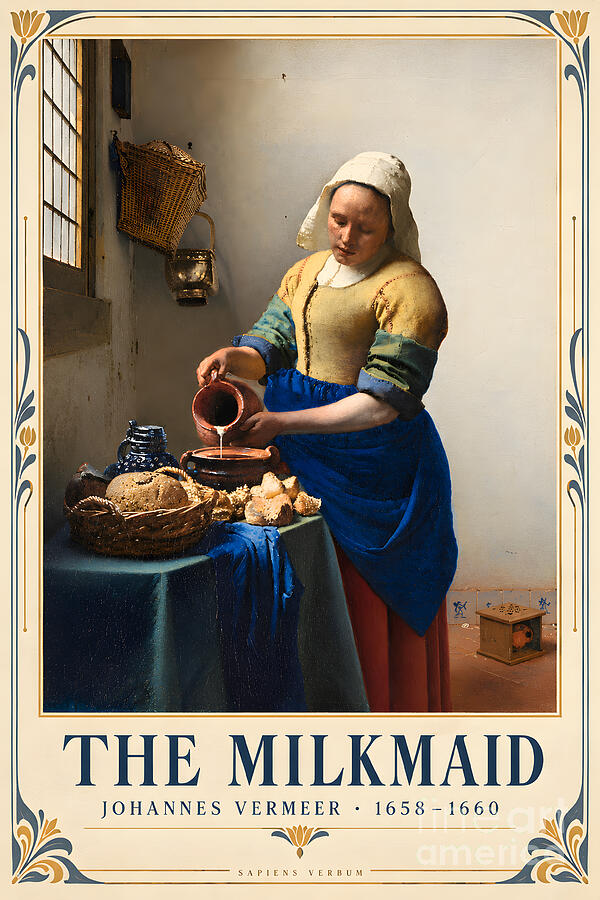
In September 2022, curators preparing the Rijksmuseum's blockbuster Vermeer retrospective pointed macro X-ray and infrared scanners at the most reproduced painting in Dutch history, expecting to confirm what everyone already believed: that Johannes Vermeer worked slowly, precisely, and never changed his mind. Instead they found a basket for warming a baby's bedding, quietly painted over and replaced with a foot warmer and a small ceramic Cupid — the detail every art historian actually already knew about. The woman pouring the milk has an even older problem: strictly speaking, she was never a milkmaid at all. The picture below is our vintage poster version of the painting; the original is shown further down.
🖼️ Get the vintage poster →License this image →
Artist: Johannes Vermeer (1632–1675)
Date: c. 1658
Medium: Oil on canvas
Collection: Rijksmuseum, Amsterdam
Notable fact: Sold for 175 guilders in 1696 — the second-highest price in Vermeer's entire estate sale, behind only View of Delft
A Maid, Not a Milkmaid
The Dutch title, Het Melkmeisje, translates literally as "the little milk-girl," but in Vermeer's own century the woman at the table would have been called a keukenmeid — a kitchen maid, or maid-of-all-work — not a melkmeid, the term reserved for someone who actually milked cows in the field. She is standing indoors, in a spare, whitewashed Delft kitchen, pouring milk from a jug into an earthenware pot surrounded by torn pieces of bread. The art historian Harry Rand has argued she isn't making a drink at all, but bread pudding — soaking broken bread in milk before it goes into the oven, which would explain both the scattered crusts on the table and the slow, deliberate tilt of her wrist. The chore in the painting's title, in other words, may not even be the chore she is performing.
What the 2022 Scan Actually Found
The Rijksmuseum's 2022 imaging campaign is often summarized as uncovering a "hidden code," but its real findings were about process, not symbolism. Beneath the maid's raised left arm, scientists found a hastily brushed black line — a rough underpainting Vermeer used to block in light and shadow before adding detail, overturning his reputation for painting with no visible preparation at all. On the back wall behind her head, they found a wooden jug-rack sketched in black paint and then abandoned mid-thought. Most striking of all, the lower right corner originally held a woven willow "fire basket," a household object used across the Dutch Republic to warm infants' bedding and dry nappies. Vermeer painted over it completely, replacing a piece of nursery equipment with the wooden foot warmer, the run of blue-and-white tiles, and the floor visible in the finished picture. That substitution — a domestic, maternal object quietly swapped for one long read as erotic — is the actual discovery buried beneath the paint. The Cupid tile itself was never hidden; it has been in plain sight since the 1650s.
A Foot Warmer and a Delft Cupid
The foot warmer and the small Delft tile of Cupid beside it have been visible to every viewer of this painting for over 350 years, and art historians have disagreed about them for almost as long. Walter Liedtke, the Metropolitan Museum's longtime Vermeer scholar, read the pairing as a discreet joke at the maid's expense: 17th-century emblem literature linked foot warmers to female arousal, and Cupid tiles turn up in genre paintings that cast servants as available to the men of the house. Taco Dibbits, the Rijksmuseum's director, has countered that Delft Cupid tiles were mass-produced and decorated ordinary Dutch kitchens with no symbolic intent at all — coincidence, not code. What both sides agree on is rarer: unlike most Dutch genre painters of the period, who painted maids as comic or lascivious stock figures, Vermeer gives this one concentration, weight, and dignity, whatever is or isn't implied by the tile at her feet.
The Optical Trick That Probably Wasn't
The painting's odd shifts of focus — crisp in the foreground, softly blurred in the middle distance — have long fed the theory that Vermeer traced the scene through a camera obscura, an optical device that projects an image for an artist to copy. But the theory has a physical problem: a pinhole was found at the vanishing point of the composition, almost certainly used to anchor a chalked string for laying out perspective by hand, a routine studio technique with no camera involved. As Liedtke pointed out, a projected optical image lasts only as long as the light source; this painting took months to complete. The blurred textures may owe more to Vermeer's own eye and brush than to any lens.
The Second-Highest Price in the Room
When the estate of Jacob Dissius, Vermeer's last private owner, was auctioned in Amsterdam in 1696, this small kitchen scene sold for 175 guilders — an enormous sum for a genre painting, and the second-highest price of the entire sale, beaten only by Vermeer's own View of Delft at 200 guilders. It passed through five further private Amsterdam collections before the Rijksmuseum acquired it in 1908 with support from the Rembrandt Society. It hangs today in the museum's Gallery of Honour, a few rooms from View of Delft itself — still, more than three centuries on, one of the most closely studied paintings in the building.
Vermeer’s Milkmaid reimagined as a vintage art poster by Sapiens Verbum.
 Choose your size and frame →
See the vintage poster collection →License this image →

Get The Milkmaid as a museum-quality print, canvas, or poster from the Sapiens Verbum print shop.
 Choose your size and frame →
Printed and shipped by Fine Art America · 30-day money-back guarantee
Museum image: Rijksmuseum Open Access (CC0). Prints sold separately.
Watch the full video essay on @SapiensVerbum on YouTube.
Comments
Post a Comment