
Pietà (after Delacroix) by Van Gogh: The Painting That Began With a Spoiled Print (1889)
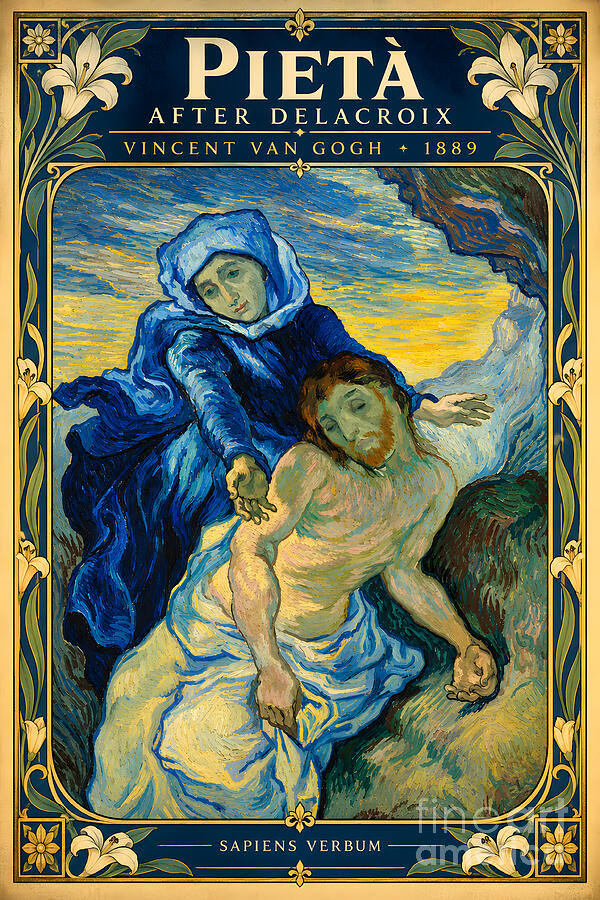
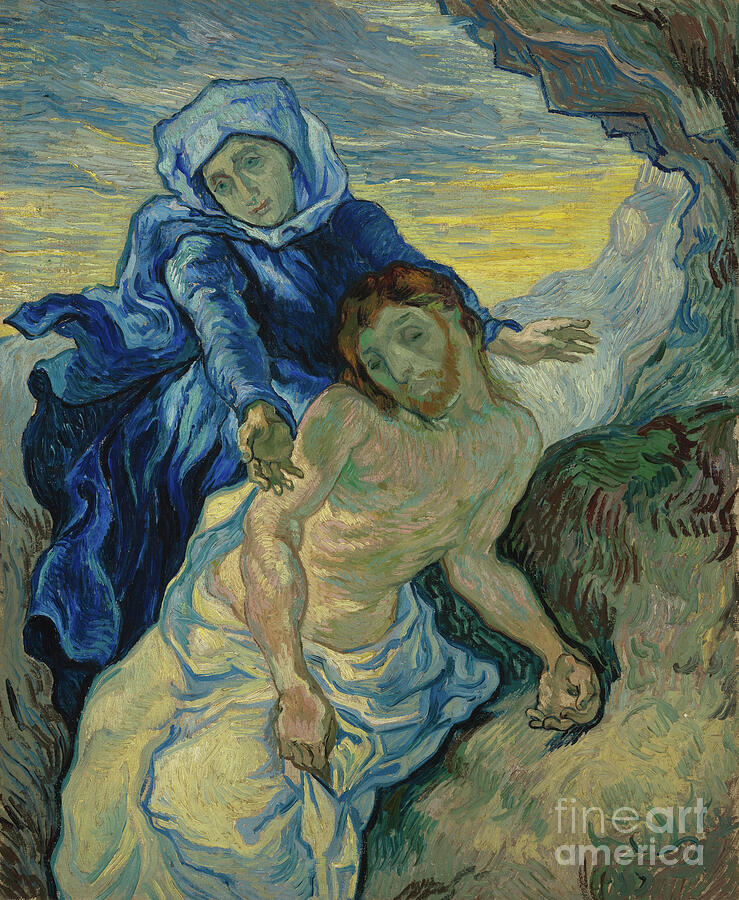
A woman in a blue cloak sits at the mouth of a cave with her arms flung open, one hand reaching towards us. Across her lap lies the body of her son, pale and heavy, his head fallen against her, his red hair and beard bright against the yellow light of a stormy evening. This is Vincent van Gogh’s Pietà, painted in September 1889 in the asylum at Saint-Rémy after a print of a painting by Eugène Delacroix. It began with an accident, and it became one of his rare religious subjects. Here we look at it through a new frame: a vintage Art Nouveau poster with a border of white lilies.
🖼️ Get the Art Nouveau poster →
Artist: Vincent van Gogh (1853–1890), after Eugène Delacroix (1798–1863)
Title: Pietà (after Delacroix)
Date: September 1889, Saint-Rémy-de-Provence
Medium: Oil on canvas, 73 × 60.5 cm
Collection: Van Gogh Museum, Amsterdam; a smaller version (42 × 34 cm) is in the Vatican Museums
Source: Delacroix’s Pietà of about 1850 (National Museum, Oslo), known to Van Gogh through a black-and-white lithograph
A print that fell into the paint
In May 1889 Van Gogh had voluntarily entered the asylum of Saint-Paul-de-Mausole at Saint-Rémy, a few months after the crisis in Arles in which he cut off part of his ear. In the summer he suffered a new attack that kept him from working for weeks. Theo had sent him a lithograph of Delacroix’s Pietà. In a letter to Theo in early September he explained what happened to it: the sheet, with some others, had fallen into oil and paint and was ruined. It made him sad, so he painted the picture himself. The Van Gogh Museum still has the lithograph, stain and all.
He was pleased with the result. He told Theo he had painted it without measuring anything, and that the four hands and arms in the foreground were gestures and poses that were far from easy. As the museum puts it, the painting is more a variation than a copy: Van Gogh took Delacroix’s subject, the Virgin mourning her dead son, and his composition, and added his own colour and his own handwriting.
Van Gogh’s colours
The lithograph was black and white, so the colours are entirely Van Gogh’s. He chose a pairing he used again and again: blue against yellow. The Virgin’s cloak is built from curving strokes of deep and pale blue, her head wrapped in a paler blue veil. Behind her, the sky glows yellow under bands of violet and blue cloud. Christ’s body is painted in pale greens and yellows, his shroud in white and blue, and the rock around them in the same restless, rhythmic strokes as the cypresses and olive trees he was painting outside the asylum walls that year. Writing to his sister Willemien, he described the picture himself: the dead Christ at the entrance to a cave, the Virgin in blue, and clouds of violet fringed with gold.
A face like his own?
Look at the dead Christ: red hair, a short red beard, a thin, worn face. Some art historians, among them Ingo F. Walther and Rainer Metzger, have read it as Van Gogh’s own face, a self-portrait hidden in a borrowed composition at a time when he himself had come through weeks of illness. Van Gogh never said so, and the reading remains an interpretation. But it is hard not to see a painter who had been broken and was now working again in this image of a body held, mourned and waiting.
Two versions
Van Gogh painted the subject twice that September. He kept the larger version, now in Amsterdam, with him, and later took it to Auvers-sur-Oise; the smaller one he sent to his sister Willemien, and it is now in the Vatican Museums. For the painting he made a few months earlier from his window at Saint-Rémy, read our essay on The Starry Night; for the same year’s blue self-portrait, see Van Gogh’s Self-Portrait of 1889; and for Delacroix himself, The Last Words of Marcus Aurelius.
Why it works as an Art Nouveau poster
Van Gogh’s curling, rhythmic brushstrokes are already close to the whiplash lines of Art Nouveau, the style that would sweep Europe within a decade of his death. The Sapiens Verbum version keeps the painting whole and sets it in an arched frame with a border of white lilies, a traditional symbol of the Virgin, beneath a deep blue title panel that echoes the colour of her cloak. For two more sacred images reimagined the same way, see Holman Hunt’s The Light of the World and Salvator Mundi as an Art Nouveau Icon.
Hang Van Gogh’s Pietà — the blue cloak, the open arms and the golden evening sky — as a vintage Art Nouveau poster from the Sapiens Verbum print shop.
 Choose your size and frame →
See the vintage poster collection →
Choose your size and frame →
See the vintage poster collection →Printed and shipped by Fine Art America · 30-day money-back guarantee
Hang Van Gogh’s Pietà as he painted it, as a print, canvas or framed print from the Sapiens Verbum print shop.
 Choose your size and frame →
Printed and shipped by Fine Art America · 30-day money-back guarantee
💬 Over to you: Do you see Van Gogh’s own face in the dead Christ? And which do you prefer: Delacroix’s composition or Van Gogh’s colours? Tell us in the comments.
Sources
Van Gogh Museum — Pietà (after Delacroix) (s0168V1962)
Vincent van Gogh, letter to Theo, Saint-Rémy, c. 7–8 September 1889 (WebExhibits)
Art & Theology — Van Gogh’s Pietà (after Delacroix), with the letters to Theo and Willemien
Comments
Post a Comment