Van Gogh's Self-Portrait (1889): Intense Gaze Amid Swirling Blues
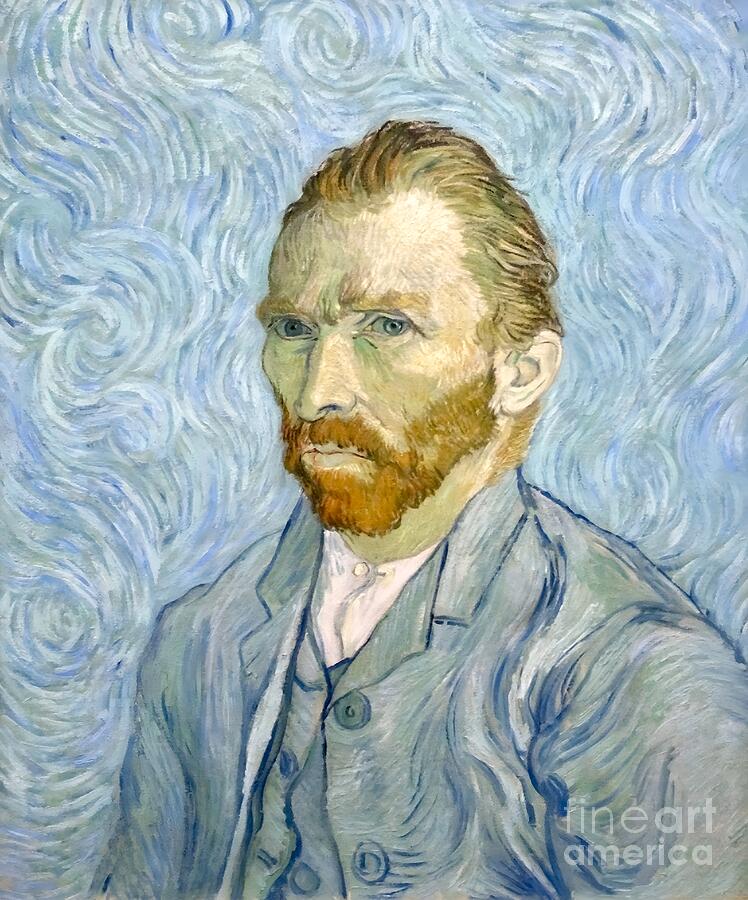
The face barely moves. Everything else does. In Vincent van Gogh's Self-Portrait of September 1889, orange hair and beard lock against a field of turquoise and blue that coils like weather. The eyes hold you with a hard, green-rimmed stare while the background refuses to sit still. Painted at the asylum of Saint-Paul-de-Mausole in Saint-Remy-de-Provence, this is the Van Gogh most visitors meet at the Musee d'Orsay: not the work jacket and palette of other self-portraits, but a man in a suit, framed by motion.
Artist: Vincent van Gogh (1853-1890)
Date: September 1889 (Saint-Remy-de-Provence)
Medium: Oil on canvas (65 x 54.2 cm)
Collection: Musee d'Orsay, Paris (RF 1949 17; F627)
Notable fact: Gift of Paul and Marguerite Gachet, 1949; painted months after The Starry Night, with a swirling ground that answers that sky
Saint-Remy, After the Storm
Van Gogh entered the asylum at Saint-Remy in May 1889. By September he was still working at speed: landscapes, cypresses, and this head-and-shoulders likeness he sent to his brother Theo with a careful hope - that Theo would see a calmer face than before, even if the look itself felt a little vaguer. The canvas is self-scrutiny under medical confinement, not a salon pose. The suit replaces the pea jacket; the mirror does the rest.
Orange Against Turquoise
Complementary colour does the emotional work. Fiery orange in the hair and beard answers the absinthe greens and pale turquoise that wrap the head. Skin looks drained beside that heat; the green rims around the eyes sharpen the stare. Immobility in the features, agitation in the paint: that contrast is the portrait's engine.
The Background That Will Not Rest
Behind him, brushstrokes curve into arabesques - the same late language of motion that fills The Starry Night, painted at the same asylum a few months earlier. Hair and beard undulate; the ground amplifies them until the figure seems held inside a private weather system. The gaze stays fixed. The world around it does not.
From Gachet to Orsay
The painting later belonged to the Gachet family and entered the French national collections in 1949. Today it hangs in the Musee d'Orsay in Paris - one of more than forty self-portraits Van Gogh made in a decade, and among the last. It is also one of the clearest: a face asking to be read slowly while the surface keeps moving.
Why the Gaze Still Holds
Look once for biography - the asylum, the letters, the myth. Look again for craft: complementary colour, swirling ground, and a stare that refuses to soften. Self-Portrait (1889) endures because it stages calm and turbulence in the same square of canvas - and makes you choose which one you believe.
Own This Painting
Hang Van Gogh's Orsay self-portrait - the orange beard, the turquoise swirls, and that unblinking gaze.
Related on @SapiensVerbum: a video essay on Van Gogh's Starry Night - the same Saint-Remy season and swirling language that answers this portrait's ground.


Comments
Post a Comment