
Allegory of Satan by Ludwik Stasiak: The Devil Who Smiles Instead of Snarls (c. 1900)
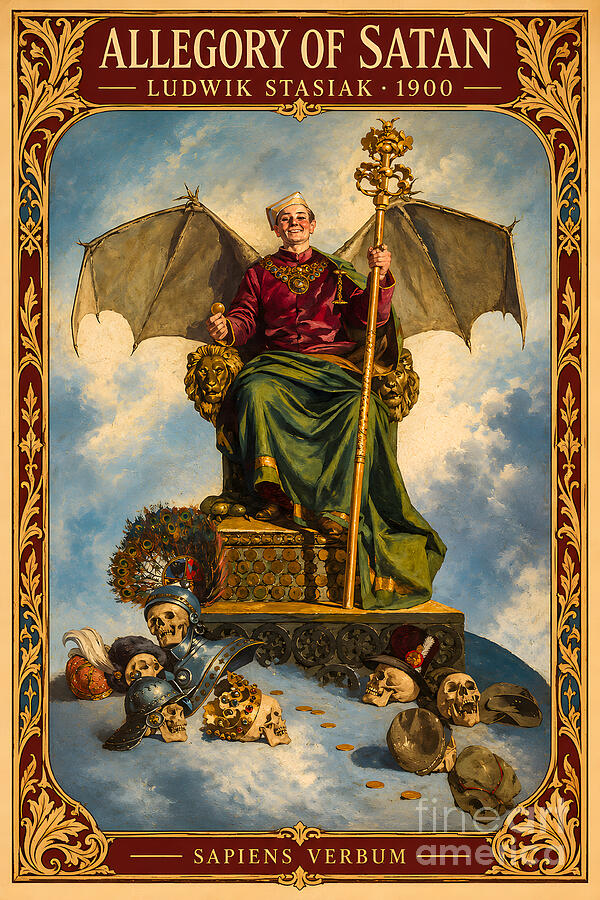
He has no horns, no tail, and no fire at his feet. Ludwik Stasiak's Satan wears a crown-like cap, drapes himself in a bishop's red and a monarch's green, and smiles the unbothered smile of someone who has never once been told no. Painted around 1900 in Austrian-ruled Kraków, Alegoria szatana (Allegory of Satan) has spent the last several years resurfacing again and again on social media, usually shared with some version of the same question: why does this look less like a monster, and more like somebody we'd recognize? The picture below is our vintage poster version of the painting; the original canvas is shown further down.
🖼️ Get the vintage poster →License this image →
Artist: Ludwik Stasiak (1858–1924)
Date: c. 1900
Medium: Oil on canvas, 200 × 145 cm
Collection: National Museum in Kraków (inv. MNK II-b-3252)
Notable fact: Held by the same museum as Leonardo's Lady with an Ermine
Who Was Ludwik Stasiak?
Stasiak was never just a painter. Born in 1858 near the Bochnia salt mine where his father worked, he studied philosophy at the Jagiellonian University in Kraków while training as a painter under Jan Matejko, then continued abroad in Vienna and Munich. Back home, he became a prolific exhibitor, a cartoonist, a journalist, and an art historian who spent years arguing, controversially, that the sculptor Veit Stoss was Polish rather than German. In 1898 he founded a publishing house, later known as Stella, for a pointedly nationalist reason: to stop German and Austrian printers from dominating the reproduction of Polish art. After 1901 he mostly abandoned the brush for the pen, writing historical novels and satirical sketches until his death in 1924. Allegory of Satan belongs to the brief window when painting was still his main trade.
A Devil Dressed for a Coronation, Not a Fire
Strip away the bat wings and almost nothing here reads as hellish. Stasiak's Satan is plump, pink-cheeked, and cheerful, dressed in vestments that borrow from both a bishop's mozzetta and a king's robes, and he grips a tall gold staff that could just as easily be a crosier or a scepter — the ambiguity looks deliberate. Instead of a pitchfork he raises a small object between two fingers, more a gesture of grace than of threat. It is a portrait of authority in general, sacred and secular fused into one smiling figure, which is precisely what makes it more disquieting than any snarling demon: this is a devil built to be trusted.
The Throne Built on the Dead
Look down and the painting turns into an inventory of everything that has already died for this throne to exist. Skulls litter the base, still wearing the props of the offices they once held: a knight's helmet, a jeweled bishop's mitre, a soldier's cap, a broken crown. Loose gold coins are scattered among them, and the throne itself is built from stacked coins, its armrests carved into lion heads. The message is blunt once it's spotted — the Church, the nobility, the army, and the monarchy all end the same way, as bone, while the wealth and power they competed for simply passes to whoever sits down next. Satan doesn't have to conquer these institutions. He just has to wait.
Painted in a Country That Didn't Exist
In 1900 there was no Poland on the map — the country had been partitioned among Russia, Prussia, and Austria-Hungary for over a century. Kraków, under the comparatively relaxed rule of Austrian Galicia, became the refuge where Polish culture could still be made in Polish, and it was there that the Young Poland movement (Młoda Polska) took shape: a generation of Symbolist and Decadent artists who traded the confident realism of their parents for spiritual doubt, folklore, and unease. Stasiak's painting fits that mood exactly, and so did the rest of his career — the same instinct that made him found a Polish-run publishing house to fight German print dominance is the instinct behind a devil who wins not with armies, but with the trappings of respectability.
Why the Painting Keeps Coming Back
Alegoria szatana has no shortage of company among fin-de-siècle Symbolist paintings that keep resurfacing online decades after the artists who made them were forgotten — it has circulated on social media in waves for years, usually stripped of the museum label and captioned instead as a comment on power that needs no supernatural excuse. Stasiak, who spent much of his career fighting to get Polish art seen at all, would likely find it fitting that this one canvas outlasted the rest of his catalogue in the public imagination — even if it took the internet, not a gallery, to do it.
Hang Stasiak’s Allegory of Satan as a vintage art poster by Sapiens Verbum.
 Choose your size and frame →
See the vintage poster collection →License this image →
Choose your size and frame →
See the vintage poster collection →License this image →Printed and shipped by Fine Art America · 30-day money-back guarantee
_-_Alegory_of_Satan_(Lord_of_the_World)_-_MNK_II-b-3252_-_National_Museum_Kraków.jpg/1280px-Stasiak,_Ludwik_(1858-1924)_-_Alegory_of_Satan_(Lord_of_the_World)_-_MNK_II-b-3252_-_National_Museum_Kraków.jpg)
See Ludwik Stasiak’s Allegory of Satan as he painted it, framed on your wall: a museum-quality print or canvas from the Sapiens Verbum print shop.
 Choose your size and frame →
Printed and shipped by Fine Art America · 30-day money-back guarantee
Watch the full video essay on @SapiensVerbum on YouTube.
Comments
Post a Comment