
Isle of the Dead by Böcklin (1883): The Painting Hitler Bought and Dalí Reimagined
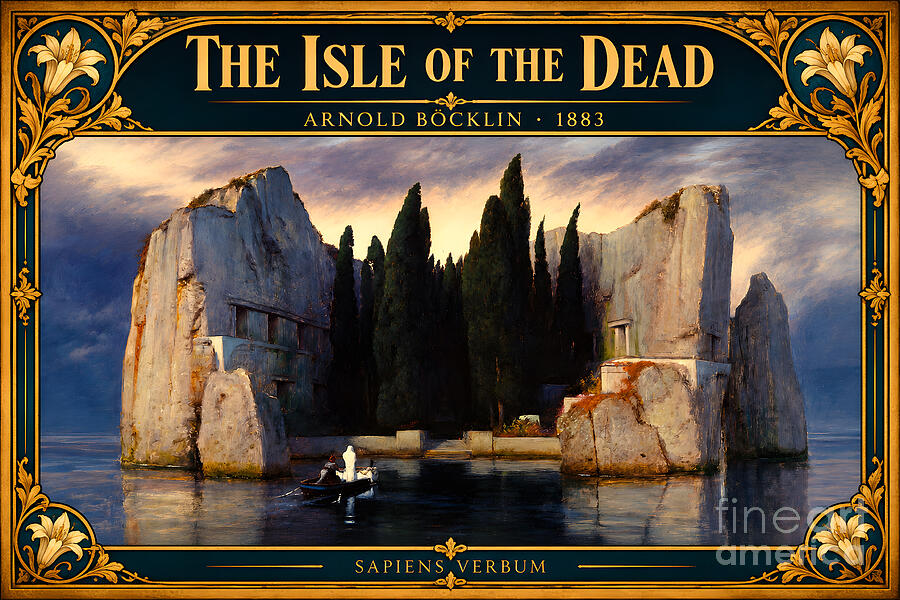
In 1880, a grieving widow asked Arnold Böcklin for "a picture to dream by." What she got back was so quietly unsettling that it went on to haunt the next century: hung in cheap reproduction over the desks of Vladimir Lenin and Sigmund Freud, bought for a private collection by Adolf Hitler, reworked by Salvador Dalí, and set to music by Sergei Rachmaninoff — who later admitted he might never have composed a note of it had he seen the original in color. Böcklin painted the same silent island six times. Only five of those paintings still exist. The picture below is our vintage poster version of the painting; the original is shown further down.
🖼️ Get the vintage poster →License this image →
Artist: Arnold Böcklin (1827–1901)
Date: 1883 (third of six painted versions, 1880–1901)
Medium: Oil on panel, 80 × 150 cm (31.5 × 59 in)
Collection: Alte Nationalgalerie, Berlin
Notable owner: Adolf Hitler, who bought this version in 1933
A Picture to Dream By
In Florence in 1880, Böcklin painted a small, motionless canvas: a rock island crowded with cypress trees, its cliff walls cut with dark, tomb-like openings, approached across glassy water by a boat carrying a standing white-shrouded figure and a coffin. He called his paintings of the subject Die Gräberinsel — the island of tombs. What real place, if any, inspired it is still debated: candidates proposed over the decades include the English Cemetery in Florence near Böcklin's own studio, where he had buried an infant daughter (one of eight of his fourteen children who did not survive childhood), the cemetery island of San Michele in Venice, and the islet of Pontikonisi off Corfu. Böcklin himself never named a source.
That same year, the widow Marie Berna commissioned a second, smaller version of the scene and asked for two additions: the coffin and the upright white figure were painted in at her request, for the piece she described wanting as, simply, a picture to dream by.
Six Islands, Not Five
Most retellings of the story — including a good number of video essays — describe five versions of the painting. Böcklin actually painted six. Between 1880 and 1901 he returned to the composition five more times after the original, tightening the cypresses, shifting the light, and, in the final attempt, working alongside his son Carlo. The fourth painting, done in 1884 on copper for the collector Baron Heinrich Thyssen, is the one that keeps getting left out: it was destroyed by Allied bombing during the Second World War and survives today only as a black-and-white photograph. Of the five that remain, one hangs in Basel, one in New York's Metropolitan Museum, one in Leipzig, one in the Hermitage in St. Petersburg — and the third, reproduced above, ended up with a very particular owner.
The Version Hitler Chose
The third version, finished in 1883, is generally considered the darkest and most severe of the five surviving paintings: the sky lower, the water flatter, the rock face more oppressive. In 1933, the year he took power, Adolf Hitler bought it for his private collection. He hung it first at the Berghof, his residence in the Bavarian Alps, then moved it to the Reich Chancellery in Berlin after 1940. Soviet troops seized it when Berlin fell in 1945, and it eventually entered the collection of what is now the Alte Nationalgalerie, where it hangs today, on public view — a dictator's private fixation turned back into a museum piece.
The Painting That Wouldn't Let Go
Hitler was far from the only person the island unsettled into fascination. Salvador Dalí painted his own answer to it in 1932, The True Painting of "The Isle of the Dead" by Arnold Böcklin at the Hour of the Angelus, folding Böcklin's composition into his own private mythology. The composer Sergei Rachmaninoff first came across the image as a black-and-white print and was struck enough to write an entire symphonic poem, Isle of the Dead, Op. 29 — only to admit afterward that he probably would never have written it had he seen the original in color, which affected him less than the monochrome reproduction had. Cheap prints of the painting circulated widely enough in early twentieth-century Europe that Vladimir Lenin reportedly kept one, and Sigmund Freud kept another in his consulting room in Vienna.
Why the Island Still Holds
Part of what makes the painting so easy to project onto is how little it actually tells you. Böcklin gives no story, no explanation of who is arriving or why — only silence, stone, cypress, and water so still it looks solid. It works less like a landscape than a threshold: not a place, but the last moment before one. Böcklin painted it out of his own repeated grief and called it, at first, an island of tombs; everyone who has been unable to look away from it since, from a widow in Florence to a dictator in Berlin, seems to have recognized something of themselves in that boat, still short of the shore.
Hang Böcklin’s Isle of the Dead — the silent boat, the white figure and the dark cypresses — as a vintage art poster from the Sapiens Verbum print shop.
 Choose your size and frame →See the vintage poster collection →License this image →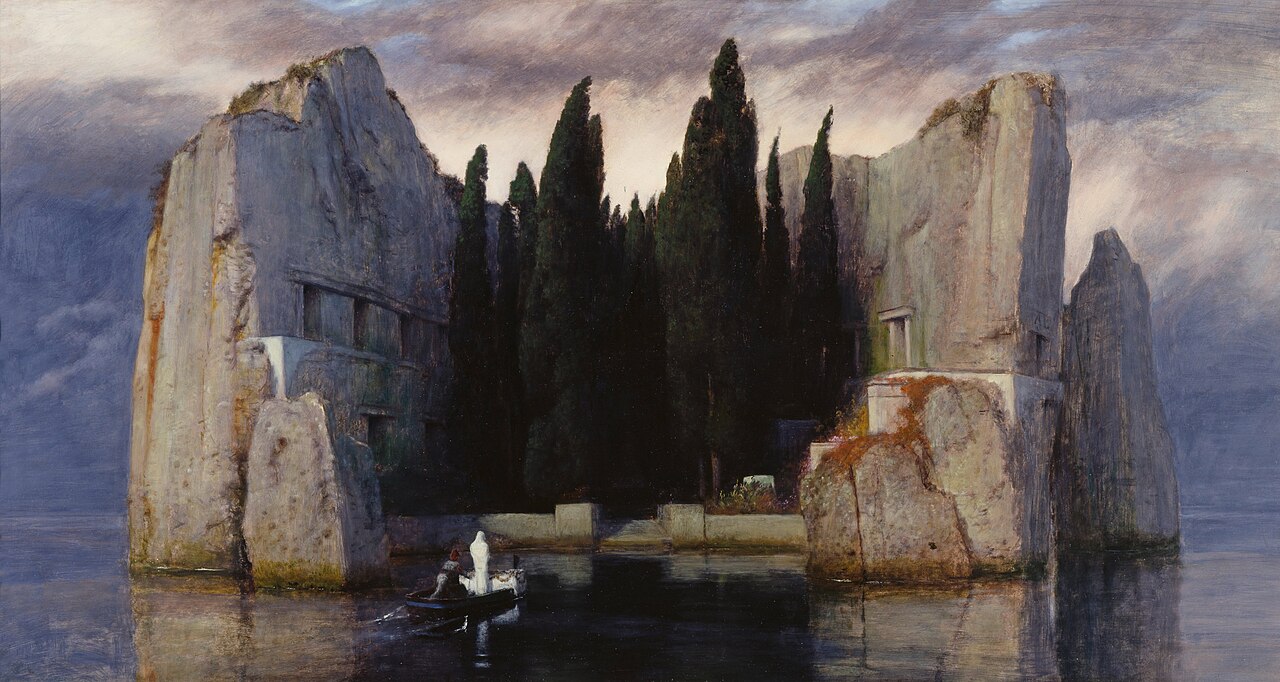
See Arnold Böcklin’s Isle of the Dead framed on your wall: a museum-quality print, canvas or poster from the Sapiens Verbum print shop.
 Choose your size and frame →
Printed and shipped by Fine Art America · 30-day money-back guarantee
Watch the full video essay on @SapiensVerbum on YouTube.
Comments
Post a Comment