The Starry Night by Van Gogh: Swirls, Asylum Windows, and a Quiet Village (1889)
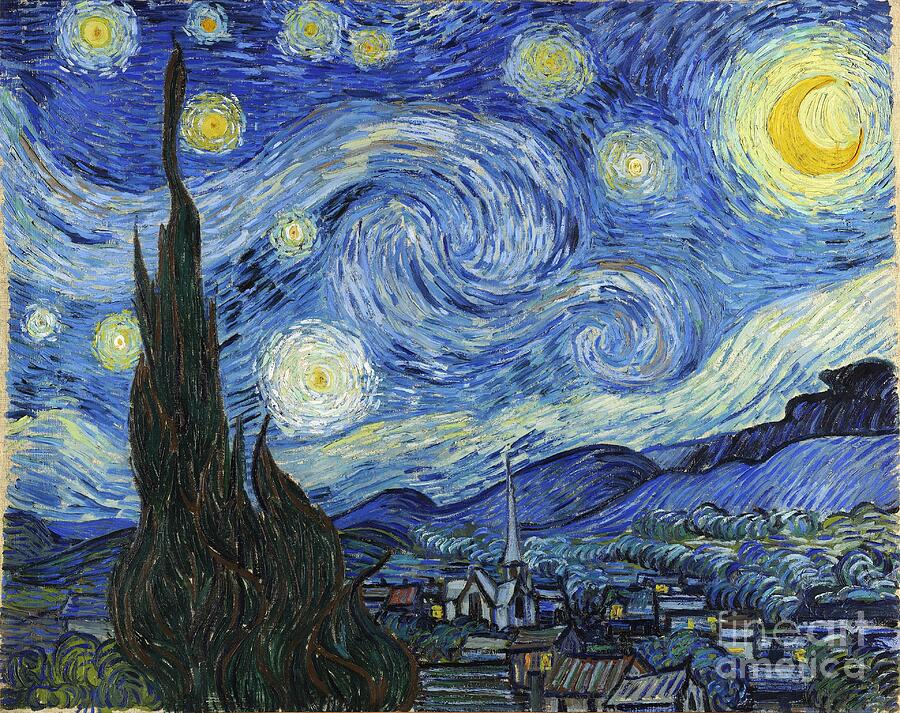
Eleven stars wheel over a quiet village, and none of them behave like stars in a textbook. They pulse, spiral, and drag the night around them in thick blue and yellow paint. Vincent van Gogh painted The Starry Night in June 1889 from the east-facing window of his room at the Saint-Paul-de-Mausole asylum in Saint-Remy-de-Provence. The cypress rises like a dark flame. The village sleeps. The sky does not.
Artist: Vincent van Gogh (1853-1890)
Date: 1889
Medium: Oil on canvas
Collection: Museum of Modern Art (MoMA), New York
Notable fact: Painted during van Gogh's stay at the Saint-Remy asylum; the view combines the real window vista with an imagined village and exaggerated sky
A Window, Not a Postcard
Van Gogh could see the hills and the night sky from his room, but he could not see this exact village laid out so neatly below. He rebuilt the world for feeling. The church steeple hints at Dutch memory more than Provencal fact. The cypress - common in the south of France - becomes a vertical bridge between earth and the churning heavens. What looks like a landscape is also a mood report: restless above, grounded below.
Paint That Moves
The famous swirls are not decoration. Thick impasto catches light; short strokes lock into currents. Blues and yellows fight for dominance until the night itself seems alive. Against that turbulence, the village is quieter and darker - roofs, windows, and a few warm points of light that refuse to compete with the stars. Emotion sits in the contrast: chaos overhead, human scale underneath.
What the Sky Is Asking
Van Gogh wrote of wanting something of the infinite in paint - trees as rockets, stars as living fire. Viewers have read religion, illness, hope, and cosmic loneliness into the canvas. The painting does not pick one answer. It holds the tension: a mind that sees too much motion in the dark, and still plants a village that can be lived in.
Why It Still Feels Current
The Starry Night endures because it refuses a calm night. It shows looking itself as an act of intensity - how a window can become a storm when the person at the window will not look away.
Own This Painting
Hang van Gogh's night sky - the swirls, the cypress, and the village that sleeps under a restless heaven.
Watch the video essay on @SapiensVerbum on YouTube.


Comments
Post a Comment