Last Words of Marcus Aurelius by Delacroix: A Stoic Deathbed (1844)
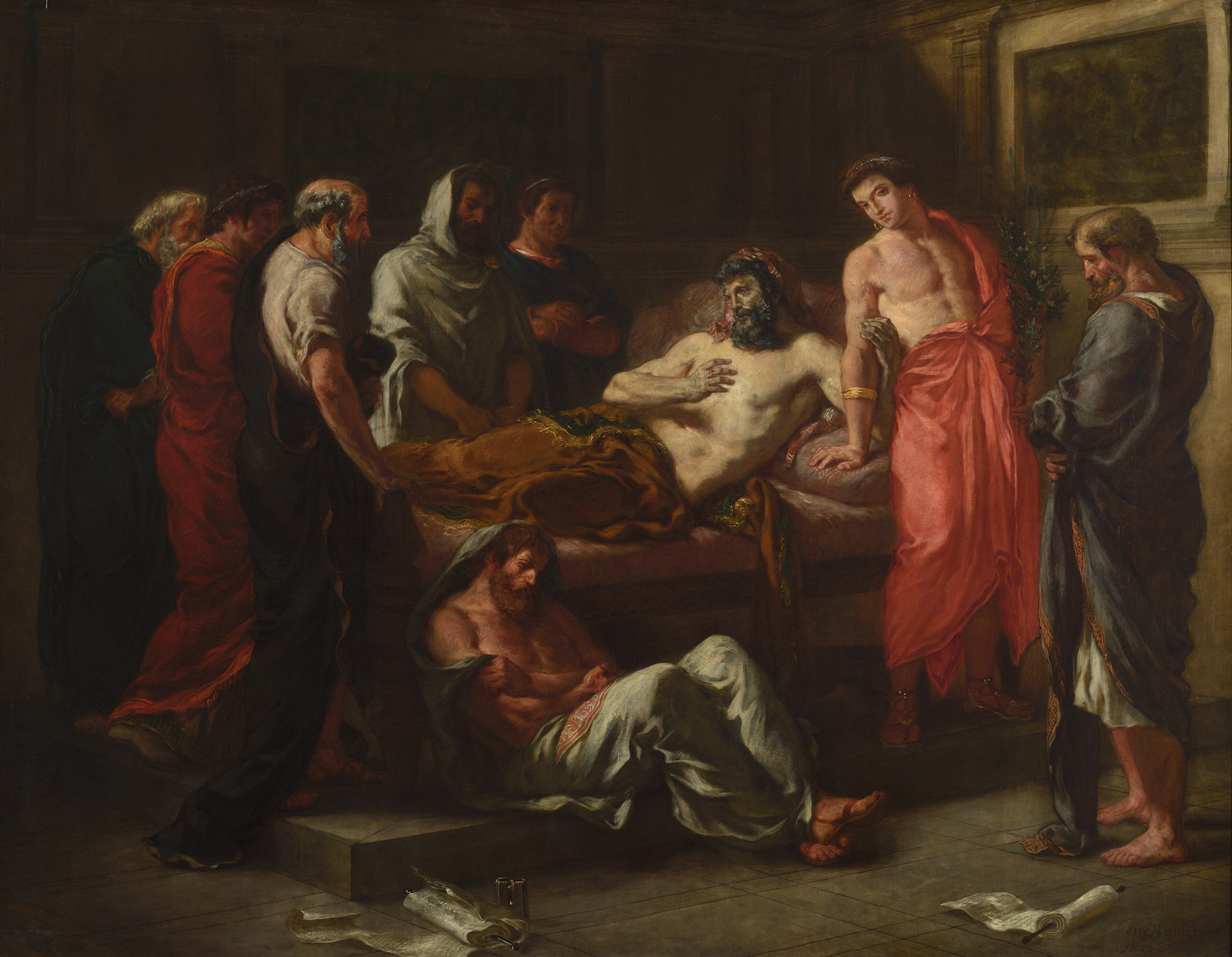
The emperor is dying in brown shadow. His son stands in a blaze of red. Around the bed, Stoic friends in black look like a funeral already underway. In Eugene Delacroix's Last Words of the Emperor Marcus Aurelius (1844), philosophy meets succession - and the colour tells you who will inherit the room.
Artist: Eugene Delacroix (1798-1863)
Date: 1844
Medium: Oil on canvas
Collection: Musee des Beaux-Arts, Lyon
Notable fact: Shown in 1845 to harsh reviews; Baudelaire later called it "beautiful, huge, sublime, misunderstood"
Red Against Black
Delacroix had returned from North Africa obsessed with saturated colour. Here that lesson becomes politics. Commodus, haughty in crimson, draws the eye away from the failing emperor who grips his arm. The philosophers in dark cloth register grief; the heir registers appetite. Stoicism is present as atmosphere - and already losing the argument of the paint.
A Stoic Without a Sermon
Delacroix admired Marcus Aurelius and the Stoics, yet the canvas refuses a neat moral caption. Cassius Dio records last words about the rising sun; the Meditations leave quieter exits. The painting stages the gap between wise writing and a messy deathbed where the next emperor is already costumed for power.
Misunderstood in 1845
Critics mocked the "decomposing" body and missing nobility. Baudelaire heard the opposite: colour as blood and weather, history as crisis rather than marble lesson. Romantic history painting often wants heroes. Delacroix gives you a sick man, a flashy son, and a room that knows the empire's tone is changing.
Why the Deathbed Still Holds
The drama is not only ancient Rome. It is any transfer of power where virtue wrote the book and vanity wears the cloak. Look first at the red. Then ask whether the last words - spoken or written - can compete with what the heir already wants.
Watch the video essay on @SapiensVerbum on YouTube.


Comments
Post a Comment