

Girl with a Pearl Earring by Vermeer: The Gaze That Never Explains Itself (c. 1665)
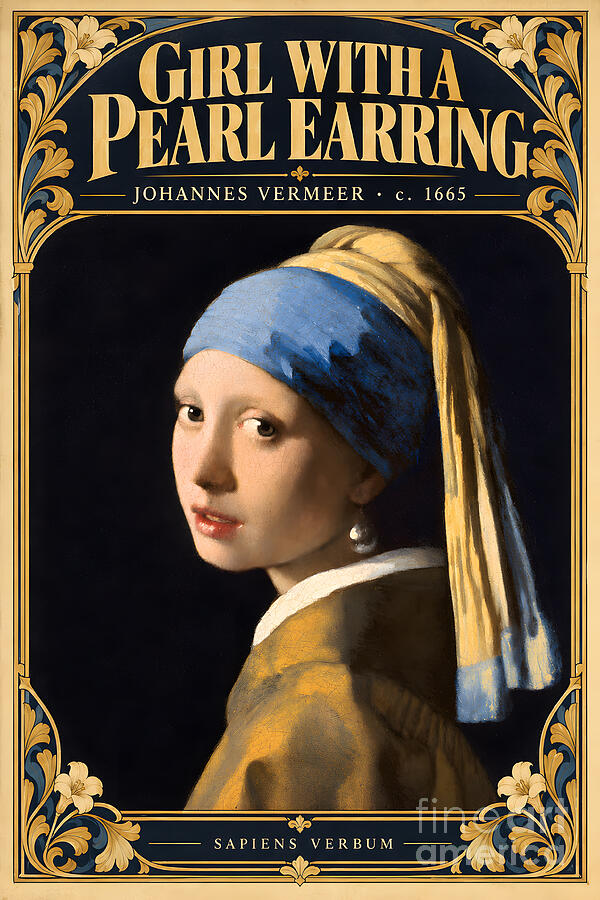
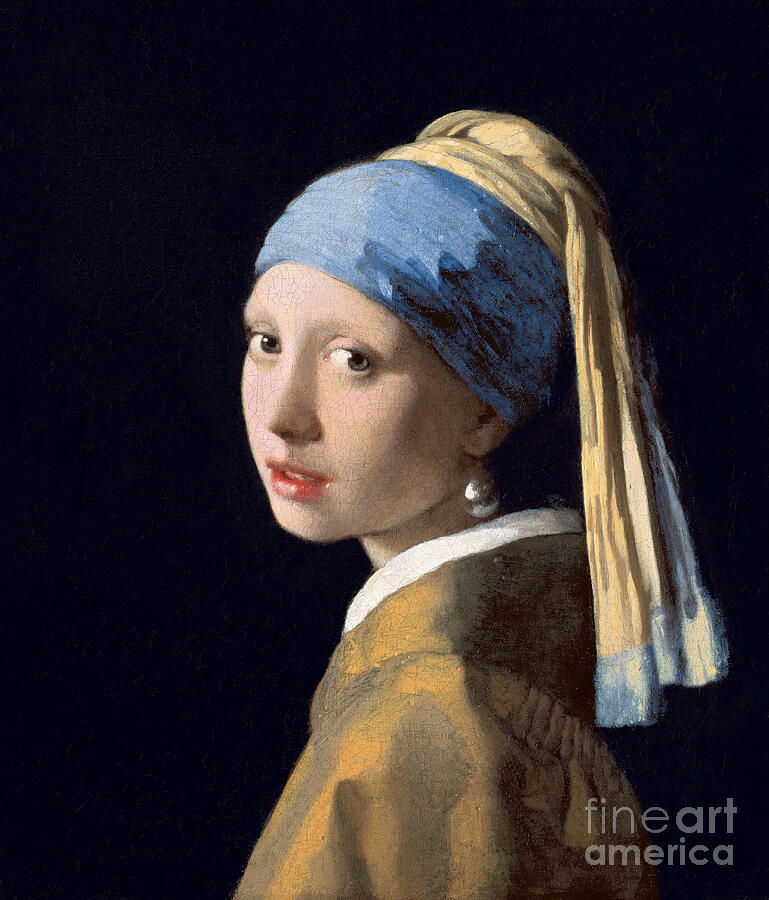
A girl turns her head over her shoulder and looks straight at us. Her lips are slightly parted, as if she were about to speak. She wears a blue and yellow turban and a large pearl hangs from her ear, catching the light. The background is almost black, and there is nothing else: no room, no story, no name. Johannes Vermeer's Girl with a Pearl Earring, painted around 1665 and kept in the Mauritshuis in The Hague, is one of the most famous faces in the history of art, and one of the most mysterious. The picture below is our vintage poster version of the painting; the original is shown further down.
🖼️ Get the vintage poster →License this image →
Artist: Johannes Vermeer (1632–1675)
Date: c. 1665
Medium: Oil on canvas, 44.5 × 39 cm
Collection: Mauritshuis, The Hague (inv. 670)
Signed: upper left, "IVMeer"
Who was the girl?
Nobody knows, and in a sense the question has no answer. As the Mauritshuis explains, the painting is not a portrait but a tronie, a Dutch term for a study of a face representing a type or character rather than a specific person. Here the type is a girl in exotic dress, with an Oriental turban and an improbably large pearl. A real model surely sat for Vermeer, and many names have been suggested, including his eldest daughter Maria, but there is no evidence for any of them. The novel by Tracy Chevalier and the 2003 film that made the painting a global icon imagined a maid in Vermeer's house; that story is fiction.
What makes it so special?
Vermeer was a master of light, and here he uses it with extraordinary economy. The light falls from the left onto the girl's face, modelling her cheek, her nose and her chin with soft transitions and almost no lines. A tiny white highlight in each eye and on her moist lower lip makes her look alive. The pearl itself is little more than two strokes: a bright highlight at the top and a soft reflection of her white collar at the bottom. Between them, there is no outline at all; our eye completes the shape.
The colours are few and precious: the yellow of her jacket, the white of her collar, and the intense blue of the turban, painted with natural ultramarine, a pigment made from lapis lazuli that was more expensive than gold. Against the dark background, the girl seems to emerge from nowhere and to exist only in the instant of her turning glance.
What did scientists discover?
In 2018 the Mauritshuis led an international research project, Girl in the Spotlight, to study the painting with modern imaging techniques. The researchers found that the background, now almost black, was originally a dark green curtain, whose folds have faded as the paint changed over time. They also found tiny eyelashes around the eyes, invisible to the naked eye, and confirmed that the pearl has no hook to attach it to the ear: it is an illusion of light floating on the canvas.
From two guilders to world fame
The painting's early history is uncertain. It may have belonged to Vermeer's patron Pieter van Ruijven in Delft, and it was probably one of the "tronies" sold at the Dissius auction in Amsterdam in 1696. Then it disappeared from view. In 1881 it turned up at a sale in The Hague, in poor condition, and was bought by the collector Arnoldus Andries des Tombe for just 2.30 guilders. He lent it to the Mauritshuis the same year and left it to the museum in his will; it entered the collection in 1903.
Vermeer painted only about 36 known pictures, most of them quiet interiors such as The Milkmaid. For another famous face that keeps its secret, compare Leonardo's Mona Lisa, and for Vermeer's great contemporary in Amsterdam, Rembrandt's The Night Watch.
Where can you see it?
The painting belongs to the Mauritshuis, a small, beautiful museum in a seventeenth-century palace beside the Hofvijver lake in The Hague. It is the highlight of the collection and is normally on permanent display, though it is occasionally taken off view for maintenance or research, so it is worth checking the museum's website before you travel.
Vermeer’s Girl with a Pearl Earring reimagined as an Art Nouveau vintage art poster by Sapiens Verbum.
 Choose your size and frame →
See the vintage poster collection →License this image →
See Vermeer’s Girl with a Pearl Earring framed on your wall: a museum-quality print, canvas or poster from the Sapiens Verbum print shop.
 Choose your size and frame →
Printed and shipped by Fine Art America · 30-day money-back guarantee
Girl with a Pearl Earring is one of the thirty pictures in our book The 30 Most Famous Paintings in the History of Art: The Myths They Hide, the History They Reveal. Each chapter takes one painting, the myth around it and the history behind it. On Kindle, in paperback, in hardcover and as an audiobook.
Get the book →See all 30 paintings →
Watch the video essay (in Spanish) on @SapiensVerbum on YouTube.
Sources
Mauritshuis, The Hague, collection record, Girl with a Pearl Earring (inv. 670); Wikipedia, “Girl with a Pearl Earring”.
Comments
Post a Comment