
Mona Lisa by Leonardo: The Smile That Never Settles (c. 1503)
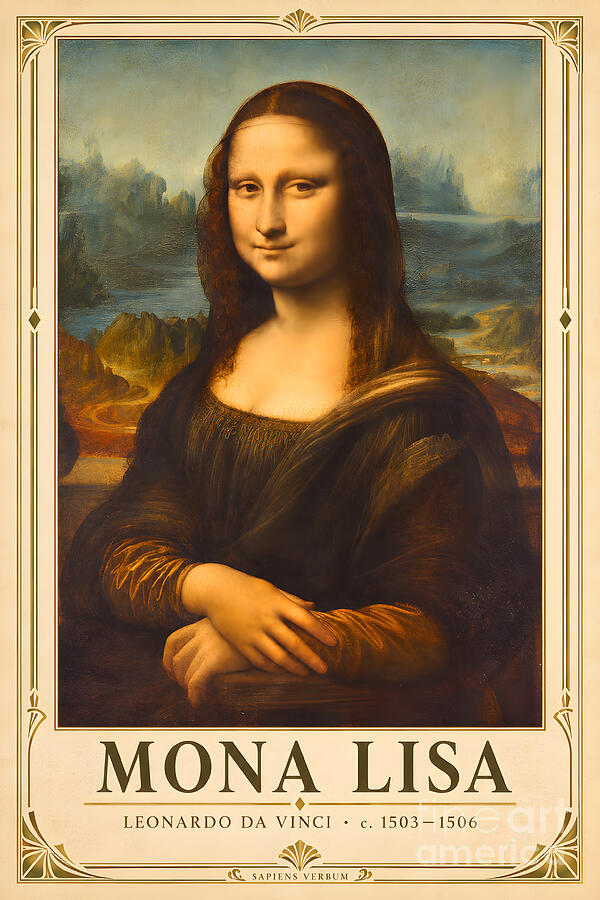
A woman sits in a loggia, turned three-quarters towards us, her hands resting quietly one on top of the other. Her smile almost arrives, then stops. Behind her, a strange landscape of winding roads, a bridge, rivers and blue mountains dissolves into haze. Leonardo da Vinci's Mona Lisa, begun in Florence around 1503 and now in the Musée du Louvre in Paris, is probably the most famous painting in the world. It is also one of the most carefully made: Leonardo kept working on it for years, and never handed it over to the man who had ordered it. The picture below is our vintage poster version of the painting; the original is shown further down.
🖼️ Get the vintage poster →License this image →
Artist: Leonardo da Vinci (1452–1519)
Date: begun c. 1503, worked on until c. 1517–1519
Medium: Oil on poplar panel, 77 × 53 cm
Collection: Musée du Louvre, Paris (inv. 779)
Also known as: La Gioconda (Italian) or La Joconde (French)
Who was Mona Lisa?
The sitter is Lisa Gherardini, born in Florence in 1479, the wife of the silk merchant Francesco del Giocondo. "Mona" is a contraction of madonna, "my lady", and her married name gives the painting its Italian title, La Gioconda, which also means "the cheerful one". The identification goes back to Giorgio Vasari's Lives of the Artists (1550), and it was confirmed in 2005, when a note written in the margin of a book in 1503 by the Florentine official Agostino Vespucci was found in the University Library of Heidelberg. Vespucci compared Leonardo to the ancient painter Apelles and mentioned that he was then working on a portrait of Lisa del Giocondo.
Why does the smile seem to change?
The secret is sfumato, from the Italian for "smoke": Leonardo blends light into shadow in extremely thin, transparent layers of oil glaze, so gradually that there are no visible lines or edges. The corners of the mouth and eyes, which give a face its expression, are left in soft shadow. One explanation, proposed by the neuroscientist Margaret Livingstone, is that when we look straight at the mouth, the smile seems to fade; when we look at the eyes, our peripheral vision picks up the shadows at the corners of the lips, and the smile seems to appear. The expression is never fixed, and that is what keeps us looking.
The landscape does the same work on a larger scale. The horizon on the left is lower than the one on the right, so that the figure seems to shift slightly depending on which side we look at. The colours fade into blue with distance, an effect Leonardo called aerial perspective and studied in his notebooks. The woman, the rocks and the rivers all seem to belong to the same living, changing world.
How did it reach Paris?
Leonardo never delivered the portrait. He took it with him to Milan and Rome, and finally to France in 1516, when he entered the service of King Francis I. After his death in 1519 the painting entered the French royal collection, and it has been in the Louvre since the French Revolution, apart from a few years in Napoleon's bedroom in the Tuileries and wartime evacuations.
For most of its history it was admired by connoisseurs but not especially famous. Its global celebrity began on 21 August 1911, when it was stolen from the Louvre by Vincenzo Peruggia, an Italian handyman who had worked in the museum and simply walked out with it under his smock. For two years the empty space on the wall drew crowds. The painting was recovered in Florence in December 1913, when Peruggia tried to sell it to a dealer, and its return to Paris made headlines around the world.
Leonardo's other portraits and masterpieces
Leonardo painted very few portraits. Compare the young Florentine woman of Ginevra de' Benci, painted thirty years earlier, and the Milanese court beauty of Lady with an Ermine. In the Louvre, the Mona Lisa shares the museum with his Virgin and Child with Saint Anne, where the same sfumato and the same blue mountains appear. For a face that rivals hers in fame and mystery, see Vermeer's Girl with a Pearl Earring.
Where can you see it?
The painting hangs behind protective glass in the Salle des États of the Louvre, the largest room in the museum, opposite Veronese's huge Wedding at Cana. It is the most visited work in the Louvre, so expect crowds; arriving at opening time and booking a timed ticket in advance help.
🎁 Looking for a gift? The Mona Lisa poster opens our art gift guide, with twenty-seven famous paintings as vintage posters, our best-selling prints and our book.
Leonardo’s Mona Lisa reimagined as an Art Deco vintage art poster by Sapiens Verbum.
 Choose your size and frame →
See the vintage poster collection →License this image →
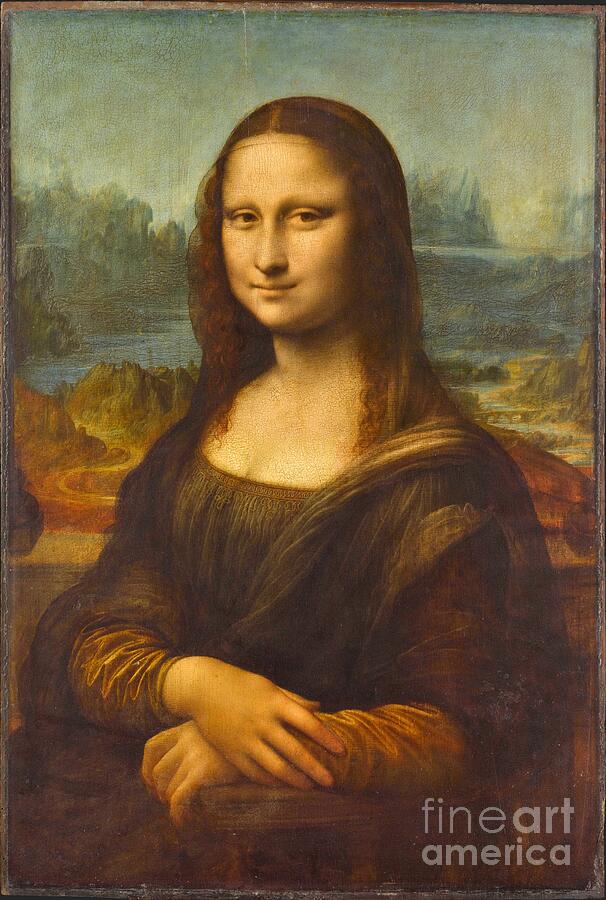
See Leonardo’s Mona Lisa framed on your wall, without the crowds: a museum-quality print, canvas or poster from the Sapiens Verbum print shop.
 Choose your size and frame →
Printed and shipped by Fine Art America · 30-day money-back guarantee
Mona Lisa is one of the thirty pictures in our book The 30 Most Famous Paintings in the History of Art: The Myths They Hide, the History They Reveal. Each chapter takes one painting, the myth around it and the history behind it. On Kindle, in paperback, in hardcover and as an audiobook.
Get the book →See all 30 paintings →
Watch the video essay on @SapiensVerbum on YouTube.
Sources
Musée du Louvre, collection record, Portrait of Lisa Gherardini (inv. 779); Heidelberg University Library, Agostino Vespucci’s 1503 marginal note; Wikipedia, “Mona Lisa”.
Comments
Post a Comment