
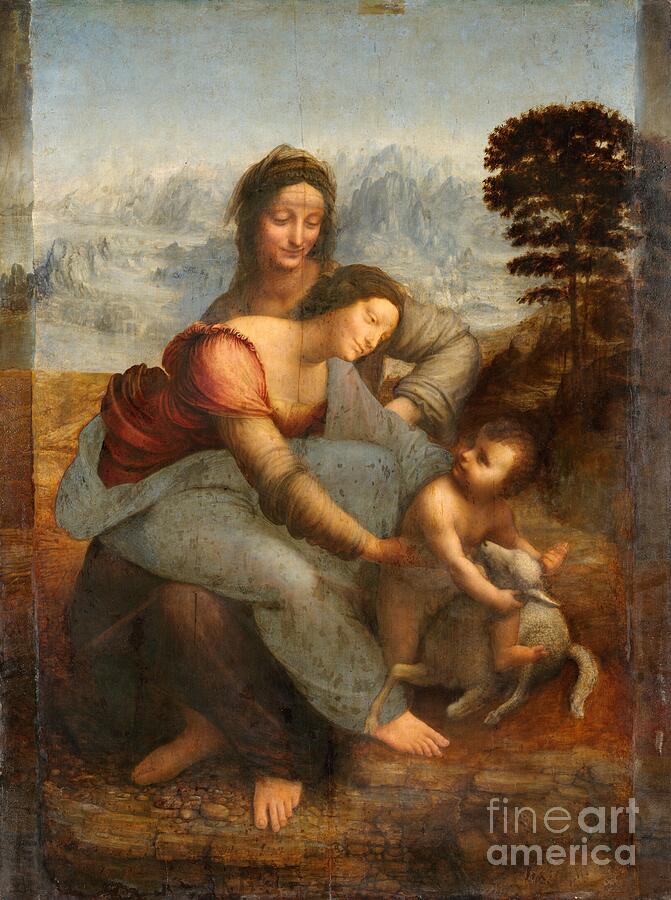
The Virgin and Child with Saint Anne by Leonardo: Three Generations and a Lamb (c. 1501-1519)
An older woman sits on a rock with a younger woman on her lap. The younger one leans forward, reaching down to hold back a naked little boy who has grabbed a lamb by the ears and is trying to climb onto it. The boy looks back at his mother over his shoulder; the older woman watches them both with a quiet smile. Behind them, blue mountains rise like a dream. This is Leonardo da Vinci's The Virgin and Child with Saint Anne, in the Louvre: Jesus, his mother Mary, and her mother Anne, folded into one of the most daring compositions of the Renaissance.
🖼️ Get this painting as a print →
Artist: Leonardo da Vinci (1452–1519)
Date: c. 1501–1519, never fully finished
Medium: Oil on poplar panel, 168.4 × 130 cm
Collection: Musée du Louvre, Paris (INV 776)
Notable fact: Leonardo kept working on it until his death and took it with him to France
What does the painting show?
Saint Anne was the mother of the Virgin Mary. Pictures of the three generations together, Anne, Mary and the Christ Child, were popular in Leonardo's time, but they were usually stiff and stacked, with Mary sitting on Anne's knee like a statue. Leonardo turns the group into a single flowing movement. The bodies overlap and lean into one another, forming a pyramid that seems to tip forward and down the slope, from Anne's calm face at the top to the boy and the lamb at the bottom right.
Every figure is caught in a gesture that leads to the next. Mary's arms stretch out to pull her son back. The child holds the lamb tightly, one leg already over its back, and turns to look up at her. Anne, above and behind, watches with a faint smile, her hand resting on her hip. The lamb is the key: it is the traditional symbol of Christ's sacrifice. Mary seems to want to keep her child from his fate, while Anne, perhaps, accepts that it cannot be avoided.
Behind the group the ground falls away to a vast landscape of jagged blue peaks, mist and water, painted with Leonardo's famous sfumato, the soft, smoky transitions that blur outlines into air. On the right stands a single tree. In the foreground, at the women's feet, the stony ground is painted with the eye of a geologist, reminding us that Leonardo studied rocks and rivers as closely as faces.
Twenty years in the making
Leonardo worked on this subject for almost two decades. In 1501, back in Florence, he made a full-size drawing of Anne, Mary, Jesus and a lamb, and a letter written that year describes it in detail. Another great drawing of a related group, with the young John the Baptist instead of the lamb, survives as the Burlington House Cartoon in the National Gallery in London. The painting itself may have been intended for King Louis XII of France, who had a daughter named Claude in 1499 and whose queen was Anne of Brittany, but it was never delivered.
Instead Leonardo kept it with him, retouching it for years, and took it to France when he moved there at the invitation of Francis I in 1516. Parts of it remain unfinished: Mary's drapery and the lower part of the panel are less resolved than the faces. The picture later entered the French royal collection and has been in the Louvre since the Revolution.
Secrets and controversies
Few paintings have attracted so many theories. In 1910 Sigmund Freud claimed to see the outline of a vulture hidden in Mary's blue drapery and built a whole psychological interpretation of Leonardo on it, based on a mistranslation. We tell that story in The Vulture That Wasn't There. In 2008, infrared examination revealed faint drawings on the back of the panel, including a horse's head and a skull, very probably by Leonardo himself. And the cleaning carried out between 2010 and 2012 caused a scandal when two members of the advisory committee resigned, arguing that the painting had been made brighter than Leonardo ever intended.
Where can you see it?
The painting hangs in the Louvre, in the Grande Galerie of Italian painting, close to the room of the Mona Lisa, which shares its smoky landscape and its smile. Our guide to the paintings you can see in Paris will help you plan the visit. For other Leonardo stories, read about Lady with an Ermine and The Last Supper.
See Leonardo’s The Virgin and Child with Saint Anne framed on your wall: a museum-quality print, canvas or poster from the Sapiens Verbum print shop.
 Choose your size and frame →
Printed and shipped by Fine Art America · 30-day money-back guarantee
Watch the video essay on @SapiensVerbum on YouTube.
Sources
Wikipedia, "The Virgin and Child with Saint Anne (Leonardo)"; Wikipedia, "Burlington House Cartoon".
Comments
Post a Comment