

Lady with an Ermine: The Leonardo the Nazis Almost Kept (c. 1489–1491)
A sixteen-year-old mistress with a reputation for outsmarting the philosophers at her own dinner table. A small white animal caught mid-turn in her arms, its fur rendered hair by hair. And, four and a half centuries later, a Nazi governor who liked the painting enough to hang it in his own office while he ran occupied Poland from the castle upstairs. Leonardo da Vinci's Lady with an Ermine is barely the size of a serving tray, one of only about seventeen paintings scholars agree he actually finished, and easily the most eventful decade any Renaissance portrait has ever had.
Quick facts
Artist: Leonardo da Vinci (1452–1519)
Date: c. 1489–1491
Medium: Oil on walnut panel
Dimensions: 54.8 × 40.3 cm (21½ × 15⅞ in)
Collection: Czartoryski Museum, Kraków
Notable fact: Recovered in 1945 from the Bavarian country house of Hans Frank, the Nazi governor of occupied Poland, who had kept it in his Wawel Castle office for most of the war
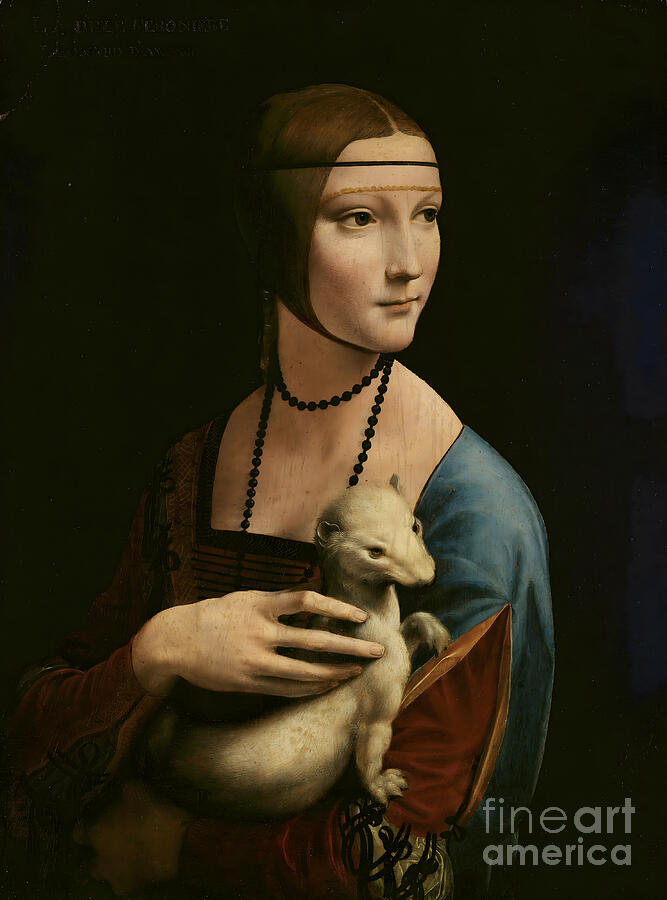
Leonardo da Vinci, Lady with an Ermine, c. 1489–1491. Oil on walnut panel. Czartoryski Museum, Kraków. Image via the Sapiens Verbum print shop.
Cecilia, Sixteen and Already the Smartest Person in the Room
The sitter is identified as Cecilia Gallerani, daughter of a minor Sienese official at the Milanese court, who became the mistress of Ludovico Sforza, Duke of Milan, sometime around her sixteenth birthday. She was no ornamental favourite: Cecilia wrote poetry in Latin and Italian, and her apartments hosted gatherings of Milanese philosophers and writers that later historians have credited as one of the first salons in Europe. She was pregnant with Ludovico's son, Cesare, around the time Leonardo painted her — and was quietly married off to a minor count once the duke's politically necessary marriage to Beatrice d'Este made the affair impossible to sustain. Decades later, when Isabella d'Este asked to borrow the portrait to compare it with other beauties, Cecilia wrote back with a very specific kind of grace: she no longer looked like it, she said, because she had been so young when it was painted that "nobody seeing it and me together would suppose it was made for me."
A Weasel, a Pun, and a Brand-New Ducal Title
The animal in her arms is not incidental. In Renaissance emblem books the ermine stood for purity and self-restraint, supposedly preferring capture to soiling its white winter coat — and in 1488, the year before this portrait is usually dated, Ludovico Sforza had just been inducted into the Neapolitan chivalric Order of the Ermine, adopting the animal as his own personal badge. There is also a pun buried in the fur: the Ancient Greek word for ermine is galê, a near-homophone for Gallerani, a wordplay game Renaissance patrons loved and poets of the Sforza court are recorded making explicitly about Cecilia. Purity, a lover's badge, and her own name, folded into a single animal — it is a lot of meaning to load onto something with claws.
A Portrait Leonardo Kept Changing His Mind About
Technical imaging of the panel has turned up a painting that did not arrive in one sitting. Infrared and X-ray studies show a dark, plain background repainted over an original lighter grey-blue, underdrawing visible around the sitter's hands and the edges of her hair, and evidence that the ermine itself went through more than one version before Leonardo settled on the animal we see now, its neck twisted at an angle no real creature holds for long. Some researchers have pushed this further, arguing from multispectral scans that Leonardo painted Cecilia at least twice without any animal at all before adding first a smaller, greyer creature and finally the sinuous white ermine — a claim other Leonardo scholars treat with real scepticism, but one that fits a painter who was, by every account, constitutionally unable to consider a picture finished.
Stolen Twice, and Nearly Lost for Good
The Czartoryski family bought the painting in Italy in 1798 and built a museum around it in Kraków in 1878; a princess is said to have personally smuggled it out of reach of Russian troops during the 1830 uprising. It survived one world war in protective exile in Dresden. It did not get off so easily in the second: German forces seized it in 1939, shipped it to Berlin, and then handed it back to Hans Frank, the Nazi governor-general of occupied Poland, who displayed it in his own office in Kraków's Wawel Castle for most of the war, an occupier admiring a masterpiece stolen from the country he was busy destroying. It was moved again to a plundered-art warehouse in 1941 before returning to Wawel in 1943. When Allied forces caught up with Frank in 1945, they found the painting hanging in his private house in Bavaria. It went back to Poland in 1946, and in 2016 the Polish state bought the entire Czartoryski collection outright for €100 million, finally putting the painting's ownership beyond any future argument.
🖼️ Own This Painting
Get Lady with an Ermine as a museum-quality print, canvas, or poster from the Sapiens Verbum print shop.
Shop This Print →
Watch the full video essay on @SapiensVerbum on YouTube.


Comments
Post a Comment