
Christ Carrying the Cross by El Greco: The Cross He Embraces (1590–1595)
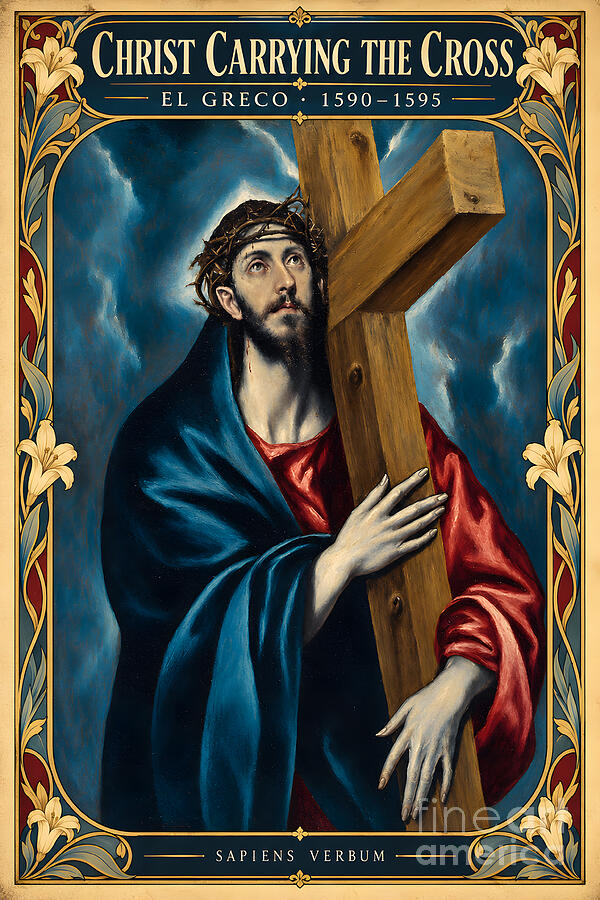
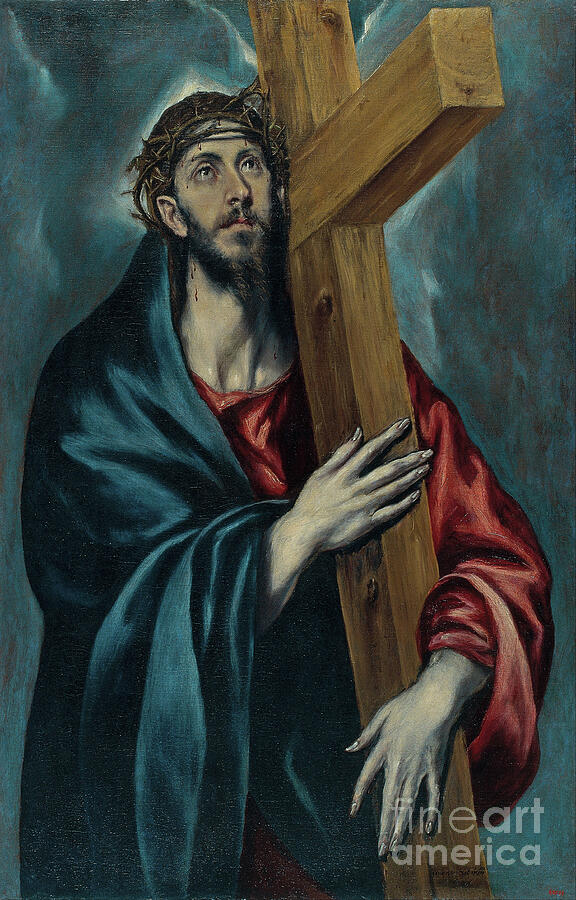
There is no road to Calvary in this picture, no crowd, no soldiers, no Simon of Cyrene. There is only Christ, seen from below against a stormy sky, wrapped in a red tunic and a blue cloak, with a crown of thorns on his head and the cross resting on his shoulder. He does not stagger under its weight. He holds it gently, almost tenderly, with long pale fingers, and looks up to heaven. El Greco painted this Christ Carrying the Cross in Toledo around 1590–1595, and today it hangs in the Museu Nacional d’Art de Catalunya in Barcelona. Here we also look at it through a new frame: a vintage Art Nouveau poster with a border of white lilies.
🖼️ Get the Art Nouveau poster →
Artist: El Greco (Doménikos Theotokópoulos, 1541–1614), born in Crete, active in Toledo
Title: Christ Carrying the Cross
Date: 1590–1595
Medium: Oil on canvas, 106.4 × 69 cm
Collection: Museu Nacional d’Art de Catalunya, Barcelona (inv. 065577-000), bequeathed by Santiago Espona in 1958
Notable fact: El Greco and his workshop painted this subject many times; other versions are in the Prado, the Thyssen-Bornemisza Museum and the Metropolitan Museum of Art.
A story turned into a prayer
For centuries, painters had shown Christ carrying the cross as a crowded scene: the procession out of Jerusalem, the soldiers pushing, the women weeping, Christ falling under the weight. El Greco removed all of it. As the Museo Thyssen-Bornemisza puts it, he transformed a narrative episode into a devotional one, “a simple image for prayer”. Nothing distracts from the face, the hands and the wood.
The Museo del Prado, which owns a later version, describes the type in the same terms: a half-length Christ, seen from very low, holding the cross on his shoulder and seeming to embrace it “like a light instrument”, with no sign of pain or effort, and no tormentors around him. The low viewpoint makes the figure almost sculptural, and the Prado links it to the painted wooden statues carried through the streets in Spanish Holy Week processions. The Prado also names a local precedent: the small devotional panels of Luis de Morales, with their dark backgrounds, which El Greco replaced with dramatic skies.
The eyes and the hands
Everything in the picture leads to two places. The first is the eyes, turned upward, wet and shining. The Thyssen catalogue identifies the moment as a pause on the way, when Christ raised his gaze to speak with the Father and accepted his sacrifice. The expression is not agony but calm. The Museu Nacional d’Art de Catalunya reads the cross here as a symbol of Christ’s triumph over death rather than an instrument of suffering, and the face as one of serenity and faith in eternal life. It connects the image with The Imitation of Christ, the fifteenth-century book of devotion that taught the faithful to follow Christ’s example.
The second is the hands. One lies flat across the wood; the other, lower down, barely touches it. The fingers are long and thin, the nails pearly, and the gesture is so light that the heavy beam seems to weigh nothing. The Prado calls El Greco’s hands in this composition “outstanding”, and the Thyssen commentary notes that they fix the gesture and carry the emotion of the whole picture. This is El Greco’s way of painting the spirit rather than the body: as the Barcelona museum puts it, he distorts the forms to express the characters’ spiritual longing.
Colour as drawing
Look closely at the cloak. El Greco does not outline it; he builds it out of patches of blue, green and almost white, laid side by side with quick, visible strokes. The red tunic is done the same way, and so is the sky, where flickering bands of light break through grey-green cloud. The Museu Nacional calls this his characteristic brushwork, in which colour itself models the forms. Born in Crete, trained as an icon painter and then in Venice and Rome, El Greco settled in Toledo in the 1570s and spent the rest of his life there; by the 1590s his style had become entirely his own.
Many versions, one image
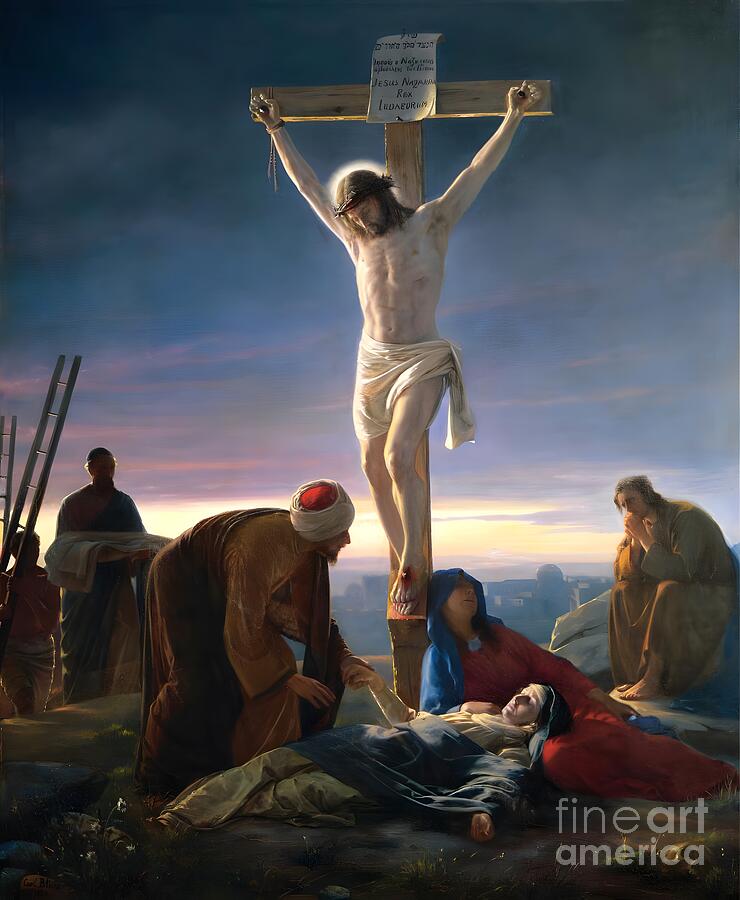
The composition was a success with El Greco’s clients, and he and his workshop repeated it many times, with small changes in the crown, the face and the cross. The Prado version is dated 1600–1605; the Thyssen version, in which the arms of the cross disappear from view, around 1587–1596. The Barcelona canvas came to the museum in 1958 as part of the bequest of the collector Santiago Espona and now hangs in its Renaissance and Baroque galleries. For two other ways of painting Christ with the cross, see Carl Bloch’s Christ on the Cross and Pietro Sassi’s Calvary, where the crucifixion is seen from far away; and for a Victorian Christ painted as a devotional image, Holman Hunt’s The Light of the World.
Hang El Greco’s Christ Carrying the Cross — the upturned eyes, the pearly hands and the stormy sky — as a vintage Art Nouveau poster from the Sapiens Verbum print shop, framed by a border of white lilies.
 Choose your size and frame →
See the vintage poster collection →
Choose your size and frame →
See the vintage poster collection →Printed and shipped by Fine Art America · 30-day money-back guarantee
Hang El Greco’s Christ Carrying the Cross as he painted it, as a print, canvas or framed print from the Sapiens Verbum print shop.
 Choose your size and frame →
Printed and shipped by Fine Art America · 30-day money-back guarantee
💬 Over to you: Does this Christ look to you like a man suffering, or a man at peace? And which do you notice first: the eyes or the hands? Tell us in the comments.
Sources
Museu Nacional d’Art de Catalunya — El Greco, Christ Carrying the Cross (065577-000)
Museo del Prado — El Greco, Christ carrying the Cross (P000822)
Museo Nacional Thyssen-Bornemisza — El Greco, Cristo abrazando la cruz
Comments
Post a Comment