
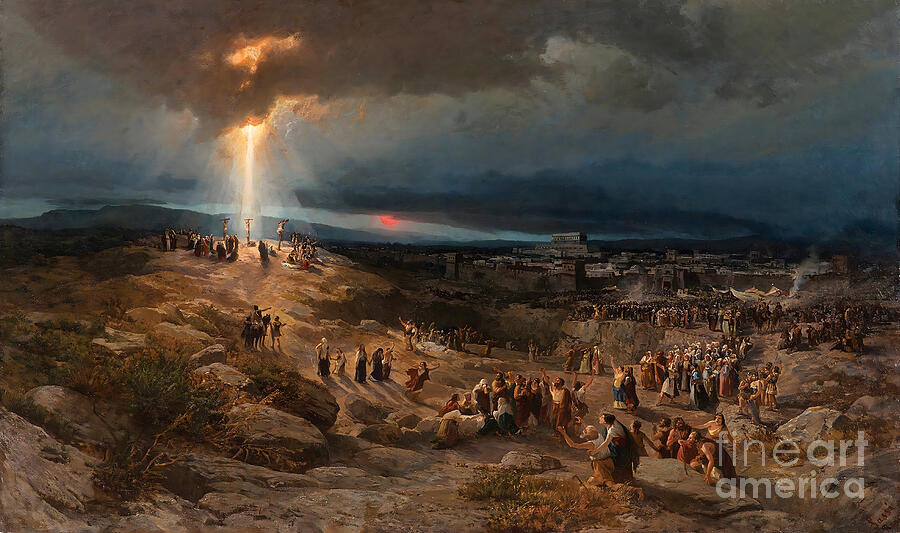
Calvary by Pietro Sassi: The Crowd Walking Home from the Crucifixion (c. 1870)
Most paintings of the Crucifixion bring you close enough to count the nails. Pietro Sassi’s Calvary does the opposite. The three crosses stand far off on a bare hill, small against the sky, and a single shaft of light breaks through the storm clouds to fall on the one in the middle. Below them a great crowd is already walking away, down the slope and back towards the walls of Jerusalem. Sassi, a painter of Roman views, turned the central event of Christian art into a landscape, and made the people who saw it the real subject.
🖼️ Get this painting as a print →
Artist: Pietro Sassi (1834–1905)
Title: Calvary
Date: c. 1870
Medium: Oil on canvas, 120 × 200 cm, signed and inscribed
Subject: The Crucifixion on Golgotha, outside the walls of Jerusalem
Present location: Private collection (last offered on the art market from a private European collection)
Status: Public domain.
A Crucifixion seen from far away
The canvas is twice as wide as it is tall, the shape of a view painting rather than an altarpiece. On the left, a rocky hill climbs to a small plateau where the three crosses stand among a scatter of figures. On the right, beyond a ravine, lies the city: a long line of walls and flat roofs, a great building raised above them on the skyline, and smoke drifting up near the gates. Between the hill and the city the ground is full of people, hundreds of tiny figures painted one by one, many of them heading the same way, down and home.
Above it all the sky does the dramatic work. Dark cloud covers almost the whole upper half of the picture. In one place it tears open, and a column of pale light drops straight onto the central cross. Low on the horizon, in a band of clear air, a red sun is going down. The light on the cross and the red disc at the edge of the world are the only two bright points in the painting, and the eye travels between them.
What the Gospels describe
Sassi is following the text closely. The Gospels place the Crucifixion outside the city, at a place called Golgotha, “the place of a skull”, near enough to Jerusalem that passers-by could read the inscription on the cross. Three of them describe a darkness over the whole land from the sixth hour to the ninth, and Luke adds that the sun was darkened. That is the storm in this sky, and that is why the sun burns so weakly red at its edge.
The crowd comes from Luke too. After Jesus dies, he writes, “all the people that came together to that sight, beholding the things which were done, smote their breasts, and returned.” Look at the figures in the foreground: some raise their arms to the sky, some turn back towards the hill, a woman kneels and reaches out, others walk on with their heads down. Sassi paints that verse almost literally. The execution is over, and the city is taking in what it has seen.
A painter of Rome and the Campagna
Pietro Sassi was born in Alessandria, in Piedmont, in 1834, and spent his working life in Rome, where he died in 1905. He was known above all for vedute, views of Rome and the Roman Campagna, along with genre scenes, and he showed in the big Italian exhibitions of the day: at Turin in 1880 and 1884, at Milan in 1881, at Rome in 1883, where three large views of the Campagna were a notable success, and at the national exhibition in Venice in 1887. His patrons included patrician families of Rome and Genoa, and among his pupils was the portraitist Cesare Tallone. The English art critic Brian Sewell owned his Arch of Titus of 1889.
That background explains this picture. A history painter would have built the Crucifixion around bodies and faces. Sassi builds it the way he built his views of the Campagna: wide ground, a city on the horizon, figures to give the scale, and weather to give the mood. The religious drama is told through space and light.
Why the distance works
Putting the crosses so far away could have made the scene feel cold. Instead it puts the viewer in the crowd. We stand where the people of Jerusalem stood, at the foot of the hill or on the road back, seeing the crosses as small dark marks against the sky, as most witnesses that day would have seen them. The beam of light tells us what the crowd only half understands.
It is also a picture about after. The nails, the soldiers and the dice belong to other paintings. Here the moment has passed, the sun is setting, and thousands of ordinary people are walking home, some in grief, some in fear, some still arguing. Few Crucifixions leave so much room for the bystanders, and that is what makes this one worth finding.
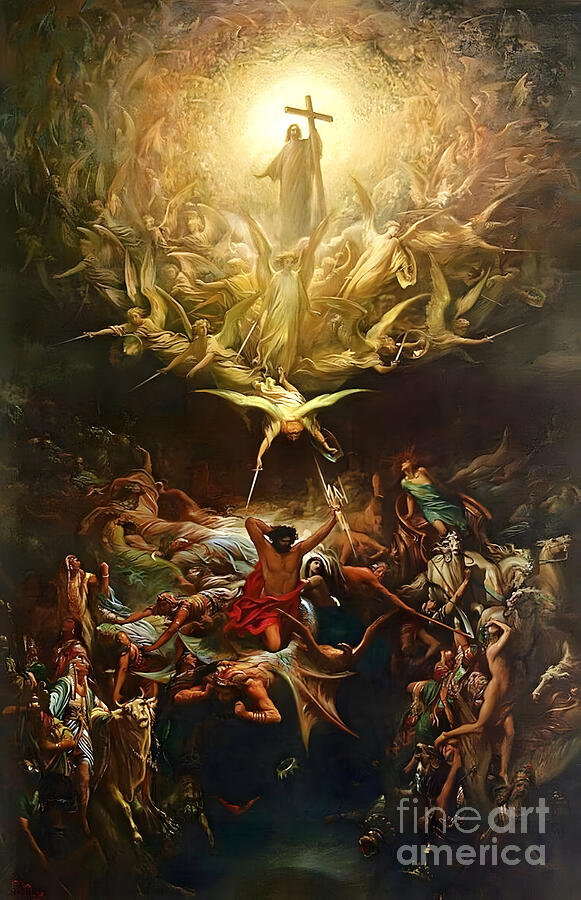
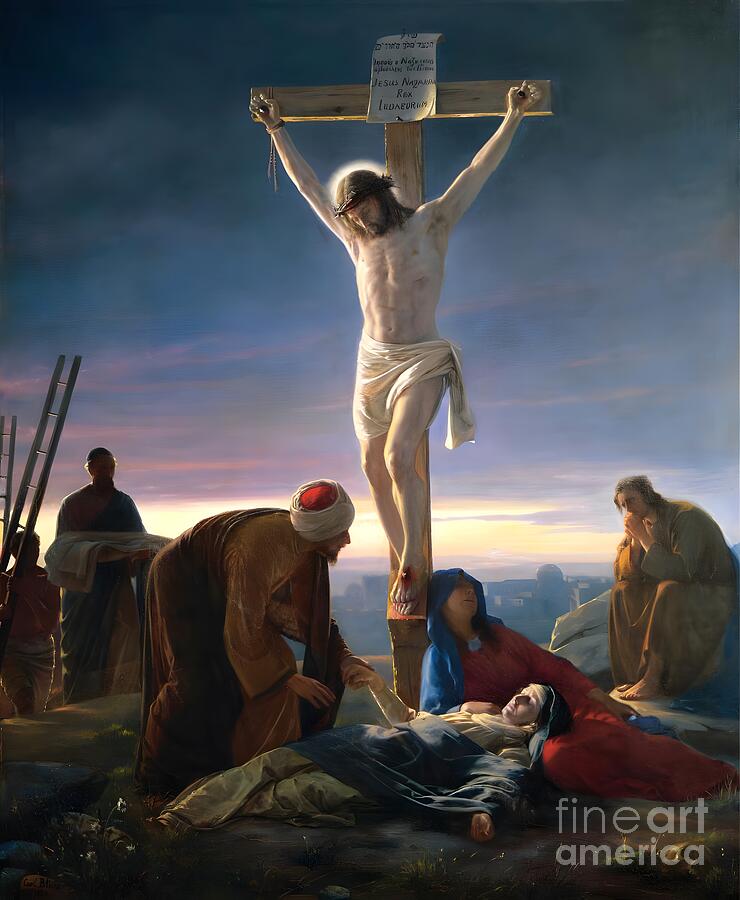
For more paintings of the Passion, see Carl Bloch’s Christ on the Cross, painted for the Frederiksborg oratory in the same years, and his Christ with Mocking Soldier. For another vast crowd under a dramatic sky, see Gustave Doré’s Triumph of Christianity over Paganism, and for more paintings like this one, our page of hidden masterpieces.
Hang Sassi’s Calvary — the storm, the shaft of light, the crowd walking home to Jerusalem — as a print, canvas or poster from the Sapiens Verbum print shop.
 Choose your size and frame →
Printed and shipped by Fine Art America · 30-day money-back guarantee
💬 Over to you: Where would you stand in this picture: up on the hill, or on the road back to the city? Tell us in the comments.
Sources
Wikipedia — Pietro Sassi
Academy Fine Paintings — Pietro Sassi, Calvary (catalogue entry)
Luke 23:33–49 (King James Version)
John 19:17–20 (King James Version)
Sapiens Verbum — Calvary, Pietro Sassi
Comments
Post a Comment