Christ on the Cross by Carl Bloch: Copper, Sunset, and the Frederiksborg Commission (1870)
Carl Heinrich Bloch painted Christ on the Cross in 1870 on copper, not canvas, for the King’s Oratory at Frederiksborg Castle in Hillerød. It belongs to the cycle of twenty-three scenes from the life of Christ that he made between 1865 and 1879 for the chapel rebuilt after the fire of December 1859. The picture is now in the Museum of National History at the same castle. A later Bloch, Christ with Mocking Soldier (1880), looks at the hours before the Cross. This one looks at the hour itself.
Artist: Carl Heinrich Bloch (1834–1890), Copenhagen
Date: 1870
Medium: Oil on copper
Collection: Museum of National History, Frederiksborg Castle, Hillerød, Denmark
Notable fact: One of twenty-three Life of Christ scenes commissioned after the 1859 fire; paid for by the brewer J. C. Jacobsen
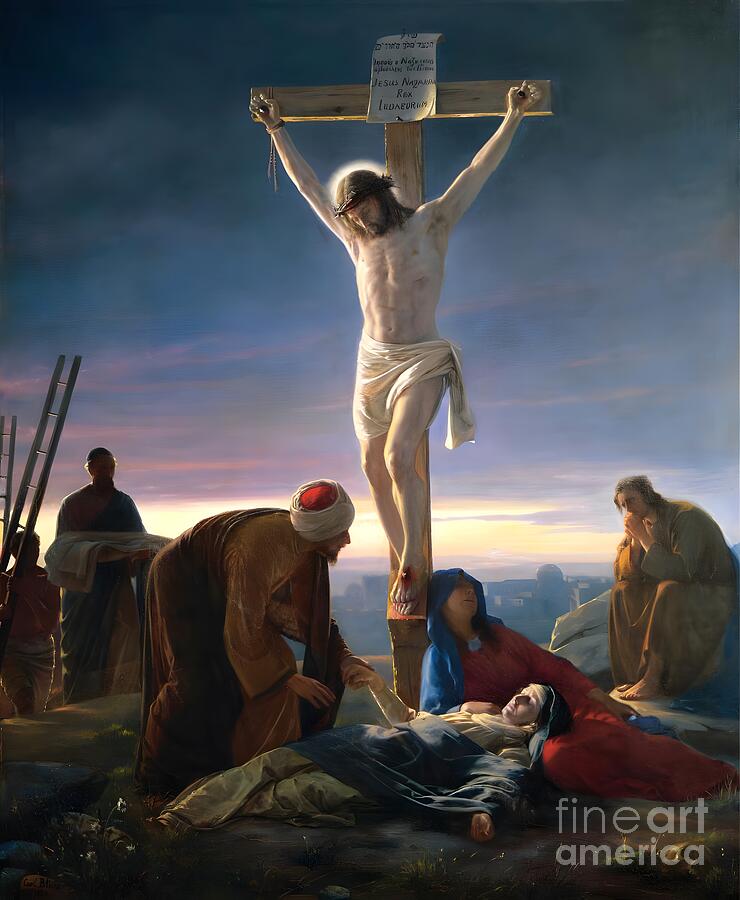
A chapel that had to be painted again
Frederiksborg, the great brick castle of Christian IV, burned in December 1859. The oratory of the chapel lost its earlier cycle of paintings. J. C. Jacobsen, founder of the Carlsberg brewery and the man who later endowed the Museum of National History in the rebuilt castle, commissioned the young Bloch — then still marked by his Italian years — to replace the lost scenes with a new Life of Christ. Bloch worked on the set for fourteen years. By the time he finished, in 1879, he was the obvious name in Denmark for altarpieces.
The 1870 Crucifixion sits in the middle of that labour, not at the end. Bloch had married Alma Trepka in 1868, two years earlier. The commission is the spine of his career; the copper plate is one vertebra of it.
Why copper
Most of the nineteenth century’s big religious pictures went onto canvas. Bloch put this Crucifixion on copper. The shop records the medium as oil on copper; later catalogues of the Frederiksborg series agree. Copper holds a tight, even skin of paint. Edges stay sharp. Dark grounds stay dark. For a chapel picture meant to be read at a short distance, in mixed daylight, that hardness matters more than sweep.
It also ties the plate, quietly, to older northern practice: small sacred pictures on metal, built to last in damp rooms. Bloch had looked hard at Rembrandt in the 1850s. He did not copy him here. He kept the lesson that a dark field can do as much work as a crowd.
What the plate shows
Christ is on the cross. Mourners stand in a landscape that is already losing the day. The shop description of the print is plain and accurate: a setting sun, a solemn ground, faces built for grief rather than for theatre. Bloch does not turn the hill into an opera set. He keeps the horizon low and lets the light do the theology — the last of it, falling while the body is still on the wood.
Danish viewers in the 1870s already knew the Italian look of his earlier work. The Frederiksborg cycle used that look for Lutheran walls: Roman light, northern purpose. The Crucifixion is the test of that bargain. If the light is only picturesque, the plate fails. If it is the hour named in John — “It is finished” — the plate holds.
The cycle around it
The twenty-three oratory pictures run from Annunciation to Resurrection. Gethsemane, the Mocking, the Burial sit near this plate in the story even when they do not hang as a single row. Bloch later etched a Crucifixion (1881) and painted a Descent from the Cross now in the Statens Museum for Kunst, Copenhagen (1886). Those are other jobs. The 1870 copper belongs to the chapel that paid for fourteen years of his life.
He went on to paint at least eight large altarpieces for churches in Denmark and Sweden. He told sitters and friends that the religious work was the part that counted. Whether the oratory made him more devout, as some later writers have guessed, is not a fact the documents fix. What they fix is the labour: 1865 to 1879, twenty-three scenes, one castle.
After Frederiksborg
The plates were copied early for Danish Sunday schools. In the late twentieth century The Church of Jesus Christ of Latter-day Saints used Bloch’s Frederiksborg pictures, including the Crucifixion, across manuals and meetinghouses. That second life is why the image is now more familiar in Utah than in many European museums that own stronger nineteenth-century religious painting. Familiarity is not the same as looking. The copper is still in Hillerød. The print exists so the chapel picture can be held still on a wall that is not a royal oratory.
Bloch died in 1890. The work is in the public domain. The original remains where Jacobsen meant the new museum to keep Denmark’s pictures: Frederiksborg Castle, the Museum of National History.
Get Bloch’s Christ on the Cross as a museum-quality print, canvas, or poster from the Sapiens Verbum print shop.
Shop This Print →
For the hours before the Cross in the same painter’s hand, see Christ with Mocking Soldier (1880).
Comments
Post a Comment