Christ’s Charge to Peter: Rubens Hands Peter the Keys (c. 1616)
Two keys in Christ’s hand. A flock of sheep at his feet. An older apostle kneeling as if the weight of an institution is about to settle on his shoulders. Peter Paul Rubens’s Christ’s Charge to Peter (about 1616) looks like a Bible scene until you notice what he has done: he has fused two separate Gospel moments into one canvas, then hung that fusion over a Brussels tomb. The painting now lives free to the public in London’s Wallace Collection — but it was born as funeral furniture for a man who wanted his afterlife guarded by the keys of Heaven.
Artist: Peter Paul Rubens (1577–1640)
Date: c. 1616
Medium: Oil on oak panel (139.2 × 114.8 cm)
Collection: Wallace Collection, Hertford House, Manchester Square, London (Inv. P93)
Notable fact: Commissioned for the tomb of Nicholas Damant in the church of St Gudule, Brussels; conflates Matthew’s Keys of Heaven with John’s “Feed my sheep”
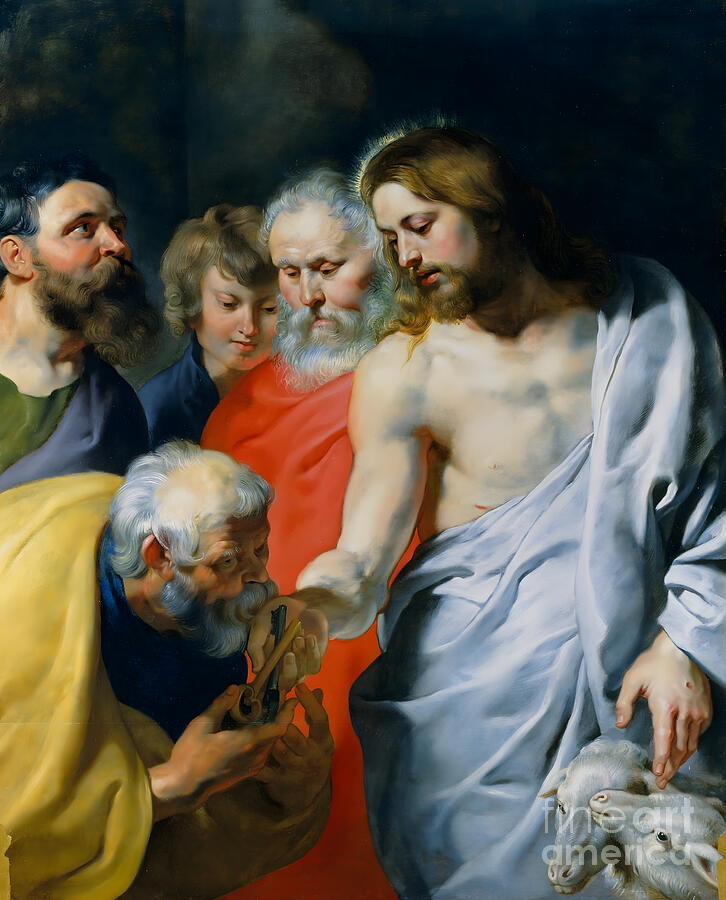
Two Gospels, One Handshake
In Matthew 16, Christ promises Peter the Keys of the Kingdom of Heaven. In John 21, after the Resurrection, he asks Peter three times whether he loves him, then charges him to feed the sheep. Rubens refuses to pick one. He puts the keys in Christ’s hands and the flock at his feet in the same frame, so the transfer of authority is both institutional and pastoral: power and care arriving together. The combination was rare. Raphael had already used it for the Sistine Chapel tapestries in Rome; Rubens, painting for Counter-Reformation Brussels, knew exactly how loaded that double image was. This is not a quiet Sunday-school illustration. It is a visual argument that the Church’s claim rests on both keys and flock.
A Tomb for Nicholas Damant
The panel was commissioned around 1613–1615 for the tomb of Nicholas Damant (c. 1531–1616) in the chapel of the Holy Sacrament at the collegiate church of St Gudule in Brussels. Damant was no anonymous donor. His patrons were Archdukes Albert and Isabella, Governors of the Spanish Netherlands, later buried in the same church. A tomb painting of Christ handing authority to Peter, under Habsburg Catholic rule, is politics as much as piety: the dead man rests under an image of legitimate succession. Rubens delivers the Baroque he was famous for — dense colour, urgent gestures, faces that register the seriousness of the handoff — without turning the chapel into a carnival. The drama stays at human scale: a circle of men, a pair of keys, animals that make the metaphor literal.
What the Eyes Are Doing
Christ stands slightly above Peter, body angled toward the kneeling apostle, keys offered rather than brandished. Peter receives them with the posture of someone who knows the job will outlive him. The other apostles press in with expressions that range from reverence to calculation; Rubens never paints a crowd as wallpaper. The sheep are not cute props. They are the congregation made visible — the reason the keys exist. Colour does the rest: saturated robes against a quieter landscape, light catching hands and metal so the transfer of power is the brightest event in the picture. If you only glance, you see a Bible story. If you stay, you see a contract being signed in oil.
From St Gudule to Manchester Square
The painting remained in St Gudule until the church sold it in 1800. Engravers had already made it famous across Europe; at least five prints circulated in the eighteenth and nineteenth centuries. Richard Seymour-Conway, 4th Marquess of Hertford, acquired it in 1850. Lady Wallace bequeathed the collection to the British nation in 1897, and the panel now hangs in the Great Gallery of Hertford House on Manchester Square — free entry, oak panel, inventory number P93. The funeral that once framed it is gone. The argument Rubens painted for that funeral is not: who holds the keys, and who feeds the sheep, are still the questions under every institutional portrait of power.
Why the Keys Still Matter
Most religious paintings pick a single verse and illustrate it. Rubens stacks two verses until the image does theological work on its own. Commissioned for a Brussels tomb, preserved in a London townhouse museum, the canvas is both Counter-Reformation propaganda and a permanent reminder that authority without care is only half a Gospel. Stand in front of the keys. Then look down at the sheep. Rubens wants you to hold both in the same glance.
Get Rubens’s Christ’s Charge to Peter as a museum-quality print, canvas, or poster from the Sapiens Verbum print shop.
Shop This Print →
Watch on @SapiensVerbum: Rubens Hands Peter the Keys — the full Commented Paintings reading of Christ’s Charge to Peter at the Wallace Collection.

Comments
Post a Comment