
Christ with Mocking Soldier: Carl Bloch Paints the Weariness Behind the Crown (1880)
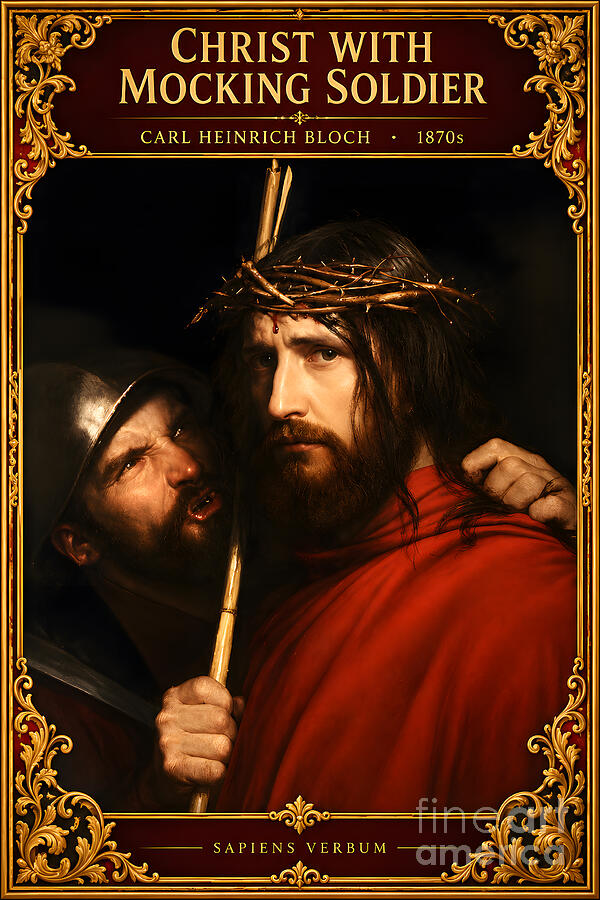
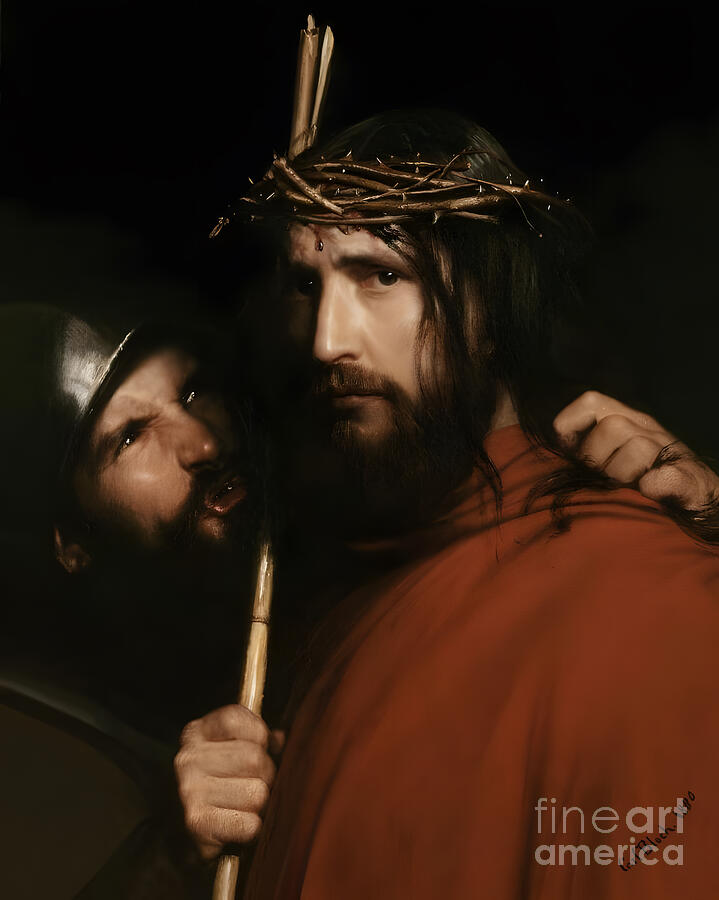
A crown twisted from thorns. A reed pressed into his hand like a scepter. A soldier's grin inches from his face. Carl Bloch's Christ with Mocking Soldier (1880) takes a scene the Gospels cover in a few verses and narrows it to two men and a joke that has already stopped being funny — because the man wearing the crown is looking straight out of the canvas, and he is not looking away. The picture below is our vintage poster version of the painting; the original is shown further down.
🖼️ Get the vintage poster →License this image →
Artist: Carl Bloch (1834–1890)
Date: 1880
Medium: Oil on canvas
Collection: BYU Museum of Art, Brigham Young University, Provo, Utah (held privately for decades before its rediscovery)
Notable fact: Painted the year after Bloch completed his 23-painting cycle on the life of Christ for the chapel at Frederiksborg Castle
A Scene the Gospels Sketch in Three Lines
Matthew, Mark, and John each give this moment barely a paragraph: Roman soldiers strip Jesus, throw a purple or scarlet robe over his shoulders, force a crown of woven thorns onto his head, put a reed in his hand as a mock scepter, then kneel before him and spit on him, calling him King of the Jews as an insult rather than a title. It is theater staged to humiliate, over almost as soon as it starts. Bloch does not paint the crowd of soldiers the Gospels imply. He paints one, close enough to breathe on his victim, which turns a public mockery into something closer to a private cruelty.
What the Paint Is Doing
The debt to Rembrandt that Bloch picked up during his years in the Netherlands is everywhere here: a near-black background, one hard source of light, and a red robe that reads as the loudest color in the room precisely because everything around it has been starved of it. The soldier's face is half-lit and grinning, close enough to be an intrusion. Christ's face gets the better light, and he is not looking at his tormentor. He is looking out, past the frame, at whoever is standing in front of the canvas. That gaze carries no defiance and no despair — just a kind of exhausted, unblinking knowing, as if he has already seen how this ends.
The Year After Frederiksborg
Bloch painted this in 1880, the year after he finished the project that made him Denmark's most celebrated religious painter: twenty-three scenes from the life of Christ for the King's Oratory at Frederiksborg Castle, completed between 1865 and 1879 and still hanging there today. Those paintings, and this one, share a deliberate refusal — no halos, no gilded backgrounds, none of the ornamental apparatus of Catholic devotional art. Bloch paints Christ as a man in a room, lit like a Dutch interior, which is exactly why his religious work traveled so far beyond Denmark and became some of the most widely reproduced Christian imagery of the next century, particularly within the Church of Jesus Christ of Latter-day Saints.
Lost, Then Found
That Latter-day Saint connection is not incidental to where this canvas ended up. After Bloch's death in 1890, the painting passed into private hands and stayed there for decades, absent from public view and largely undocumented, until it resurfaced and was acquired by the BYU Museum of Art at Brigham Young University — a fitting home for a Danish Lutheran painter whose halo-less Christ became, almost by accident, one of the defining visual languages of Latter-day Saint art.
Why This Mocking Still Unsettles
Most paintings of this subject go wide: a jeering crowd, a chaotic guardroom, spectacle enough to fill a canvas. Bloch goes narrow instead — two men, a stick, a circle of thorns, a stolen robe. The props are cheap theater. The eyes are not. It is that gap, between the joke the soldier thinks he is telling and the exhaustion on the face receiving it, that keeps this particular mockery from reading as history at all.
Hang Carl Bloch’s Christ with Mocking Soldier as a vintage art poster from the Sapiens Verbum print shop.
 Choose your size and frame →See the vintage poster collection →License this image →
Get Carl Bloch's Christ with Mocking Soldier as a museum-quality print, canvas, or poster from the Sapiens Verbum print shop.
 Choose your size and frame →
Printed and shipped by Fine Art America · 30-day money-back guarantee
Watch on @SapiensVerbum: The Mocking of Christ — the full Commented Paintings reading of Carl Bloch's Christ with Mocking Soldier at the BYU Museum of Art.
Comments
Post a Comment