
In a Roman Osteria by Carl Bloch: Why Is Everyone Staring at You? (1866)
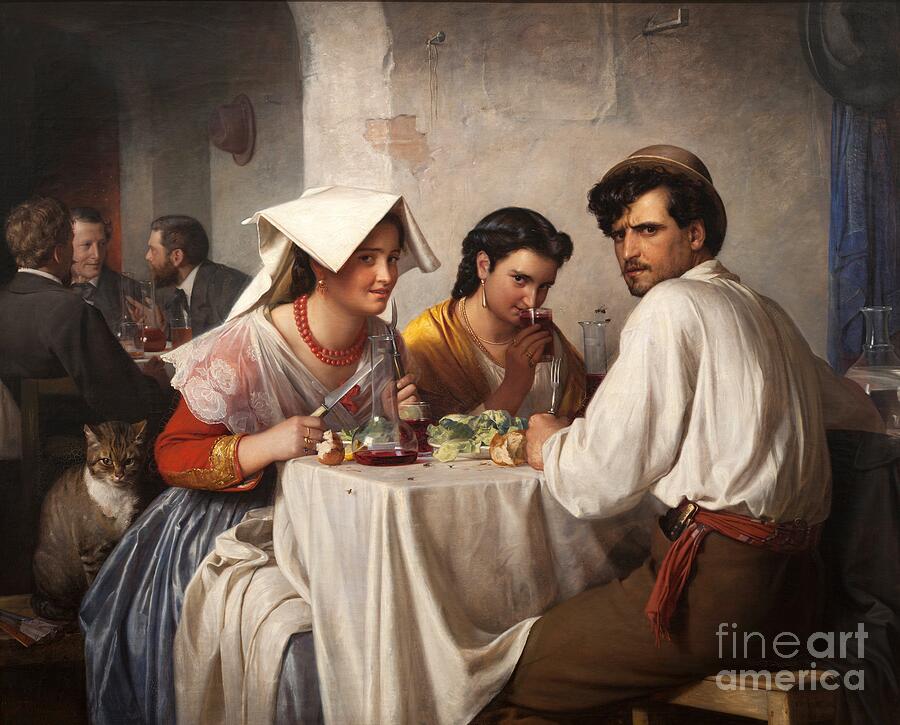
You walk into a Roman tavern, and everyone at the front table turns to look at you. A young man with a red sash twists round on his stool and fixes you with a hard, suspicious stare. A woman in a white headdress smiles at you, knife in hand, with a look that could be friendly or mocking. Her companion keeps sipping her red wine, watching you over the rim of the glass. Even the cat stares. Carl Bloch's In a Roman Osteria, painted in 1866 and now in the National Gallery of Denmark in Copenhagen, is one of the most famous paintings in Scandinavia because it makes the viewer part of the scene: we are the interruption.
🖼️ Get this painting as a print →
Artist: Carl Bloch (1834–1890)
Date: 1866, signed "Carl Bloch pinx. 1866"
Medium: Oil on canvas, 148.5 × 177.5 cm
Collection: SMK – National Gallery of Denmark, Copenhagen (KMS4087), acquired 1935
Commissioned by: the Copenhagen merchant Moritz G. Melchior
What does the painting show?
The setting is an osteria, a simple Roman tavern with whitewashed walls, patched plaster and a hat hanging on a nail. At the front table sit three young people sharing a meal of salad and bread, with carafes of red wine on a white tablecloth. The young man sits with his back half turned to us, in a white shirt with a red sash and a knife tucked in his belt. On the other side of the table, the woman on the left wears the white folded headdress, coral necklace and red bodice of a Roman woman of the people; the one beside her, in a yellow shawl, hides her face behind her glass.
What makes the picture unforgettable is that all three, and the cat, look directly out of the frame. The young man's expression says "what do you want?"; the woman in white seems amused, or flirtatious; her friend's eyes are sly. Bloch catches the exact moment when a stranger walks in and a private conversation stops. Each of us, standing in front of the canvas, becomes that stranger.
The museum's own commentary points out how freely knives and forks are brandished in Bloch's pictures, and notes the suggestive game of objects on the table: the decanter close to the woman's parted lips, and the sharp two-pronged fork pointed in her direction. The comedy has an edge of tension, and perhaps of jealousy.
A painting full of friends
The painting was commissioned by Moritz G. Melchior, a wealthy Copenhagen merchant and close friend of Bloch, whose house was a meeting place for artists and writers, including Hans Christian Andersen. After a trip to Italy, Melchior asked for an Italian tavern scene like the one Wilhelm Marstrand had painted in 1848. Bloch answered with a livelier, sharper version of the theme.
In the background, at the far table, a group of northern visitors in dark suits sits talking. According to the traditional reading, Melchior is among them, and Bloch himself is there too, with his back turned to us, chatting with two friends. It is a private joke for those who knew them, hidden in plain sight.
Who was Carl Bloch?
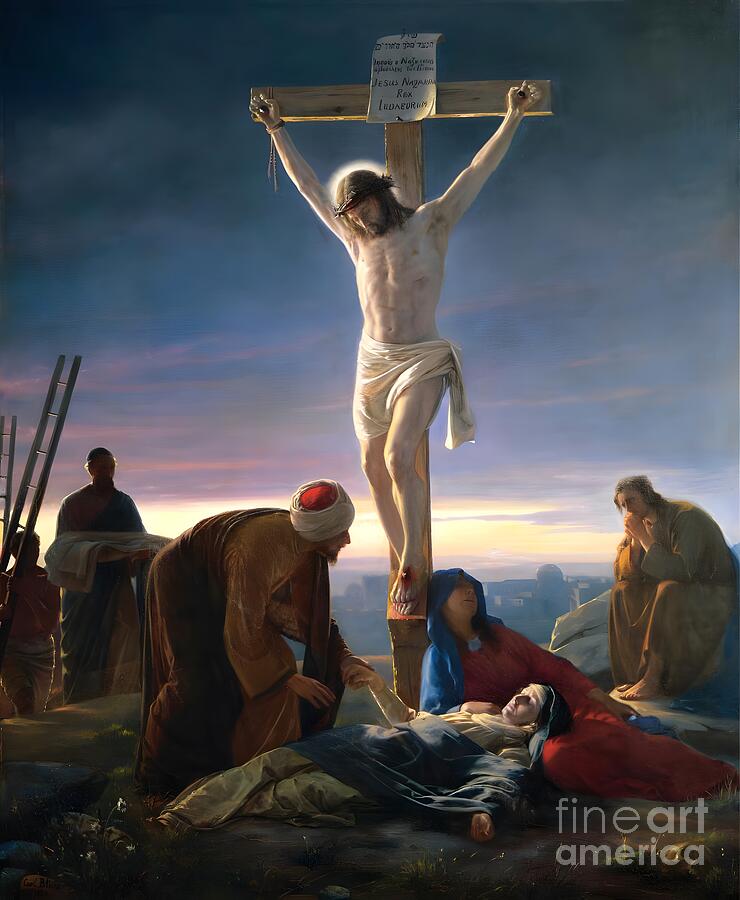
Carl Bloch was born in Copenhagen in 1834 and spent the years 1859 to 1866 in Italy, where he painted many scenes of everyday Roman life. Back in Denmark he became the most celebrated painter of his generation and received the great official commissions of the age, above all the 23 scenes from the life of Christ for the chapel of Frederiksborg Castle, such as Christ on the Cross. You can see the full series in our guide to the paintings at Frederiksborg Castle.
His genre scenes were a release from that serious work: friars with toothache, monks plucking chickens, rough fishwives. They are funny, but often strange and open to interpretation, like this one. For a very different side of Bloch, see Christ with Mocking Soldier, and browse every Carl Bloch painting we have explained.
Where can you see it?
The painting remained in private hands for decades after Melchior's death and entered the National Gallery of Denmark in 1935. It hangs today in the museum's collection of Danish art, and it was a highlight of the SMK's 2023 Bloch exhibition. The picture has also become a modern favourite online: in 2018 a British radio audience famously recreated the scene, staring out at the camera just like Bloch's diners.
See Bloch’s In a Roman Osteria framed on your wall: a museum-quality print, canvas or poster from the Sapiens Verbum print shop.
 Choose your size and frame →
Printed and shipped by Fine Art America · 30-day money-back guarantee
Watch the video essay on @SapiensVerbum on YouTube.
Sources
SMK – National Gallery of Denmark, "In a Roman Osteria" (KMS4087), collection texts by Peter Nørgaard Larsen; Wikipedia, "In a Roman Osteria".
Comments
Post a Comment