
Christus Consolator by Carl Bloch: Open Arms, an Iron Cuff, and the Hörup Altarpiece (1875)
An iron cuff is still on the wrist of the man who has already reached him. In Carl Heinrich Bloch’s Christus Consolator — painted in 1875 for Hörups kyrka in Skåne and known in Danish as Kristus, trøsteren — Christ stands at the centre with arms open at shoulder height and looks straight out of the picture. The weary are already under those arms. The painting is an altarpiece on canvas, not one of the twenty-three oils on copper in the King’s Oratory at Frederiksborg, and it has done more work for the idea of a welcoming Christ than many larger Passion scenes.
Artist: Carl Heinrich Bloch (1834–1890), born in Copenhagen
Date: 1875
Medium: Oil on canvas (altarpiece)
Collection: Hörups kyrka, Skåne, Sweden
Notable fact: Not part of the Frederiksborg copper cycle (1865–1879); Bloch painted eight altarpieces in all. A second Christus Consolator, 1884, is in Sofia Albertina Church, Landskrona

🖼️ Get this painting as a print →
After Frederiksborg, the altar
By 1875 Bloch was already deep into the cycle that would occupy him until 1879: twenty-three small oils on copper for the rebuilt prayer chamber of Christian IV at Frederiksborg Castle, paid for by the brewer J. C. Jacobsen after the fire of 1859. Those pictures taught Danish Sunday schools — and, later, a much wider public — how Christ looked in Bloch’s hands: Italian light, Rembrandt shadow, faces close enough to read.
Churches wanted that look at altar scale. Bloch answered with eight large canvases. Christus Consolator went to Hörup. The neighbouring parish of Löderup saw it and, according to the local church guide, ordered its own Bloch on one condition: that it cost twice as much as Hörup’s. The result was the Emmaus altarpiece of 1878, to which Bloch is said to have added extra figures after the parishioners complained that the Hörup picture had more people in it.
What the picture is doing
Bloch does not illustrate a miracle. He illustrates an invitation. Christ’s arms run almost the width of the panel and make a shallow cross of the body without nails or titulus. The head is calm; the gaze holds the nave. The people at his feet are not a crowd so much as a catalogue of burdens: age, illness, poverty, captivity.
The iron cuff is the detail that keeps the theology from turning soft. The man is already under Christ’s arm, and the mark of what bound him is still on the skin. Rest is offered before the chain is off. Matthew 11 sits behind the image in more than one way. In that chapter John the Baptist is still in prison when Jesus speaks the words about the weary. Bloch does not label the cuffed man as John. He does not need to. The painting makes the sentence visible: you may come while the evidence of suffering is still on you.
Light does the rest of the work. It gathers on the white robe and the face and leaves the petitioners in a lower key. Academic finish, yes — Bloch never abandoned that — but the rhetoric is pastoral. A Lutheran congregation walking toward the table was meant to meet a Christ who was already looking at them.
Copies, and why the picture travelled
Like several of Bloch’s altarpieces, Christus Consolator was copied across Scandinavia. Congregations that could not commission Bloch hired other painters to repeat the composition. That is how a picture made for a church in Skåne became, for many people, simply “the Bloch Christ with open arms.”
The Church of Jesus Christ of Latter-day Saints later used Bloch heavily in print and film. Most of those images come from the Frederiksborg copper cycle. The Consolator type belongs to the same face of Christ — bodily, near, untheatrical — but it was painted for a parish altar, not a royal prayer room.
Where to see it, and more Bloch
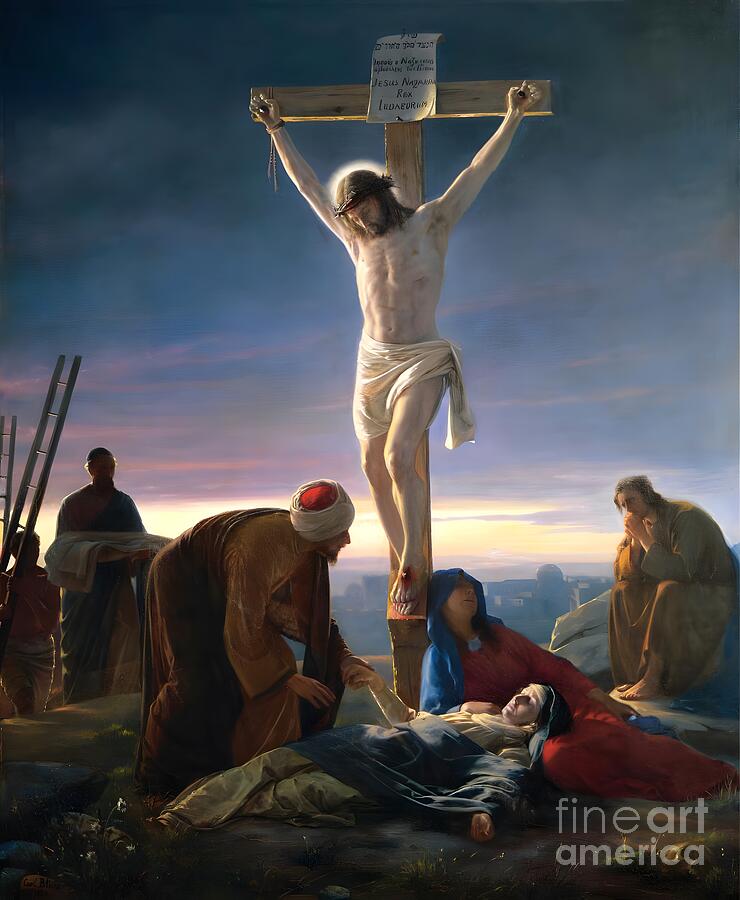
The original still hangs above the altar of Hörup Church, in Löderup parish on the south coast of Skåne; neighbouring Löderup Church has the Emmaus altarpiece. The twenty-three paintings of the Frederiksborg cycle, including Christ on the Cross (1870), are at the Museum of National History in Hillerød; see our guide to Frederiksborg Castle. For the same face of Christ a few years later, read Christ with Mocking Soldier (1880), and for Bloch before the religious commissions, his Roman tavern scene In a Roman Osteria (1866). Every Bloch we have written about is collected on our Carl Bloch artist page.
Look first at the cuff. Then at the open hands. Then at the face, which looks past the people at his feet and straight down the nave. The picture is less a scene than an invitation, painted at the scale of a parish altar.
See Bloch’s Christus Consolator framed on your wall: a museum-quality print, canvas or poster from the Sapiens Verbum print shop.
 Choose your size and frame →
Printed and shipped by Fine Art America · 30-day money-back guarantee
Watch the video essay on @SapiensVerbum on YouTube.
Comments
Post a Comment