Atalanta and Hippomenes by Guido Reni: Love as a Footrace (c. 1615)
Two nudes cut across a dark ground like dancers who forgot the music is a death sentence. Atalanta stoops for a golden apple; Hippomenes twists away mid-stride. Guido Reni's Atalanta and Hippomenes (c. 1618-1619, Prado version) freezes the cheat that wins a marriage race - desire, distraction, and classical bodies under Baroque pressure.
Artist: Guido Reni (1575-1642)
Date: c. 1618-1619 (Prado version; related version in Capodimonte, Naples)
Medium: Oil on canvas
Collection: Museo del Prado, Madrid
Notable fact: Long misattributed as a copy; confirmed as Reni's original at the Prado in 1963 after a turbulent Spanish provenance
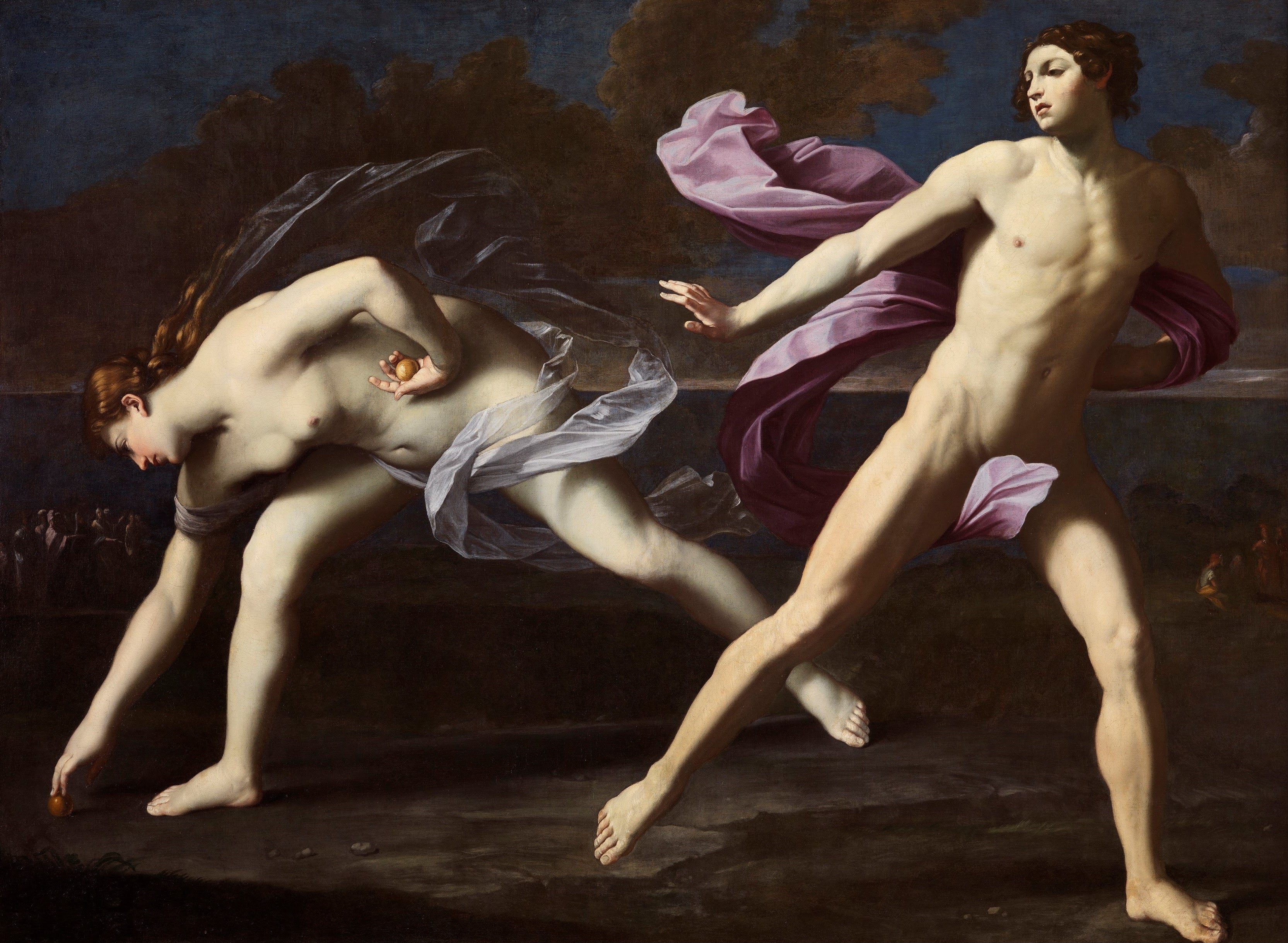
The Myth in One Diagonal
Atalanta vowed to marry only the man who could outrun her; losers died. Aphrodite handed Hippomenes golden apples to toss mid-race. Reni picks the instant she breaks form to grab the bait. The composition is a frieze of opposing thrusts: her reach down, his torque forward, both lit against a muted landscape.
Baroque Muscle, Classic Poise
Reni, trained in the Carracci orbit, keeps anatomy idealized and balanced even while the story screams motion. Caravaggesque darkness frames them without swallowing the polish. The painting stages seventeenth-century Italy's argument with itself: theatrical energy versus measured beauty.
A Rough Road to the Prado
The canvas passed through Neapolitan and Spanish royal hands, survived the Alcazar fire of 1734, was once judged too lascivious, then mislabeled a copy and sidelined. Only in 1963 was its status as an original Reni secured at the Prado. Fame arrived late; the bodies never waited.
Why the Apple Still Works
Victory here is not speed. It is interruption. Reni paints love as a footrace decided by a glittery distraction - and makes you feel the cost in the bend of a spine.
Watch the video essay on @SapiensVerbum on YouTube.


Comments
Post a Comment