
Las Meninas by Velázquez: What's Really in That Mirror? (1656)
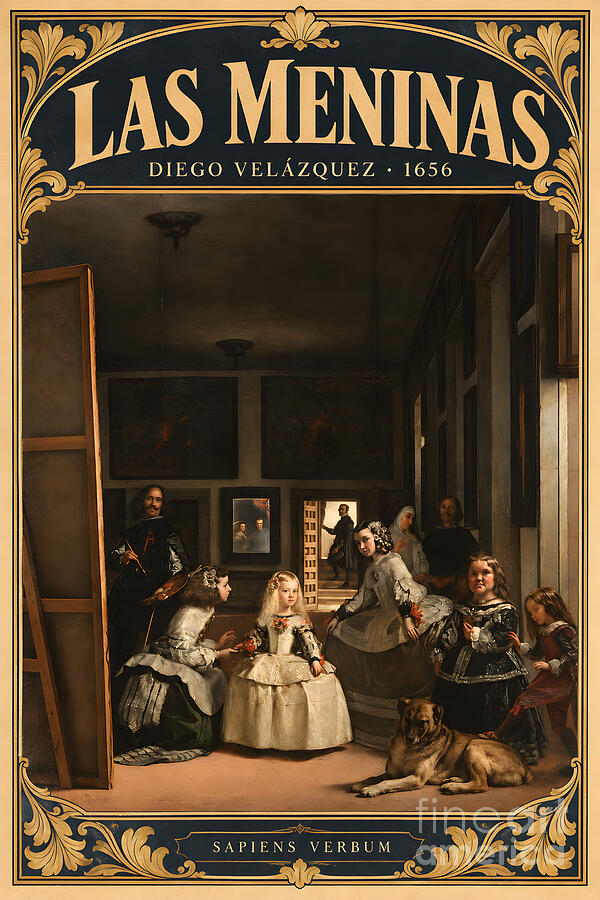
In the summer of 1656, Diego Velázquez painted himself at work: standing before an enormous canvas in a high-ceilinged room of Madrid's Real Alcázar, brush in one hand, palette in the other, pausing mid-stroke to look out at whoever has just walked in. Everyone in the room is looking the same way — the five-year-old Infanta Margarita Theresa, her maids of honour, a dwarf, a mastiff, a chaperone in the shadows. What they're all looking at is a small, blurred mirror on the back wall, reflecting two figures who aren't otherwise in the room at all: King Philip IV and Queen Mariana of Austria. The question that has occupied art historians for more than three centuries is disarmingly simple. Who, exactly, is Velázquez painting? The picture below is our vintage poster version of the painting; the original is shown further down.
🖼️ Get the vintage poster →License this image →
Artist: Diego Velázquez (1599–1660)
Date: 1656
Medium: Oil on canvas
Collection: Museo del Prado, Madrid
Notable fact: Velázquez wasn't yet a knight of the Order of Santiago when he painted this — the red cross on his chest was added to the canvas around 1659–60, after the honor finally came through
Who's Actually in the Room
The painting was inventoried in the royal collection simply as a portrait of the Infanta Margarita Theresa with her attendants; the title Las Meninas — "the maids of honour" — wasn't attached to it until the Prado's 1843 catalogue. At the center, the young princess stands lit almost like a small sun, flanked by two meninas: María Agustina Sarmiento, kneeling to offer her a red cup on a tray, and Isabel de Velasco, caught mid-curtsy. To their right, two court dwarfs employed for the family's entertainment — the German-born Mari Bárbola and the Italian Nicolasito Pertusato, who idles a bored foot against a sleeping mastiff. Behind them, barely visible in the gloom, the queen's chaperone Doña Marcela de Ulloa murmurs to an unnamed guard. And in the far doorway, caught in a shaft of light on the stairs, the queen's chamberlain José Nieto pauses with one hand on a curtain, arriving or leaving — nobody has ever settled which. It's an extraordinary amount of specific, named humanity to pack into what was nominally a portrait of a small girl.
The Mirror's Trick
The detail that has kept this painting argued over since the 17th century sits dead center on the back wall: a small mirror reflecting the unmistakable, if soft-focus, forms of Philip IV and his second wife Mariana. Two readings compete. The first, and long the most popular, is that the king and queen are standing exactly where we are, in the room, posing — which would mean the enormous canvas Velázquez is shown working on, its front hidden from us, is a portrait of them, and the Infanta's retinue has simply wandered in on the sitting to watch. The second, argued by later scholars including Snyder and Cohen, is that the mirror is reflecting not the room but the canvas itself: Velázquez may already have painted the king and queen on that hidden canvas, and what we see reflected is paint, not flesh. Either way, the effect is the same disorienting trick — the vantage point of the painting is also the vantage point of the monarchs, which means anyone who stands where they would have stood, including us, briefly occupies the position of the King of Spain.
A Cross Painted In Later
Velázquez shows himself wearing the red cross of the Order of Santiago, one of Spain's most exclusive chivalric honors — a striking claim for a court painter, since painting was then considered a craft, not fit company for nobility. The trouble is timing: Velázquez wasn't admitted to the order until 1659, three years after the picture was finished, and only after Philip IV personally petitioned Rome for a dispensation, because the artist's lineage couldn't otherwise clear the order's requirements. The early biographer Antonio Palomino recorded a popular story that the king himself added the cross to the finished painting with his own hand. Most modern conservators think it more likely Velázquez repainted it himself once the honor finally arrived, a small, private act of revision on a painting that had already been hanging in the palace for years — and one that turned a study of watching and being watched into something more personal: proof, brushed into his own chest, of exactly how far a painter could rise.
The Painting That Never Stopped Being Painted
Las Meninas hung not in a public gallery but in Philip IV's private study in the Alcázar, alongside mythological scenes, until a fire gutted the palace in 1734; it survived, badly singed at the edges, and eventually reached the Prado at its founding in 1819. Its afterlife has been unusually active for a 17th-century court portrait. Michel Foucault opened his 1966 book The Order of Things with a ten-page reading of the painting as a meditation on representation itself — who sees, who is seen, and the strange absence at its center where the king and queen should stand but don't, quite. Pablo Picasso went further than any critic: in August and September of 1957, working almost daily in his Cannes studio, he produced 58 variations on Las Meninas, dismantling and reassembling Velázquez's figures in cubist fragments, now held together as a single sequence at the Museu Picasso in Barcelona. Few paintings have been so thoroughly taken apart by later artists trying to understand exactly how it was built.
Velázquez’s Las Meninas reimagined as an Art Nouveau vintage art poster by Sapiens Verbum.
 Choose your size and frame →
See the vintage poster collection →License this image →
Choose your size and frame →
See the vintage poster collection →License this image →

Get Velázquez’s Las Meninas as a museum-quality print, canvas, or poster from the Sapiens Verbum print shop.
 Choose your size and frame →
Printed and shipped by Fine Art America · 30-day money-back guarantee
Las Meninas is one of the thirty pictures in our book The 30 Most Famous Paintings in the History of Art: The Myths They Hide, the History They Reveal. Each chapter takes one painting, the myth around it and the history behind it. On Kindle, in paperback, in hardcover and as an audiobook.
Get the book →See all 30 paintings →
Watch the full video essay on @SapiensVerbum on YouTube.
Comments
Post a Comment