The Garden of Earthly Delights by Bosch: Paradise, Pleasure, and Hell (c. 1490)
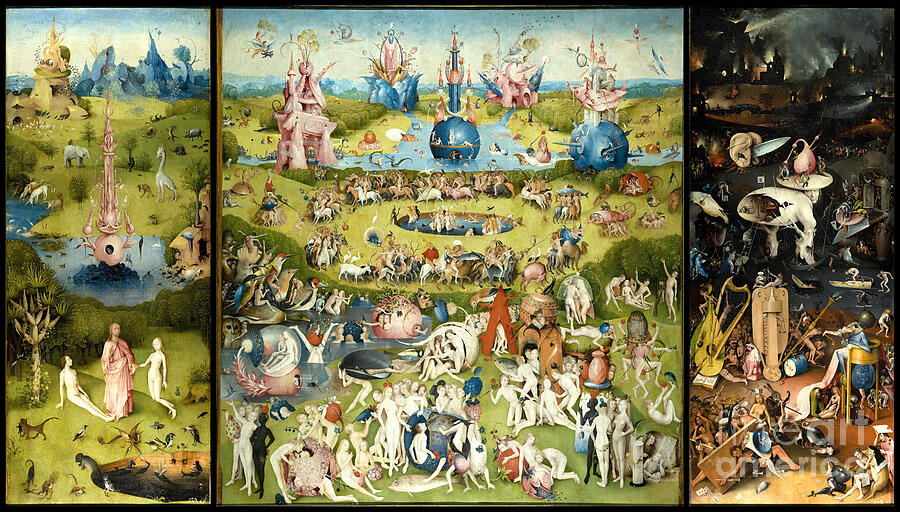
Closed, the altarpiece is almost silent: a pale globe floating in grey water under God's word. Open it, and the silence explodes. Hieronymus Bosch's The Garden of Earthly Delights (c. 1490-1510) is a triptych that moves from Creation to a carnival of bodies to a machine of punishment - paradise, pleasure, and hell laid out like a single argument about what humans do with freedom.
Artist: Hieronymus Bosch (c. 1450-1516)
Date: c. 1490-1510
Medium: Oil on oak panel (triptych, approx. 220 x 389 cm open)
Collection: Museo del Prado, Madrid
Notable fact: When closed, the outer wings show the third day of Creation as a fragile world-sphere; the Latin inscription cites Psalm 33: "Ipse dixit, et facta sunt"
A World Before Colour
Shut the wings and you get monochrome Creation: Earth held in a transparent sphere, vegetation without animals, God tiny in the upper corner speaking light into being. The restraint is deliberate. Bosch stages the unfinished planet as fragile glass - a cosmos that can still be closed, sealed, judged. Open the doors and that grey morality play becomes a riot of green, pink, and flame.
Eden, Then Excess
On the left, Christ presents Eve to Adam beside strange fountains and a coiled serpent at the Tree of Knowledge. In the centre, naked crowds ride animals, share giant fruit, and invent pleasures that look half-innocent and half-doomed. Bosch does not paint a single orgy so much as a catalogue: every appetite given a creature, a vessel, a game. Grace, the panels imply, is already slipping.
Hell as Invention
The right wing is where imagination turns punitive. Musical instruments become torture devices; ice, fire, and ruined cities grind sinners into spectacle. It is not generic suffering. It is engineered consequence - the garden's toys redesigned as traps. Look long enough and the central panel starts to feel like rehearsal for this night.
Why the Triptych Still Unsettles
Bosch refuses a tidy moral sticker. You can read the centre as satire, warning, dream, or all three. What endures is the structure: a closed world of divine order, an open world of human appetite, and a third panel that asks what appetite costs. The Prado keeps the object; the argument keeps walking out of the frame.
Own This Painting
Hang Bosch's triptych of paradise, pleasure, and hell - the garden that never stops asking what freedom is for.
Watch the video essay on @SapiensVerbum on YouTube.


Comments
Post a Comment