
Dante and Virgil by Bouguereau: Hell's Most Violent Embrace (1850)
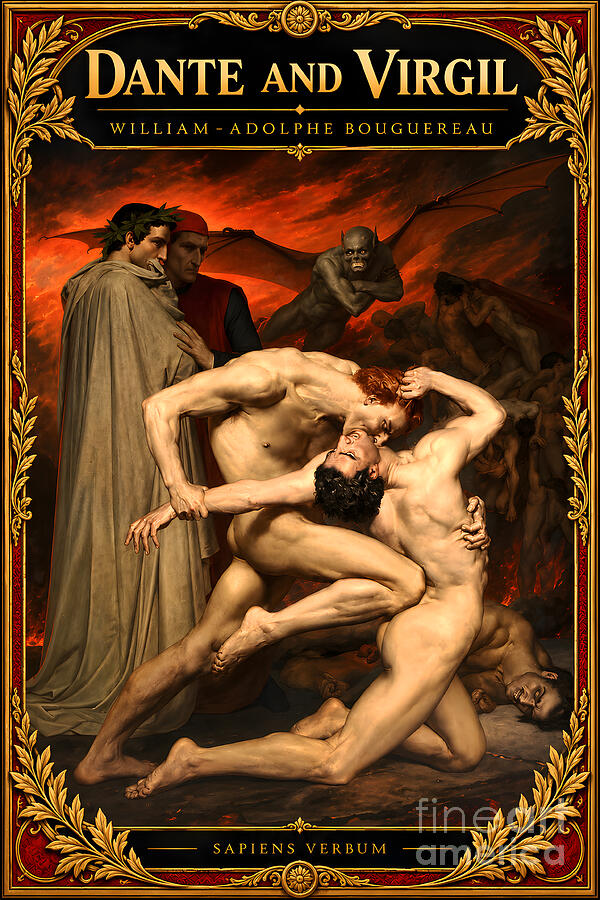
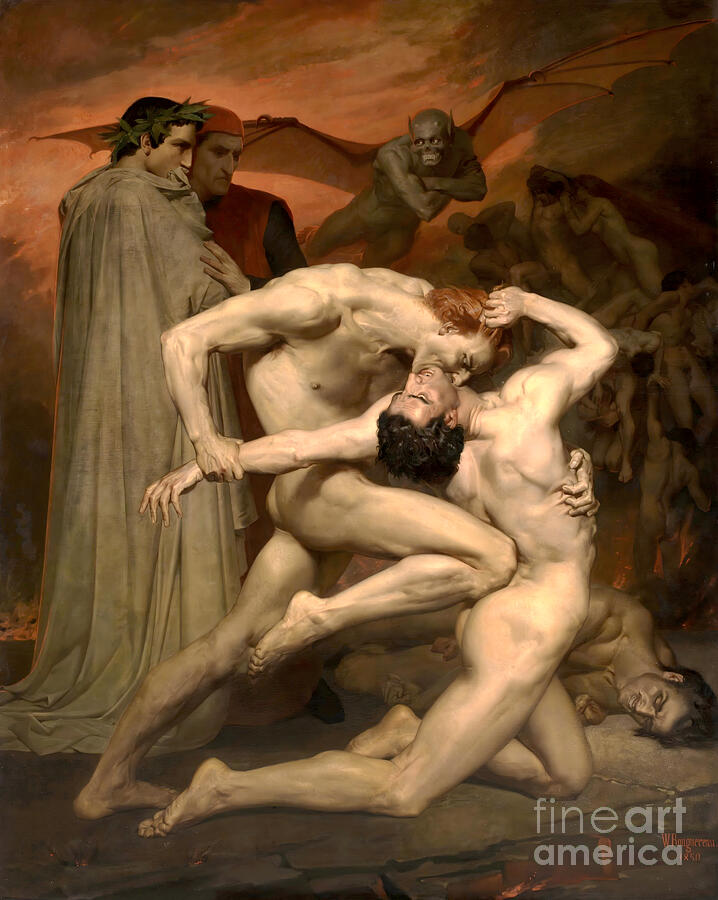
Two naked men are locked in a savage fight. One has his knee in the other's back and sinks his teeth into his throat; the victim arches backwards in agony, his hands clawing the air. On the left, wrapped in long cloaks, Dante and his guide Virgil watch in horror. Above them a grinning winged demon hovers in the smoky air, and behind, in the red gloom, a heap of the damned writhes in torment. William-Adolphe Bouguereau's Dante and Virgil, shown at the Paris Salon of 1850 and now in the Musée d'Orsay, is the most violent picture the famously sweet painter ever made. The picture below is our vintage poster version of the painting; the original is shown further down.
🖼️ Get the vintage poster →License this image →
Artist: William-Adolphe Bouguereau (1825–1905)
Date: 1850
Medium: Oil on canvas, 280.5 × 225.3 cm
Collection: Musée d'Orsay, Paris (accepted by the French state in 2010 from the painter's heirs in lieu of inheritance tax)
Source: Dante, Inferno, Canto XXX
What is the story?
In the Inferno, the first part of Dante Alighieri's Divine Comedy, the poet is guided through the circles of Hell by the Roman poet Virgil. In the eighth circle, among the falsifiers, he sees souls punished for deception. In Canto XXX two of them attack each other. Gianni Schicchi, a Florentine who impersonated a dead man in order to forge his will, leaps on the alchemist Capocchio, who had counterfeited metals, and sinks his teeth into his neck, dragging him across the ground. Dante describes the two souls running "pale and naked", biting like hogs let loose from the sty.
What does the painting show?
Bouguereau makes the struggling pair the centre of the picture and paints them almost life size. Schicchi, dark-haired, presses his knee into Capocchio's back and bites his throat; Capocchio, red-haired, twists away with his body arched in a violent curve, his arm flung up and his hand clenched. Every muscle and tendon is visible, strained to the limit. The Musée d'Orsay points to the bold choices: distorted musculature, exaggerated poses and dramatic contrasts of colour and shadow.
Dante and Virgil stand apart on the left, upright and still, almost like statues in their long robes, their calm forms setting off the fury of the fight. Above them a demon with bat wings hovers and smiles at the scene. In the background, under a sky of fire and smoke, more damned souls are piled on one another. The palette is hot and heavy, full of reds, browns and greenish shadows.
A side of Bouguereau nobody expects
Bouguereau is remembered today for smooth, idealised nudes, nymphs and sentimental peasant children. Dante and Virgil belongs to his early years, when he was only twenty-five and still trying to make a name for himself. The museum relates its dark, Romantic mood to British painters such as William Blake, Henry Fuseli and Thomas Lawrence, and to the sense of sublime horror of Dante's underworld. The critic Théophile Gautier praised the power of the work. According to the museum, Bouguereau never again returned to such dark and dramatic subject matter.
For his later and much better-known style, compare Nymphs and Satyr, The Wave and Orestes Pursued by the Furies, where violence returns in a more classical form. For other visions of hell, see Bosch's Garden of Earthly Delights and Tassaert's Heaven and Hell.
Where can you see it?
For a century and a half the painting stayed with the artist's family. In 2010 it entered the Musée d'Orsay in Paris through a dation, the French system that allows heirs to pay inheritance tax with works of art. Our guide to the paintings you can see in Paris will help you plan the visit.
Hang William-Adolphe Bouguereau’s Dante and Virgil as a vintage art poster from the Sapiens Verbum print shop.
 Choose your size and frame →See the vintage poster collection →License this image →
See Bouguereau’s Dante and Virgil framed on your wall: a museum-quality print, canvas or poster from the Sapiens Verbum print shop.
 Choose your size and frame →
Printed and shipped by Fine Art America · 30-day money-back guarantee
Watch the video essay (in Spanish) on @SapiensVerbum on YouTube.
Sources
Musée d'Orsay, "Dante et Virgile", collection record; Wikipedia, "Dante and Virgil"; Dante, Inferno, Canto XXX.
Comments
Post a Comment