
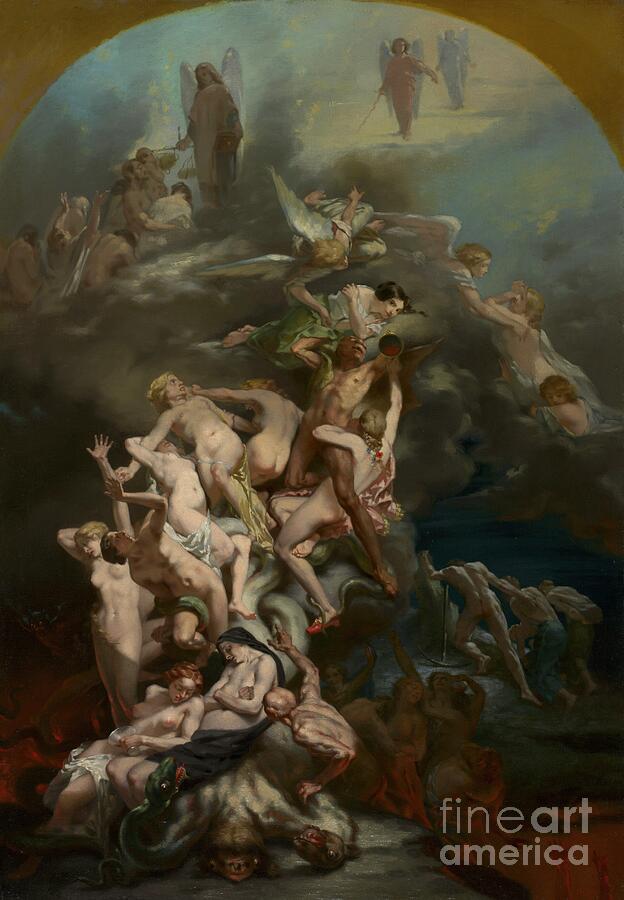
Heaven and Hell by Octave Tassaert: Good and Evil Fight for a Young Woman's Soul (c. 1850)
Halfway up a column of cloud, a young woman in a green dress reclines and looks straight out at us. Above her, a white-winged angel reaches down. Below her, a dark demon lifts a cup towards her lips. Further down, a writhing mass of bodies tumbles into flames and serpents, while far above, in a golden light, Saint Michael weighs souls on his scales. Octave Tassaert's Heaven and Hell, painted around 1850 and now in the Cleveland Museum of Art, stages the oldest choice in Christian art as a spectacle in which the viewer is invited to take part.
🖼️ Get this painting as a print →
Artist: Octave Tassaert (1800–1874)
Date: c. 1850
Medium: Oil on fabric, 100 × 69.5 cm
Collection: Cleveland Museum of Art (1980.287), bequest of Noah L. Butkin
Notable fact: The woman may personify France, torn between monarchy and Republic after 1848
What does the painting show?
The canvas is arched at the top like an altarpiece, and it reads from top to bottom. In the highest zone, bathed in pale gold, two angels stand at the gates of heaven, and on the left a robed figure holds the scales: Saint Michael, who weighs the goodness of souls and admits the blessed. The saved rise towards him on the clouds.
In the middle sits the young woman, the only figure who looks out of the picture. She leans back on the cloud in her green dress with an expression that is hard to read: curious, tempted, perhaps already half won over. Just above her a white angel dives down to pull her up. Just below, a dark-skinned demon pushes his way up through the crowd and raises a cup towards her, the classic symbol of worldly pleasure.
The lower half of the canvas belongs to hell. A tangle of pale nude bodies twists and falls among clouds and coiling serpents. Some raise their arms in despair, others cling to one another. Near the bottom a figure in a black veil, like a nun, sits among the damned. Monstrous heads gape at the lower edge, red flames break through on both sides, and on the right a line of bent figures trudges away into the dark.
France in the balance
Tassaert painted this picture in the years after the Revolution of 1848, when France was torn by violent conflict between royalists and republicans. The Cleveland Museum of Art points out that Tassaert was a strong supporter of the Republic, and suggests that the young woman probably personifies France herself, caught between the sensual temptations of royal excess and the noble ideals of the Republic. Read this way, the demon's cup is the luxury of the old regime, and the angel is the austere virtue of the citizen.
The painting works just as well without the political key. It belongs to a long tradition of Last Judgements and battles for the soul, from Raphael's Saint Michael Vanquishing Satan to the hell panel of Bosch's Garden of Earthly Delights. Its swirling, Romantic style, with figures tossed in a storm of bodies, recalls Bouguereau's Dante and Virgil, painted in the same year.
Who was Octave Tassaert?
Tassaert was born in Paris in 1800 into a family of Flemish artists and trained at the École des Beaux-Arts under Guillaume Guillon Lethière. After failing to win the Prix de Rome, he worked for years as an engraver and lithographer before returning to painting in the 1830s. He became known for melodramatic scenes of poverty and suffering among the working poor of Paris, which earned him the nickname "the Prud'hon of the poor". Delacroix admired him, and collectors such as Alfred Bruyas and Alexandre Dumas fils bought his work; Dumas owned around fifty of his paintings.
His later years were hard. He withdrew from the art world after 1857, sold his remaining paintings to a dealer and died in Paris in 1874. Today his best-known pictures are in the Musée d'Orsay, the National Gallery of Australia and Cleveland.
Where can you see it?
The painting belonged to a French private collection before passing through the Shepherd Gallery in New York, where it was bought in 1977 by the Cleveland collectors Noah and Muriel Butkin, great champions of nineteenth-century French art. It came to the Cleveland Museum of Art with Noah Butkin's bequest in 1980. For another devil who tempts rather than threatens, see Ludwik Stasiak's Allegory of Satan.
See Tassaert’s Heaven and Hell framed on your wall: a museum-quality print, canvas or poster from the Sapiens Verbum print shop.
 Choose your size and frame →
Printed and shipped by Fine Art America · 30-day money-back guarantee
Watch the video essay on @SapiensVerbum on YouTube.
Sources
The Cleveland Museum of Art, "Heaven and Hell" (1980.287), Open Access collection record; Wikipedia, "Octave Tassaert".
Comments
Post a Comment