
Saint Michael Vanquishing Satan by Raphael: Divine Triumph over Evil (1518)
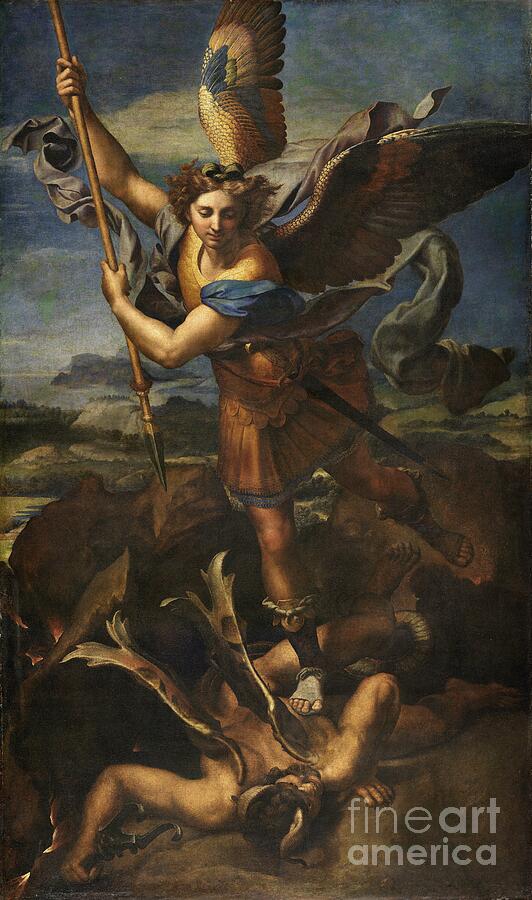
The archangel Michael comes down from the sky like a bolt of light. His wings are open, his armour gleams, and he raises a spear with both hands. One foot rests lightly on the back of Satan, a dark, winged figure who writhes on the rocks below, face twisted, at the edge of a smoking abyss. Michael’s face, by contrast, is calm, almost serene: no effort, no anger, only certainty. Raphael’s Saint Michael Vanquishing Satan, painted in 1518 and known in France as Le Grand Saint Michel, is one of the great showpieces of the Louvre’s Grande Galerie, and a painting made to flatter a king.
🖼️ Get this painting as a print →
Artist: Raphael (Raffaello Santi, 1483–1520)
Date: 1518
Medium: Oil on canvas (originally on panel), 268 × 160 cm
Collection: Musée du Louvre, Paris (INV 610), Denon Wing, Grande Galerie, Room 710
Provenance: Gift to King Francis I of France, 1518; former French royal collection
A diplomatic gift
In 1518 Raphael was the most sought-after painter in Rome, working for Pope Leo X, a Medici, on the Vatican rooms where he had already painted The School of Athens. The pope and his family wanted good relations with the young King of France, Francis I, who had conquered Milan three years earlier. Two large paintings by Raphael were sent to France as gifts that year: this Saint Michael and a Holy Family, both now in the Louvre. According to the Louvre, the Saint Michael entered the collection of Francis I in 1518.
The subject was carefully chosen. Saint Michael was the patron of the Order of Saint Michael, the chivalric order of the French kings, and the image of the archangel overthrowing evil could easily be read as a compliment to the young monarch, defender of the Church. Raphael signed the painting on the hem of the angel’s tunic, with his name and the date 1518.
What does the painting show?
The story comes from the Book of Revelation: “there was war in heaven: Michael and his angels fought against the dragon,” and the devil was cast down to earth. Raphael condenses the whole cosmic battle into two figures. Michael fills the upper part of the canvas, his body set on a strong diagonal from the tip of his wing to his foot. His armour, painted in shining blue and gold, shows off the painter’s skill with reflected light. Satan, below, has the body of a man with dark, bat-like wings; he twists back towards us, caught at the moment of defeat.
The contrast is the point. All the movement, strain and darkness belong to Satan; all the light and calm belong to Michael, who barely seems to touch him. Victory is shown as something effortless and inevitable, a perfect image of authority. In the background, a rocky landscape smokes and burns, a glimpse of the underworld opening beneath the falling devil.
Raphael’s workshop and the late style
By 1518 Raphael ran a large workshop, and scholars have long discussed how much of the painting is by his own hand and how much by assistants such as Giulio Romano. The Louvre catalogues it as by Raphael, and it was shown in 2012–13 at the Prado and the Louvre in the exhibition Late Raphael, devoted to his last years. The painting was originally on wood and was later transferred to canvas to preserve it, a delicate operation that has left the surface more fragile than it looks.
For a very different vision of struggle in the same years, compare Michelangelo’s The Creation of Adam on the Sistine ceiling, where the drama is in a gap between two fingers rather than a spear thrust. Raphael’s graceful certainty, in turn, would become the model of the academic tradition, from the court of Louis XIV to Bouguereau’s Dante and Virgil, another battle between bodies and the forces of Hell.
A model for French painters
The painting stayed in the French royal collection for the next three centuries. Under Louis XIV it hung at Versailles, and the king’s first painter, Charles Le Brun, held it up as a model of perfect composition; it was copied for the royal collection and admired by generations of French artists. After the Revolution it entered the Louvre, where it has remained ever since.
See Raphael’s Saint Michael Vanquishing Satan framed on your wall: a museum-quality print, canvas or poster from the Sapiens Verbum print shop.
 Choose your size and frame →
Printed and shipped by Fine Art America · 30-day money-back guarantee
Where can you see it?
The painting hangs in the Grande Galerie of the Louvre (Denon Wing, first floor, Room 710), the long gallery of Italian painting that leads towards the Mona Lisa. Our guide to the paintings you can see in Paris has practical information on visiting the museum, and you can browse more Renaissance paintings in Explore Art.
Watch the video essay on @SapiensVerbum on YouTube.
Sources
Musée du Louvre, collections database, “Saint Michel terrassant le démon, dit Le Grand Saint Michel” (INV 610); Book of Revelation 12:7–9; Wikipedia, “St. Michael Vanquishing Satan”.
Comments
Post a Comment