The School of Athens by Raphael: Who's Who in the Hall of Philosophy (1509)
In the center of a vast hall, two men walk forward and disagree with their hands. Plato points up; Aristotle levels his palm toward the earth. Around them, mathematicians draw, skeptics argue, and a whole imaginary academy fills Raphael's fresco in the Vatican's Stanza della Segnatura. The School of Athens (1509-1511) is less a classroom than a stage for thought - architecture, gesture, and philosophy locked in one perspectival trap.
Artist: Raphael (Raffaello Sanzio, 1483-1520)
Date: 1509-1511
Medium: Fresco
Collection: Vatican Museums (Stanza della Segnatura), Vatican City
Notable fact: Part of Raphael's Vatican Stanze; Plato's face is widely read as Leonardo, and a brooding figure as Michelangelo
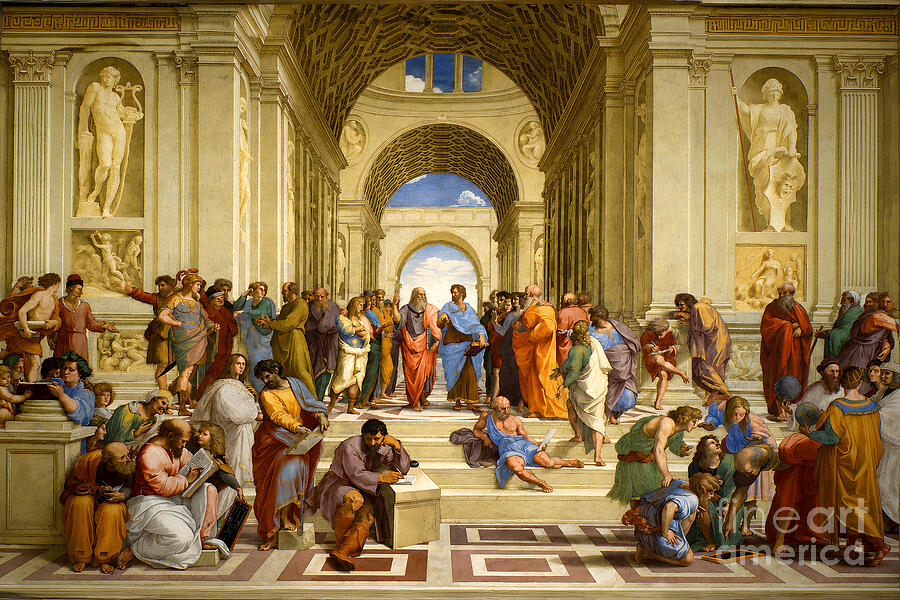
Who Stands Where
Identification is a sport with this fresco. Plato and Aristotle hold the axis. Pythagoras calculates to one side; Euclid (often linked to Bramante's features) demonstrates geometry with a compass. Diogenes sprawls on the steps. Heraclitus, chin in hand, looks like Michelangelo borrowed for the room. Raphael even includes a self-portrait among the observers. The point is not a perfect roll call. It is the idea that every kind of mind belongs in the same hall.
Perspective as Argument
Raphael learned from Leonardo how to make space persuade. Coffered vaults and receding pavement pull the eye to the vanishing point between the two central philosophers. The architecture is invented classical grandeur - more ideal Rome than archaeological fact - and that idealism is the Renaissance claim: antiquity can be rebuilt as harmony.
Body Language of Ideas
Hands do the philosophy. Upward and downward gestures stage the debate between Forms and observation. Groups of three keep the crowd readable; diagonals keep it alive. Nobody freezes into a catalog of statues. Thought looks like conversation, interruption, and demonstration.
Why the Hall Still Crowds
The School of Athens survives as a map of curiosity. You can tour it for famous faces, or you can stand back and feel the larger claim: that learning is a public space, lit and vaulted, where disagreement is the architecture.
Own This Painting
Hang Raphael's hall of philosophy - Plato, Aristotle, and the crowd that still argues in perfect perspective.
Watch the video essay on @SapiensVerbum on YouTube.


Comments
Post a Comment