
The Three Philosophers by Giorgione: Ages of Wisdom in One Cave (c. 1508)
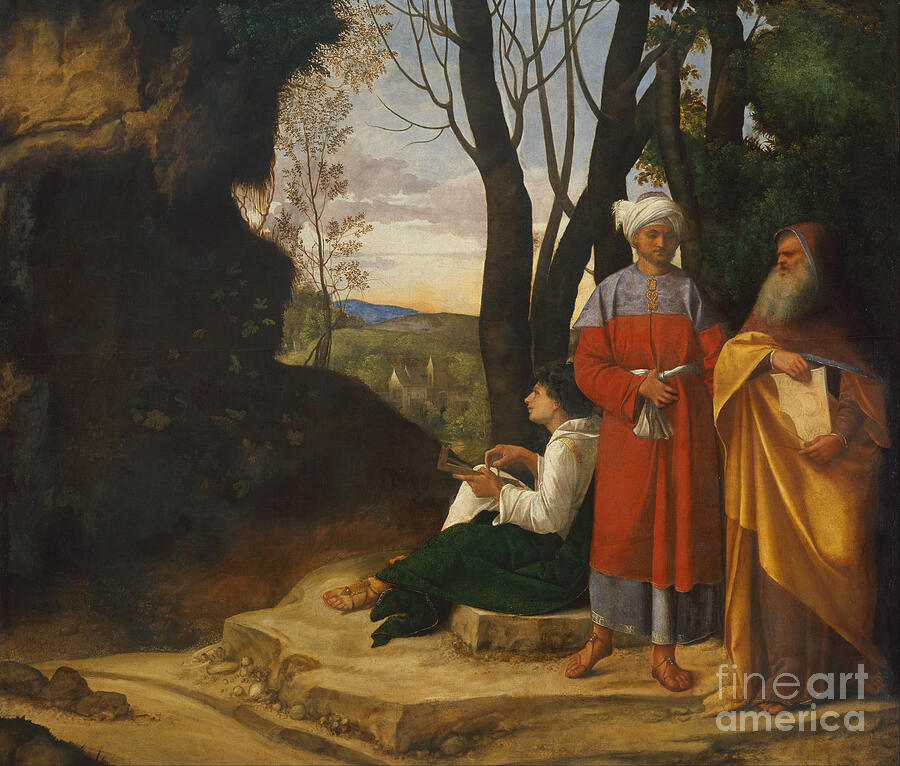
Three men stand at the edge of a wood, beside a dark rock face that opens into a cave. The youngest sits on the ground with a set square and a pair of compasses, staring into the shadows. Beside him stands a man of middle age in a turban and Eastern robes. The eldest, grey-bearded and wrapped in a heavy cloak, holds a sheet covered with astronomical diagrams. Behind them, a soft Venetian landscape glows in the evening light. Giorgione's The Three Philosophers, painted around 1508–09 and now in the Kunsthistorisches Museum in Vienna, is one of the great riddles of Renaissance art: five centuries later, no one is quite sure who these men are.
🖼️ Get this painting as a print →
Artist: Giorgione (c. 1477/78–1510)
Date: c. 1508–1509
Medium: Oil on canvas, 123.8 × 144.5 cm
Collection: Kunsthistorisches Museum, Vienna (GG 111)
First owner: Taddeo Contarini, Venice
What does the painting show?
The three figures are grouped on the right of the canvas, each in a different pose and costume. The young man is seated, his body turned towards the cave, holding the instruments of geometry and measurement. The man in the middle, in a turban and a long robe, looks out calmly. The old man, with a long grey beard and a heavy cloak, holds a sheet covered with what look like astronomical diagrams and calculations. On the left, the dark rock and the mouth of the cave take up almost a third of the picture. Between rock and trees opens a distant landscape with hills, farm buildings and a sky lit by the setting, or rising, sun.
There is no action and no story. What holds the picture together is the light: soft and warm, modelling faces and draperies with the gentle blending of tones that Venetian painters learned from Leonardo. The edges are blurred and the atmosphere is still, as if the three men were waiting for something to happen.
Who are the three men?
The oldest record of the painting is a note by the Venetian connoisseur Marcantonio Michiel, who saw it in 1525 in the house of the nobleman Taddeo Contarini. He described it simply as a canvas in oil of three philosophers in a landscape, two standing and one seated contemplating the rays of the sun, with a rock painted with wonderful skill, begun by Giorgione and finished by Sebastiano del Piombo. That description gave the picture its name, but not its meaning.
Since then, scholars have proposed many readings. For some, the men are the Three Magi, waiting on a hill for the star that will lead them to Bethlehem; X-ray examination has shown that the figures were changed during painting, and some see the remains of a more explicit Magi subject underneath. For others, they represent the three ages of man, or three stages of knowledge: the philosophy of ancient Greece, the learning of the Arab world, and the new science of the Renaissance. Names suggested for them include Aristotle and Averroes, or Pythagoras and his teachers. The Kunsthistorisches Museum itself notes that the youngest man's compasses and square could also point to the profession of painting. Giorgione left no explanation, and that silence is part of the picture's power.
Giorgione, the painter of mystery
Very little is known about Giorgione. He was born in Castelfranco Veneto around 1477, worked in Venice, and died there of the plague in 1510, in his early thirties. Only a handful of paintings are attributed to him with certainty, among them The Tempest in the Accademia in Venice, another enigma with no agreed subject. His influence was huge: the young Titian and Sebastiano del Piombo both worked with him, and his poetic, atmospheric style shaped Venetian painting for a century.
The same years saw Raphael painting The School of Athens in Rome (1509–11), a very different vision of philosophers, crowded, clear and named. For later painters' takes on the philosopher as hero, see David's The Death of Socrates and Langetti's Diogenes and Alexander.
Where can you see it?
After passing through several Venetian collections, the painting was acquired in the seventeenth century by Archduke Leopold Wilhelm of Austria, governor of the Spanish Netherlands; at some point it was cut down by about 17.5 centimetres on the left. It came to Vienna with the Habsburg collections and now hangs in the Italian Renaissance galleries of the Kunsthistorisches Museum.
See Giorgione’s The Three Philosophers framed on your wall: a museum-quality print, canvas or poster from the Sapiens Verbum print shop.
 Choose your size and frame →
Printed and shipped by Fine Art America · 30-day money-back guarantee
Watch the video essay (in Spanish) on @SapiensVerbum on YouTube.
Sources
Kunsthistorisches Museum, Vienna, collection record, The Three Philosophers (GG 111); Marcantonio Michiel, Notizia d’opere di disegno (1525 entry on Taddeo Contarini’s collection); Wikipedia, “The Three Philosophers”.
Comments
Post a Comment