The Death of Socrates by David: Hemlock, Loyalty, and Light (1787)
An old man sits upright on a bed and reaches for a cup as if it were a lecture note. Around him, younger men collapse into grief; one hides his face while offering the poison. Jacques-Louis David's The Death of Socrates (1787) turns Plato's farewell scene into Neoclassical theater: bare stone, hard light, and a body that refuses to wilt when the law demands it.
Artist: Jacques-Louis David (1748-1825)
Date: 1787
Medium: Oil on canvas
Collection: The Metropolitan Museum of Art, New York
Notable fact: Hemlock as civic virtue: Socrates points upward while reaching for the cup; Plato sits aged at the foot of the bed
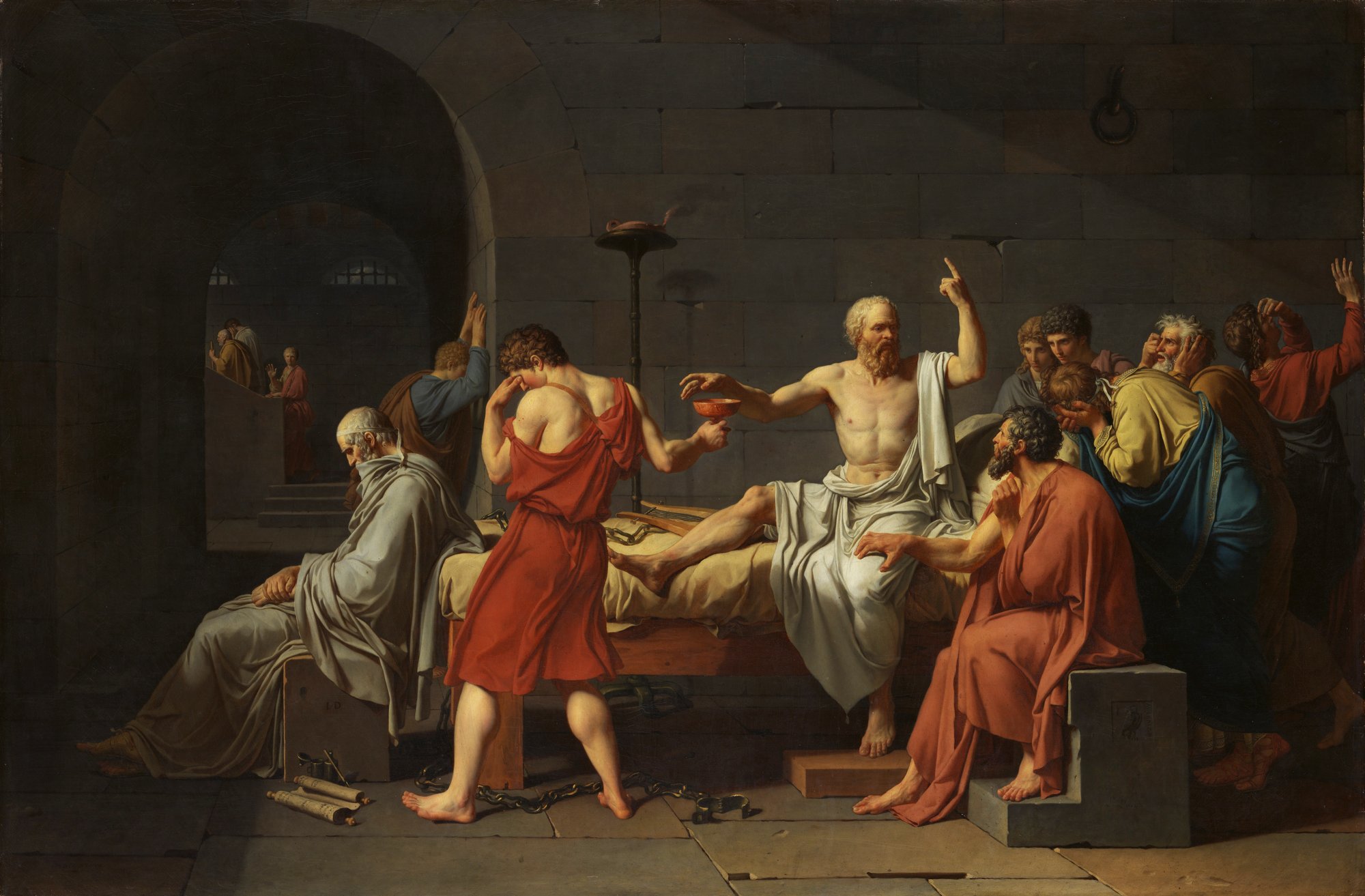
Calm in the Center
Socrates wears pale, almost bluish white; the man with the cup burns in red. David funnels color toward the moral center so that virtue reads as light and composure. Crito grips the philosopher's thigh; others gesture in panic. Socrates points to the realm of ideas and accepts the hemlock in the same motion - teaching until the last second.
Editing Plato
The dialogues describe a fuller room. David simplifies: fewer bodies, clearer geometry, a stairwell glimpse of Xanthippe leaving. Plato appears as an elderly mourner at the bed's end, not the young witness of history. Accuracy bows to clarity. The painting wants a civic parable more than a documentary.
Neoclassical Politics
In 1787 France, a canvas about lawful death and philosophical courage was never only ancient. Stoic posture, Roman staging, and the refusal of Rococo softness made Socrates a model for public virtue on the eve of revolution. Whether viewers took it as loyalty to principle or as warning, the body language is unmistakable: grief is allowed; cowardice is not.
Why the Cup Still Holds
The drama is the asymmetry of courage. One man treats death as a final argument. Everyone else treats it as a catastrophe. David paints the gap between those two responses - and leaves you standing in it.
Watch the video essay on @SapiensVerbum on YouTube.


Comments
Post a Comment