Oath of the Horatii by David: Duty or Family? (1784)
Three brothers snap their arms toward three swords held by their father; behind them, women collapse in grief. Stone arches divide the space like a stage. In Jacques-Louis David's Oath of the Horatii (1784), loyalty is geometric - and private love is pushed to the shadows.
Artist: Jacques-Louis David (1748-1825)
Date: 1784
Medium: Oil on canvas (330 x 425 cm)
Collection: Musee du Louvre, Paris
Notable fact: Commissioned under Louis XVI; became an emblem of civic duty on the eve of revolutionary upheaval
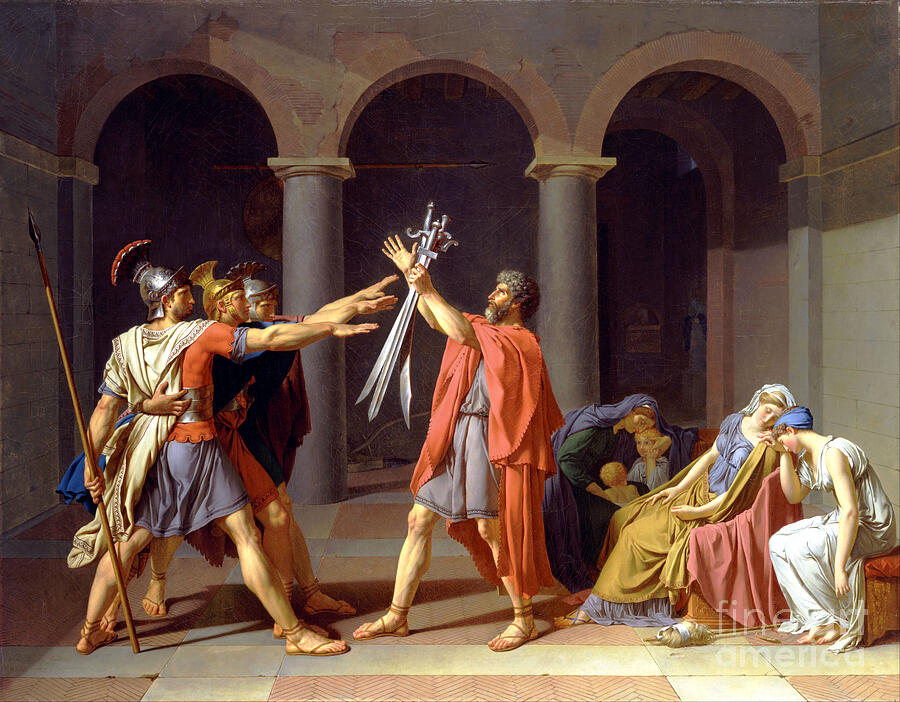
Rome Before the Duel
The Horatii, champions of Rome, must fight the Curiatii of Alba Longa to settle a quarrel between cities. Family ties cross both sides; the father still demands the oath. David freezes the instant of public resolve, not the later bloodshed he once considered painting (a surviving brother killing his own sister). He judged that aftermath too extreme and kept the moral clearer: state before sentiment.
Men of Lines, Women of Curves
The brothers' bodies form rigid parallels; the father's stance is immovable; the women in white and brown dissolve into soft diagonals of lament. Costume and architecture aim at antique clarity. David said the subject owed something to Corneille, the style to Poussin - theater of duty rendered with classical control.
An Icon Before the Revolution
Ordered in a climate that prized fidelity to state and crown, the painting later looked prophetic of revolutionary virtue even though it predates 1789. Its force is still the dilemma on the faces: obey the city, or hear the weeping. Look once for Neoclassical heroics. Look again for the cost sitting on the right side of the canvas.
Own This Painting
Hang David's Oath of the Horatii - the triple salute, the swords, and duty drawn like a blade.
Watch the video essay on @SapiensVerbum on YouTube.


Comments
Post a Comment