
Saturn Devouring His Son by Goya: The Black Painting That Still Horrifies (c. 1820)
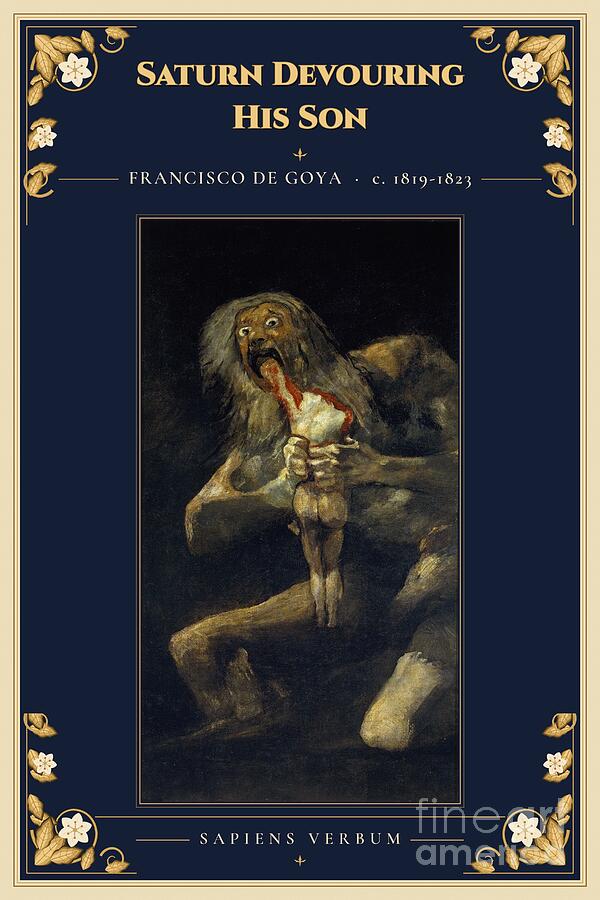
Out of the darkness looms a wild-eyed giant with grey, tangled hair. He grips a small headless body in both hands and tears into its arm with his mouth wide open, blood running from the wound. His eyes bulge as if he himself were horrified by what he is doing. Saturn Devouring His Son, painted by Francisco de Goya around 1820–1823 directly on a wall of his house outside Madrid, is the most famous of his Black Paintings and one of the most disturbing images in the history of art. It hangs today in the Museo del Prado. The picture below is our vintage poster version of the painting; the original is shown further down.
🖼️ Get the vintage poster →License this image →
Artist: Francisco de Goya (1746–1828)
Date: c. 1820–1823
Medium: Mural in oil, transferred to canvas, 143.5 × 81.4 cm
Collection: Museo del Prado, Madrid
Notable fact: Goya never gave it a title; it was painted for the dining room of his own house
What is the myth?
In Greek mythology the Titan Cronus, whom the Romans identified with Saturn, ruled the universe after overthrowing his own father. A prophecy warned him that one of his children would do the same to him, so each time his wife Rhea gave birth, he swallowed the baby. Rhea saved only the youngest, Zeus, by giving Saturn a stone wrapped in swaddling clothes instead. Zeus grew up in hiding, freed his brothers and sisters and defeated his father. Because Cronus was also linked with Chronos, time, the myth was often read as an image of time devouring everything it creates.
What does the painting show?
Earlier artists had painted the subject as a classical scene. Peter Paul Rubens, whose Saturn of 1636 Goya knew well from the Spanish royal collection, shows an old god biting into the chest of a baby. Goya strips away everything else. There is no setting, no attribute, no sky: only the black void and the monstrous figure who seems to crouch towards us out of it. The victim is not a baby but an adult body, already missing its head and one arm, and its sex cannot even be determined with certainty.
The most terrible detail is Saturn's face. His eyes are wide with something like panic or madness, as if he were trapped in a compulsion he cannot stop. Goya paints with rough, fast strokes in black, ochre and dirty white, and the red of the blood is the only bright colour. The figure is cramped into the narrow format, his knees bent, his body cut off by the edges, which makes him seem even larger and closer.
A painting for the dining room
Around 1820, Goya, old, deaf and disillusioned after years of war and political repression in Spain, covered the walls of two rooms of his country house outside Madrid, the Quinta del Sordo ("House of the Deaf Man"), with fourteen dark, private paintings. Saturn was on the ground floor, in the room that was used as a dining room. Goya never explained the series, gave them no titles and never intended them to be seen in public. Their meaning, political, personal or both, is still debated. Some see Saturn as an image of Spain devouring its own children, others as a meditation on old age, time and madness. The scholar Fred Licht even questioned whether the figure is Saturn at all, since the usual attributes are missing.
For the house and the whole cycle, read our essay on The Quinta del Sordo: Goya's Black Paintings, and for Goya's great public painting of horror, The Third of May, 1808. For another god's cruel punishment, compare Rubens's Prometheus Bound.
From the wall to the Prado
The murals stayed on the walls of the house for half a century after Goya left for France in 1824. By the 1870s they were deteriorating, and in 1874, under the direction of the restorer Salvador Martínez Cubells, they were transferred to canvas, a difficult process that caused losses and changes. Their owner, the banker Baron Émile d'Erlanger, later donated them to the Spanish state, and they entered the Prado, where they hang together in a room of their own. The house itself was demolished in the early twentieth century.
Goya’s Saturn Devouring His Son reimagined as a vintage art poster by Sapiens Verbum.
 Choose your size and frame →
See the vintage poster collection →License this image →
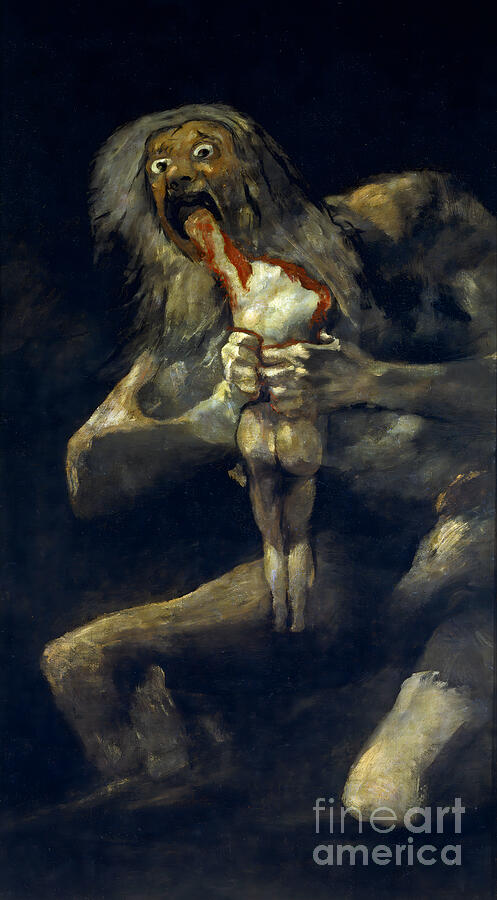
See Goya’s Saturn Devouring His Son framed on your wall: a museum-quality print, canvas or poster from the Sapiens Verbum print shop.
 Choose your size and frame →
Printed and shipped by Fine Art America · 30-day money-back guarantee
Saturn Devouring His Son is one of the thirty pictures in our book The 30 Most Famous Paintings in the History of Art: The Myths They Hide, the History They Reveal. Each chapter takes one painting, the myth around it and the history behind it. On Kindle, in paperback, in hardcover and as an audiobook.
Get the book →See all 30 paintings →
Watch the video essay on @SapiensVerbum on YouTube.
Sources
Wikipedia, "Saturn Devouring His Son" and "Black Paintings".
Comments
Post a Comment