
Pyramus and Thisbe by Pierre-Claude Gautherot: Ovid's Tragic Lovers (1799)
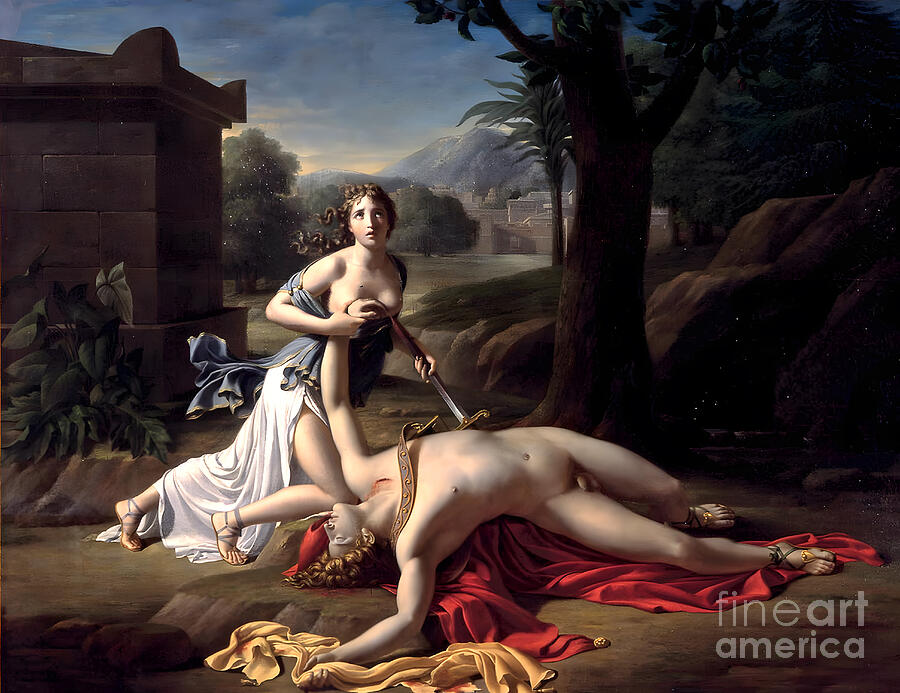
Evening is falling outside the walls of Babylon. Beside an ancient stone tomb, under a tall tree, a young man lies dead on a red cloak, his head thrown back and blood on his chest. A girl kneels over him, one hand holding his lifeless arm, the other already raising his sword towards her own breast. At his fingertips lies a torn yellow veil. This is Pyramus and Thisbe, painted in 1799 by Pierre-Claude Gautherot, a pupil of Jacques-Louis David, and it shows the last seconds of one of the oldest love tragedies in Western literature.
🖼️ Get this painting as a print →
Artist: Pierre-Claude Gautherot (1769–1825)
Date: 1799
Medium: Oil on canvas
Collection: Musée d'Art et d'Histoire, Melun, France
Source: Ovid, Metamorphoses, Book IV
What is the story?
Ovid tells the tale in Book IV of the Metamorphoses. Pyramus and Thisbe are the most beautiful young people in Babylon, and they live in neighbouring houses. They fall in love, but their parents forbid them to marry, so they talk in whispers through a crack in the wall between the two houses. At last they agree to escape at night and meet outside the city at the tomb of King Ninus, under a mulberry tree with white berries.
Thisbe arrives first. A lioness, her jaws bloody from a kill, comes to drink at a spring nearby, and Thisbe runs to hide in a cave, dropping her veil. The lioness tears the veil and stains it with blood. When Pyramus arrives and finds the bloody veil and the tracks of the beast, he believes Thisbe is dead and stabs himself with his sword. His blood splashes the mulberries, which turn dark red. Thisbe comes back, finds him dying, and kills herself with the same sword. The gods, moved by her prayer, keep the colour of the berries forever as a memorial.
What does the painting show?
Gautherot chooses the very last moment, when Thisbe has understood everything and is about to follow her lover. Pyramus lies stretched across the foreground, his body pale against the red of his cloak, his head hanging back towards us. Thisbe kneels behind him, her blue and white robes slipping from her shoulders, her eyes turned up to the sky. With one hand she lifts his arm, as if to hold on to him a moment longer, and with the other she grips his sword and turns its point towards herself.
Every element of Ovid's story is there for the viewer to read. On the left stands the square stone tomb of Ninus. Behind the lovers rises the tree where they were to meet. In the distance, beyond a palm tree, are the walls and buildings of Babylon under a mountain, lit by the last light of evening. And at Pyramus's hand lies the torn yellow veil, the false clue that caused the whole tragedy.
A pupil of David
Gautherot trained in the studio of Jacques-Louis David, the leader of French Neoclassicism, and the lesson shows everywhere: the frieze-like arrangement of the figures across the canvas, the sculptural anatomy, the clear outlines and the moral intensity of a single decisive instant. Compare David's own Death of Socrates, also built around a hero facing death, or the heroic poses of his Oath of the Horatii.
Gautherot was close to David during the Revolution and later painted scenes of Napoleon's campaigns; his best-known work, Napoleon Haranguing His Troops on the Bridge of the Lech at Augsburg, is at Versailles. He also ran a drawing academy in Paris. He died there in 1825.
From Babylon to Verona
The story of Pyramus and Thisbe has been painted since antiquity, from a wall painting at Pompeii to versions by Lucas Cranach, Hans Baldung Grien and Nicolas Poussin, and Gautherot follows a composition that goes back to those Roman models. Its plot also lies behind Shakespeare's Romeo and Juliet, with its forbidden love, its secret meeting and its fatal misunderstanding, and Shakespeare parodied the tale itself in the play the workmen perform in A Midsummer Night's Dream. For an earlier generation of French Neoclassicism, see François-André Vincent's Alcibiades Being Taught by Socrates.
See Gautherot’s Pyramus and Thisbe framed on your wall: a museum-quality print, canvas or poster from the Sapiens Verbum print shop.
 Choose your size and frame →
Printed and shipped by Fine Art America · 30-day money-back guarantee
Watch the video essay (in Spanish) on @SapiensVerbum on YouTube.
Sources
Ovid, Metamorphoses, Book IV; The Eclectic Light Company, "Paintings of Forbidden Love: Pyramus and Thisbe" (2023); Wikipedia, "Claude Gautherot".
Comments
Post a Comment