
Witches' Flight by Goya: Magic, Fear, and the Night Sky (1798)
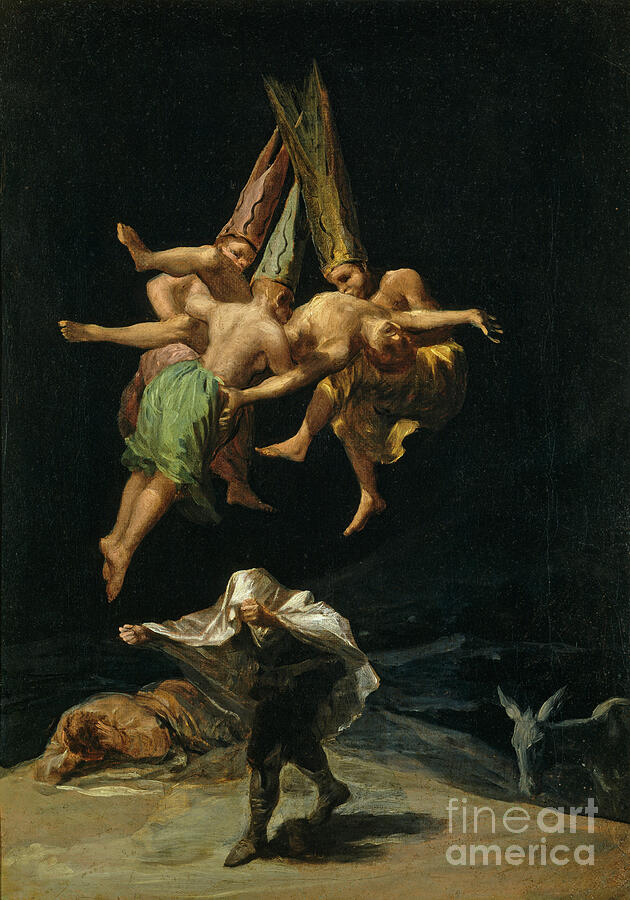
Three half-naked figures in tall pointed hats rise through the black night, holding a naked body aloft between them. Below, a man hides under a white sheet and makes a sign against the evil eye, while another lies face down, covering his ears. A donkey watches from the edge of the darkness. Francisco de Goya’s Witches’ Flight (Vuelo de brujas), painted around 1798 and now in the Museo del Prado, is a small canvas with an enormous charge: superstition, fear and satire share the same dark sky.
🖼️ Get this painting as a print →
Artist: Francisco de Goya (1746–1828)
Date: c. 1798
Medium: Oil on canvas, 43.5 × 30.5 cm
Collection: Museo Nacional del Prado, Madrid (P007748)
Commission: one of six witchcraft scenes sold to the Duke and Duchess of Osuna in 1798
Six witchcraft scenes for the Osunas
In 1798 Goya sold six small paintings on witchcraft subjects to the Duke and Duchess of Osuna, among his most important patrons, for their country house, the Alameda de Osuna, on the outskirts of Madrid. The Prado records the series as “Asuntos de brujas”, witches’ subjects. The Osunas were enlightened aristocrats and great patrons of the arts, and for them these pictures were not devotional warnings but sophisticated, unsettling entertainment: images of the superstition that educated Spaniards of the Enlightenment were trying to leave behind.
Witches’ Flight remained with the Osuna family until 1896, then passed through several private collections. The Prado acquired it in 1999 with funds from the Villaescusa bequest.
What does the painting show?
According to the Prado, the three airborne figures are bare-chested men wearing corozas, the tall conical caps that the Spanish Inquisition placed on the heads of the condemned. They lift a naked figure who seems to writhe in their arms. The detail turns the scene upside down: the witches wear the hats of the Inquisition’s victims, so that persecutors and persecuted, belief and punishment, become hard to tell apart.
On the ground, the two men respond to the apparition in different ways. One has thrown himself face down and covers his ears so as not to hear. The other walks on, hiding his head under a white cloth, and makes with his hand the gesture that was supposed to protect against the evil eye. The donkey on the right, a traditional symbol of ignorance, completes the picture: this is what happens when people refuse to look and think.
Enlightenment light, midnight subject
Late eighteenth-century Spain was full of arguments about reason and superstition. Goya, a friend of reforming writers and officials, shared their contempt for credulity and for the Inquisition. Yet his witches are not simply ridiculous. The flying group, lit by an unexplained glow against total darkness, is composed with nightmare conviction. You are not sure whether to laugh or duck. That split vision, folklore as critique and critique that still gives folklore its power, would run through the rest of his work.
The following year, 1799, Goya published the Caprichos, eighty etchings attacking the vices and superstitions of Spanish society, including many scenes of witches. Two decades later, in the Black Paintings he painted on the walls of his own house, he returned to the Sabbath in its darkest form. See our guide to Goya’s Black Paintings and his terrifying Saturn Devouring His Son.
Why the night sky still feels crowded
Modern viewers bring psychology; Goya brings teeth and gravity-defying bodies. Compare the sensual, theatrical witches that Luis Ricardo Falero painted eighty years later in Witches Going to Their Sabbath. Falero invites us to enjoy the flight; Goya asks why we are so afraid of it. Look once for the airborne ritual. Look again for the men on the ground who would rather not know.
See Goya’s Witches’ Flight framed on your wall: a museum-quality print, canvas or poster from the Sapiens Verbum print shop.
 Choose your size and frame →
Printed and shipped by Fine Art America · 30-day money-back guarantee
Where can you see it?
Witches’ Flight hangs in the Museo del Prado in Madrid, among the museum’s unrivalled collection of Goya. In the same building you can see his Third of May 1808 and the Black Paintings, as well as Velázquez’s Las Meninas. Browse more paintings by museum in Explore Art.
Watch the video essay (in Spanish) on @SapiensVerbum on YouTube.
Sources
Museo Nacional del Prado, “Witches’ Flight” (P007748), collection record and provenance; Wikipedia, “Witches’ Flight”.
Comments
Post a Comment