Witches Going to the Sabbath by Falero: The Painting No Museum Owns (1878)
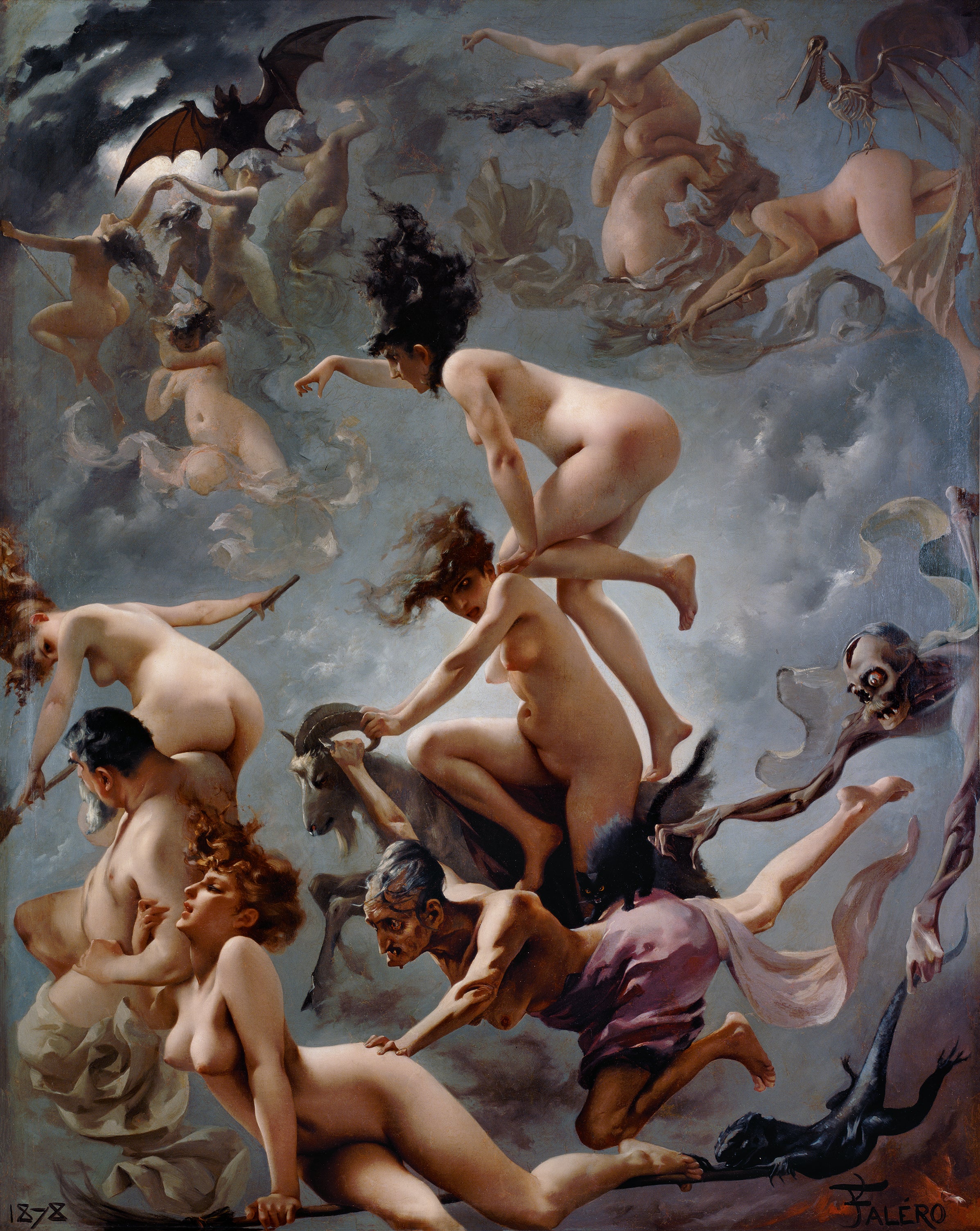
Naked witches spiral through moonlit air. A goat, a bat, a black cat, a skeletal pelican, a salamander of fire - Luis Ricardo Falero's Witches Going to Their Sabbath (1878) is less a single scene than a hypnotic circuit. Your eye never parks. Victorian Britain stared anyway.
Artist: Luis Ricardo Falero (1851-1896)
Date: 1878
Medium: Oil on canvas
Notable fact: Granada-born painter of nudes, astronomy, and occult fantasy who worked mainly in Britain; died in London at 45
A Spiral, Not a Stage
Falero builds a triangle of foreground figures that loosens into a circle and then a spiral, looping you back to the start. The Sabbath becomes motion: flight toward ritual rather than a static coven portrait. Night is full of moonlight, so flesh stays readable while the sky keeps swirling.
Occult Catalogue
Beside the flying women sit the props of popular witchcraft: goat and warlock, aged witch gripping a horn, young redhead clinging on. On the right, death-signs and alchemical fire - pelican skeleton, living corpse, salamander. Falero's private fascinations - magic, stars, mysticism - spill into a public entertainment that moral England could condemn and still buy tickets to see.
The Painter Museums Forgot
Successful in Britain, France, and the United States, Falero remains relatively obscure in Spain. This canvas is famous in reproduction and scarce as a fixed museum star - which fits an artist who sold fantasy more than civic monuments. Absence from a permanent wall does not mean absence from desire.
Why the Flight Still Hooks
The picture flatters looking itself: sensual, endless, slightly guilty. It is occult theatre for a century that preached restraint. Follow the spiral once for witches. Follow it again for the Victorian appetite that needed them.
Watch the video essay on @SapiensVerbum on YouTube.


Comments
Post a Comment