


American Gothic by Grant Wood: Pitchfork, Window, and American Myth (1930)
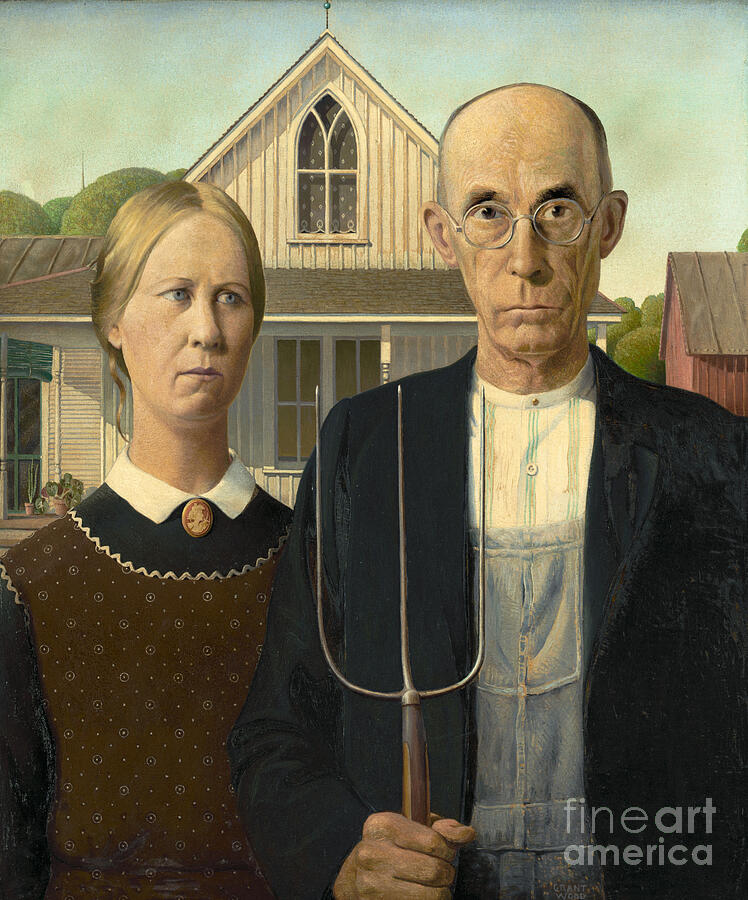
A pitchfork stands like a third person between a man and a woman. He stares straight at us; she looks away, past his shoulder. Behind them, a white farmhouse lifts a pointed Gothic window into a pale sky, borrowed cathedral lace on a plain Iowa house. Grant Wood's American Gothic, painted in 1930 and now in the Art Institute of Chicago, is one of the most recognised and most parodied images in American art. It looks simple, until you notice how little it explains.
Artist: Grant Wood (1891–1942)
Date: 1930
Medium: Oil on Beaver Board, 78 × 65.3 cm
Collection: Art Institute of Chicago (1930.934), Friends of American Art Collection, Gallery 263
Models: the artist’s sister, Nan Wood Graham, and his dentist, Byron McKeeby
A house that suggested a painting
In 1930 Grant Wood, a painter from Cedar Rapids, Iowa, was driven through the small town of Eldon, in the south of the state. There he saw a modest white farmhouse with an oversized pointed window in its upper gable, built in the 1880s in the style known as Carpenter Gothic: Gothic church architecture translated into cheap timber and mail-order trim. Wood made a sketch and, as he later explained, imagined “the kind of people I fancied should live in that house.”
He did not paint them on the spot. Back in Cedar Rapids, he posed two people he knew: his sister Nan, then thirty, and his dentist, Dr Byron McKeeby, who was in his sixties. They never stood together in front of the house; Wood painted them separately and combined the figures with his sketch of the building.
Father and daughter, or husband and wife?
Most viewers assume they are a farmer and his wife. Wood said they were a farmer and his daughter, and the Art Institute describes them that way: a father and daughter posed stiffly and dressed, in the artist’s words, like “tintypes from my old family album.” She wears a colonial-print apron and a cameo brooch; a single curl has escaped from her tight hair. He wears overalls under a dark Sunday jacket and holds the pitchfork upright like a sceptre.
Look at the shapes. The three prongs of the pitchfork are echoed in the stitching of his overalls, in the window behind and in the long, narrow faces. Verticals dominate the whole picture: the man’s face, the fork, the window, the steeple of a church in the distance. The precise, smooth technique owes a great deal to the Flemish and German painters of the Northern Renaissance, whom Wood had studied on a trip to Munich in 1928, with their sharp detail and calm, frontal figures. Compare the merchant couple of Van Eyck’s Arnolfini Portrait, another stiff double portrait that has kept viewers guessing for centuries.
Satire or tribute?
When it was shown at the Art Institute of Chicago’s annual exhibition of American painting in the autumn of 1930, the painting became an instant sensation. It won a bronze medal and a prize of 300 dollars, and the Friends of American Art bought it for the museum that same year. Newspapers across the country reproduced it, and Iowans were divided. Some felt mocked: the faces looked grim, narrow and suspicious, the picture of small-town Puritanism. Many critics read it as a satire of Midwesterners out of step with the modern world.
Wood insisted otherwise. According to the Art Institute, he intended a positive image of rural American values, a reassurance offered just as the Great Depression began. In the following years, as farms failed and the country turned inward, the couple came to stand for endurance and self-reliance. Wood became the best-known figure of Regionalism, the movement that rejected European modernism in favour of the people and landscapes of the American heartland. He died in 1942, the day before his fifty-first birthday.
The most parodied painting in America
Few paintings have been borrowed as often. The stiff pose and the pitchfork have been copied in advertisements, cartoons, political caricatures, film posters and countless photographs of couples in front of their own houses. The parodies began early: in 1942 the photographer Gordon Parks made American Gothic, Washington, D.C., a portrait of a cleaning woman posed with a mop and a broom in front of an American flag, turning Wood’s image into a comment on race and labour. The jokes have never stopped, and they have made the original almost too familiar to see.
Seen in the gallery, though, it is smaller and stranger than its reputation: barely 78 centimetres high, meticulously painted, at once affectionate and severe. Like Leonardo’s Mona Lisa or Vermeer’s Girl with a Pearl Earring, it survives its own fame because the faces refuse to tell us what they think.
Where can you see it?
American Gothic hangs in Gallery 263 of the Art Institute of Chicago, among the museum’s American paintings. The house that inspired it, known as the Dibble House, still stands in Eldon, Iowa, where the American Gothic House Center welcomes visitors, and offers costumes for the inevitable photograph. For more paintings to see in the United States, browse Explore Art by museum, or read about Van Gogh’s The Starry Night at MoMA in New York. If you are looking for a painting to hang at home, see the twelve best-selling art prints chosen by our readers.
Watch the video essay on @SapiensVerbum on YouTube.
American Gothic is one of the thirty pictures in our book The 30 Most Famous Paintings in the History of Art: The Myths They Hide, the History They Reveal. Each chapter takes one painting, the myth around it and the history behind it. On Kindle, in paperback, in hardcover and as an audiobook.
Get the book →See all 30 paintings →
Sources
Art Institute of Chicago, collection record, American Gothic (1930.934); Wikipedia, “American Gothic”.
Comments
Post a Comment