The Arnolfini Portrait by Jan van Eyck: Who Is in the Mirror? (1434)
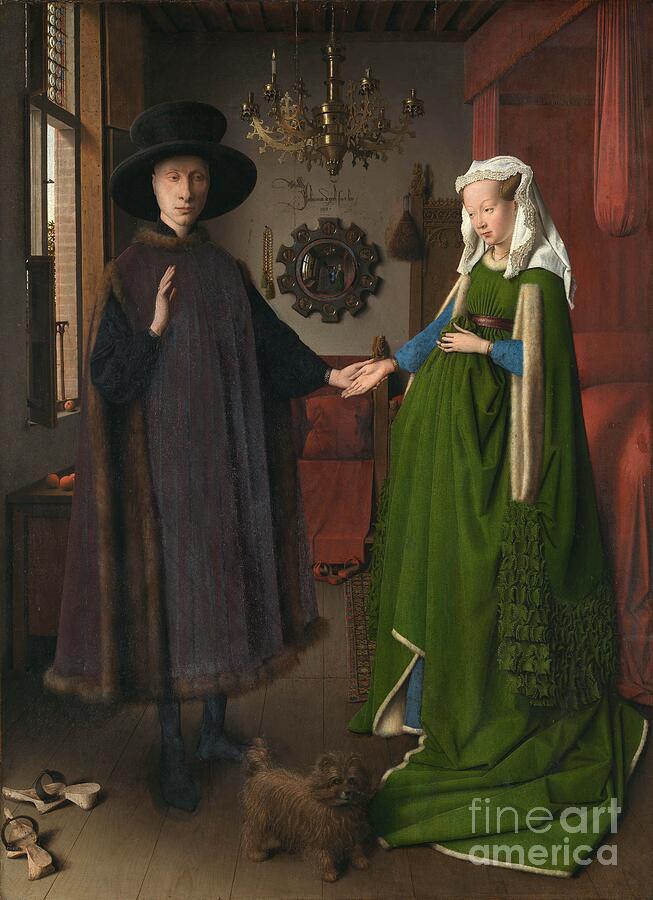
A man and a woman stand side by side in a small room in Bruges. He raises his right hand; she rests her left hand on the folds of a vast green gown. Behind them, a round mirror on the back wall reflects the whole scene from behind, and two more figures standing in the doorway. Above the mirror, in elegant letters, the painter has written that he was there. The Arnolfini Portrait, painted by Jan van Eyck in 1434 and now in the National Gallery in London, is one of the most famous and most argued-about pictures in Western art.
Artist: Jan van Eyck (active 1422, died 1441)
Date: 1434 (signed and dated)
Medium: Oil on wood (probably oak), 82.2 × 60 cm
Collection: The National Gallery, London (NG186), bought in 1842
Notable fact: The inscription above the mirror reads "Johannes de eyck fuit hic 1434": "Jan van Eyck was here, 1434"
Who are the couple in The Arnolfini Portrait?
The National Gallery identifies the sitters as probably Giovanni di Nicolao di Arnolfini, an Italian merchant working in Bruges, and his wife. The Arnolfini were a merchant family from Lucca, and several of its members lived and traded in Bruges, then one of the great commercial cities of northern Europe. The museum's full title keeps a question mark after the man's first name, "Portrait of Giovanni(?) Arnolfini and his Wife", because the identification rests on old inventories rather than on a label painted by van Eyck.
What is certain is that they wanted to be seen as prosperous. The man wears a dark tunic trimmed with fur and a broad straw hat. The woman's green gown is lined with fur and gathered in heavy folds. Many viewers assume she is pregnant, but most art historians believe she is not: female saints of the period are painted with exactly the same silhouette, which was simply the fashionable way to wear a dress with so much expensive cloth.
What is reflected in the mirror?
The convex mirror on the back wall is the most famous detail of the painting. It shows the couple from behind and, beyond them, two men entering the room; one of them also raises his arm. Around the mirror, a wooden frame holds tiny scenes of the Passion of Christ painted behind glass. According to the National Gallery, the inscription placed directly above it, "Jan van Eyck was here", invites an obvious question: is the man in the mirror the painter himself, arriving with a companion?
No one can prove it, but the idea fits the way the picture works. The mirror widens the room to include the space where we, the viewers, are standing, and puts witnesses into it. The same device fascinated later painters. Velázquez almost certainly knew this panel, which hung for many years in the royal palace in Madrid, and a mirror plays a central part in his Las Meninas, painted in the same palace. Velázquez used a mirror again in The Rokeby Venus, now in the same London museum as the Arnolfini couple.
Is the room real?
At first sight the room looks completely believable, as if van Eyck had simply removed one wall. The National Gallery points out that careful looking reveals small impossibilities: there is not enough space for the brass chandelier, and there is no sign of a fireplace, not even in the mirror. The mirror itself is also larger than any convex mirror that could be made at the time. Every object seems to have been chosen to show wealth without looking aristocratic: a few oranges by the window, which were expensive imports; a small Oriental carpet by the bed; the man's pattens, the over-shoes worn outdoors, left on the floor; a small dog at the couple's feet, an early form of the breed now called the Affenpinscher.
This is also why the painting matters so much in the history of art. Van Eyck and the other Early Netherlandish painters perfected oil paint laid down in thin, translucent layers, which allowed them to render fur, brass, glass and light with a precision nobody had achieved before. For the historian Ernst Gombrich, the result made the artist into the perfect eyewitness.
Is it a wedding picture?
For much of the twentieth century the painting was known as "The Arnolfini Wedding". The art historian Erwin Panofsky argued that it recorded a marriage ceremony, with the painter's inscription acting as a kind of signature of a witness. That reading is now widely questioned. Other scholars have suggested that the picture shows an already married couple and a legal gesture between them, or even that it is partly a memorial portrait: over the woman's side of the room, one candle in the chandelier has burned out. The painting does not settle the question, and that uncertainty is part of its fascination.
How did the painting reach London?
The panel has one of the best-documented histories of any fifteenth-century picture. By 1516 it belonged to Margaret of Austria, the Habsburg regent of the Netherlands, who had received it from the Spanish courtier Don Diego de Guevara; her inventory describes a picture of "Hernoul le Fin" with his wife in a chamber. It passed to her niece Mary of Hungary and then, in 1558, to King Philip II of Spain, and it was seen in the Alcázar palace in Madrid in 1599. By 1816 it was in London in the hands of a Scottish officer, Colonel James Hay, possibly after being taken from the baggage of Joseph Bonaparte after the Battle of Vitoria in 1813. The National Gallery bought it in 1842.
For another Netherlandish masterpiece in which ordinary life becomes the subject, read our essay on Bruegel's The Harvesters.
Get Jan van Eyck’s The Arnolfini Portrait as a museum-quality print, canvas, or poster from the Sapiens Verbum print shop.
Shop This Print →
Watch the video essay on @SapiensVerbum on YouTube.
Comments
Post a Comment