The Harvesters by Pieter Bruegel the Elder: The Lunch Break That Changed Landscape Painting (1565)
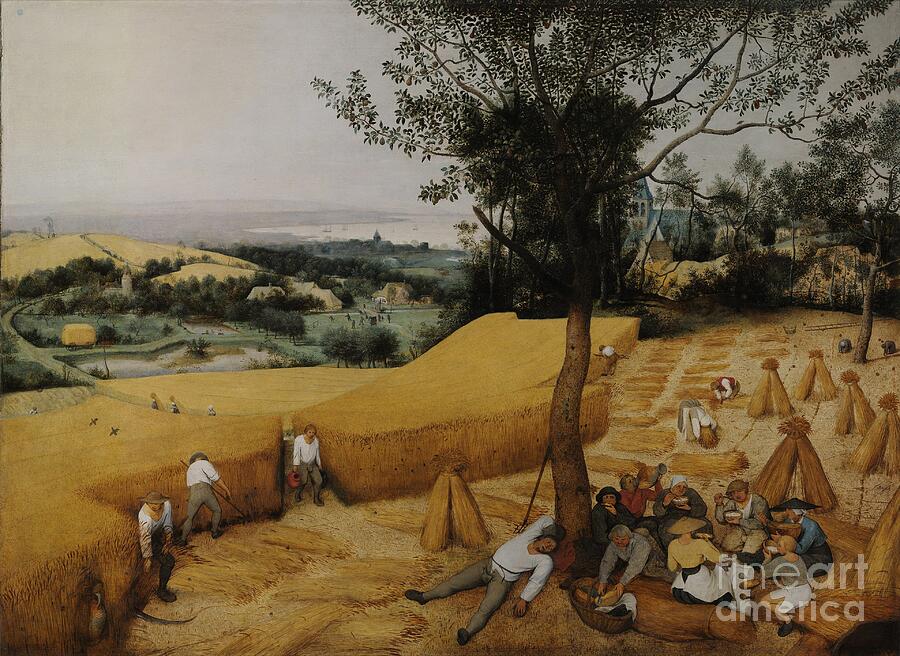
Noon in late summer. Half the field is already cut, the sheaves stand in rows, and under a pear tree a handful of workers have stopped to eat bread, porridge and pears while one man sleeps flat on his back with his legs apart. Pieter Bruegel the Elder's The Harvesters (1565) is a painting about work that spends most of its attention on the break from it, and it looks out over a whole countryside to make the point.
Artist: Pieter Bruegel the Elder (c. 1525/30–1569)
Date: 1565
Medium: Oil on wood
Collection: The Metropolitan Museum of Art, New York (Rogers Fund, 1919)
Notable fact: One of six panels on the times of the year painted for the Antwerp merchant Niclaes Jongelinck; five survive, and this is the only one outside Europe
A Set of Six for an Antwerp Collector
In 1565 Bruegel delivered a cycle of large panels to Niclaes Jongelinck, a wealthy Antwerp merchant and collector who already owned a number of his works. Each panel showed a stage of the rural year. Five remain: The Gloomy Day, Hunters in the Snow and The Return of the Herd in Vienna, Haymaking in Prague, and The Harvesters in New York. Seen together they were an unusual commission, a room of landscapes in which the season, not a saint or a myth, is the subject. This panel stands for the height of summer, when grain was cut and bound before the weather could turn.
How the Picture Is Built
The composition runs on a strong diagonal. A wall of standing wheat fills the left foreground, a narrow path cuts through it where figures carry jugs to the field, and the eye slides past the reapers and the resting group down into a valley that opens onto a church, farmsteads, a pond and, far off, a bay with ships. Bruegel keeps the colour to a narrow range of gold, green and a hazy blue-grey for distance, so the whole field seems to shimmer in the heat. The pear tree anchors the right side and gives the eaters their scrap of shade.
The Sleeper and the Eaters
The group under the tree is where Bruegel's reputation as a painter of peasants comes from, and it is more sympathetic than the old label "Peasant Bruegel" suggests. The figures are heavy and plain, but they are not mocked. One slices bread, one drinks straight from a jug, one spoons from a bowl, and the sprawled sleeper is simply exhausted. They are shown doing what anyone does at midday after a morning of scything, and the painting gives them the largest place in the foreground.
From a Merchant's House to Fifth Avenue
The set did not stay together. Within a few decades the panels had passed from Jongelinck's hands into the Habsburg collections, and over the following centuries one was lost and The Harvesters drifted away from the others. It resurfaced in private hands, and The Metropolitan Museum of Art bought it in 1919. It is now one of the best-known Netherlandish paintings in America and the only picture from the cycle that most visitors to New York can see.
Why It Still Feels Modern
There is no story here, no moral and no named hero. What Bruegel offers instead is a view of ordinary time: a working day at its hottest hour, set inside a landscape large enough to hold a whole community. That is why The Harvesters is so often cited as a turning point in the history of landscape painting. The land is not a backdrop for something else. It is the subject, and the people in it are part of how it works.
Get Pieter Bruegel the Elder's The Harvesters as a museum-quality print, canvas, or poster from the Sapiens Verbum print shop.
Shop This Print →
Comments
Post a Comment