
The Virgin of Guadalupe, Mexican School (c. 1700): The Image, the Roses and the Four Apparitions
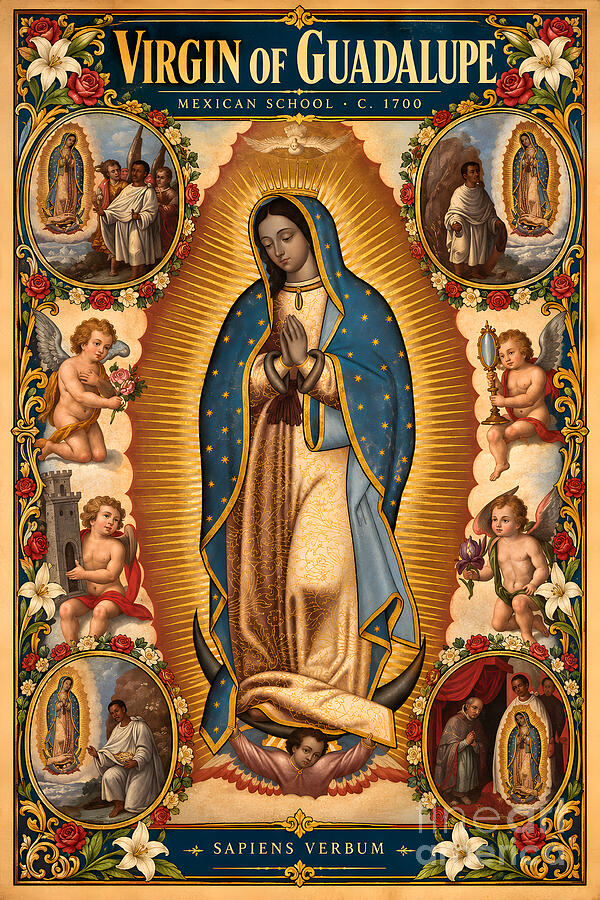
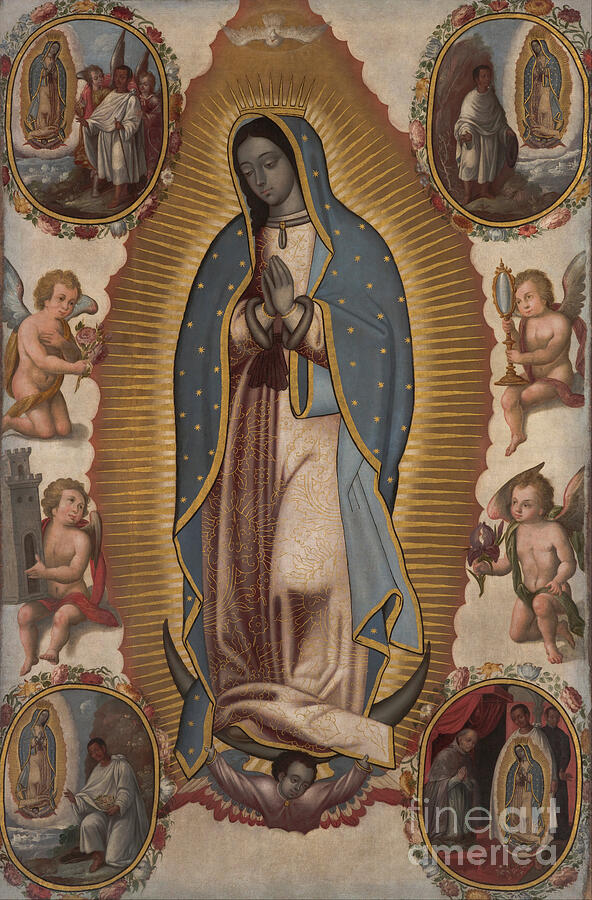
She stands on a crescent moon held up by an angel, her hands joined in prayer, her head bowed, wrapped in a blue-green mantle scattered with gold stars. Behind her, a full body of golden rays bursts out like a flame. In the four corners, small scenes tell how this image appeared. This is the Virgin of Guadalupe, painted in New Spain around 1700 by an anonymous artist of the Mexican school: a copy of one of the most venerated images in the Americas, made to carry a miracle far from Mexico City. Here we look at it in a new frame as well: a vintage poster with a border of roses and white lilies.
Artist: Anonymous, Mexican school (New Spain)
Title: Virgin of Guadalupe, with the four apparitions
Date: about 1700
Subject: The image of Our Lady of Guadalupe venerated at Tepeyac, Mexico City, with scenes of her apparitions to Juan Diego in December 1531
Notable fact: Nearly a thousand Mexican copies of the image have been counted in Spain alone, most sent there before 1821.
The story in the corners
According to tradition, the Virgin appeared four times in December 1531 to Juan Diego Cuauhtlatoatzin, a Nahua man then in his fifties: three times on the hill of Tepeyac, just north of Mexico City, beginning on 9 December, and once before the first bishop of Mexico, Juan de Zumárraga. The bishop doubted him and asked for a sign. The Virgin told Juan Diego to gather roses on the hill and carry them in his cloak, his tilma. When he opened it before the bishop, the flowers fell out and her image was found printed on the cloth. In the same story, Juan Diego’s uncle, Juan Bernardino, was cured. The account, known as the Nican Mopohua, was published in Nahuatl in 1649. The cloak itself is kept today in the Basilica of Our Lady of Guadalupe at the foot of Tepeyac.
Look at the four medallions in our painting and you can follow the story. At the top, Juan Diego meets the Virgin on the hill, with angels around them; then he speaks to her again by the rocks. At the bottom left he kneels on the hillside with the flowers; and at the bottom right the scene moves indoors, under a red curtain, where the bishop kneels before the image that has appeared on the cloak.
A model that lasted three centuries
This way of painting the Virgin of Guadalupe, with the miraculous image in the centre and the apparitions in the corners, was fixed in the seventeenth century. The Museo del Prado, which devoted an exhibition to the Guadalupe in Spain in 2025, credits the painters José Juárez and Juan Correa and the engraver Matías de Arteaga with an iconographic model that lasted for about three hundred years. Some versions add a fifth scene at the bottom, the healing of Juan Bernardino. Around 1700, the date of our painting, Juan Correa and members of his family were among the busiest painters of these images.
Copies were meant to be faithful: exact or scaled replicas of the original, sometimes with an inscription saying they had been “touched” to the cloth in the Basilica. The original was regarded as a painting not made by human hands, and every copy carried a little of that power. The first Guadalupe images reached Spain in 1654, and the Prado counts nearly a thousand Mexican copies there, commissioned by landowners, officials, clergy and families involved in trade and mining.
What you see
Everything in the central figure follows the image on the cloak: the bowed head and joined hands, the rose-coloured robe patterned with gold, the mantle with its stars, the golden rays, the crescent moon under her feet, and the small angel with outstretched wings who holds it up. At the very top, the dove of the Holy Spirit flies above her crown. Around her, our painter added four winged children, each holding a symbol: roses, an oval mirror, a tower and an iris. Such emblems, drawn from the praises of the Virgin, were often placed around images of Mary in this period. Garlands of flowers frame the whole picture, a reminder of the roses of Tepeyac.
Why it works as a vintage poster
A Guadalupe painting is already built like a poster: one central figure, a strong outline against a field of gold, and a decorative border of small scenes and flowers. The Sapiens Verbum version keeps the whole composition and adds a frame of red roses and white lilies under a deep blue title panel. It makes a natural gift for 12 December, the feast of Our Lady of Guadalupe, and for any Hispanic home, parish or chapel. For more sacred images reimagined this way, see Vermeer’s Christ in the House of Martha and Mary, Van Gogh’s Pietà and El Greco’s Christ Carrying the Cross.
Hang the Virgin of Guadalupe — the starry mantle, the golden rays and the four apparitions — as a vintage religious art poster from the Sapiens Verbum print shop.
 Choose your size and frame →
See the vintage poster collection →
Printed and shipped by Fine Art America · 30-day money-back guarantee
Hang this Virgin of Guadalupe as it was painted in New Spain, as a print, canvas or framed print from the Sapiens Verbum print shop.
 Choose your size and frame →
Printed and shipped by Fine Art America · 30-day money-back guarantee
💬 Over to you: Does your family keep an image of the Virgin of Guadalupe at home? And where in the world are you reading from? Tell us in the comments.
Sources
Museo del Prado — So far, so close: Guadalupe of Mexico in Spain (exhibition, 2025)
Wikipedia — Juan Diego
Northern Arizona University — Nicolás Enríquez, The Virgin of Guadalupe with the Four Apparitions (1773, The Metropolitan Museum of Art)
Comments
Post a Comment