
The Scream by Edvard Munch: Who Is Really Screaming? (1893)
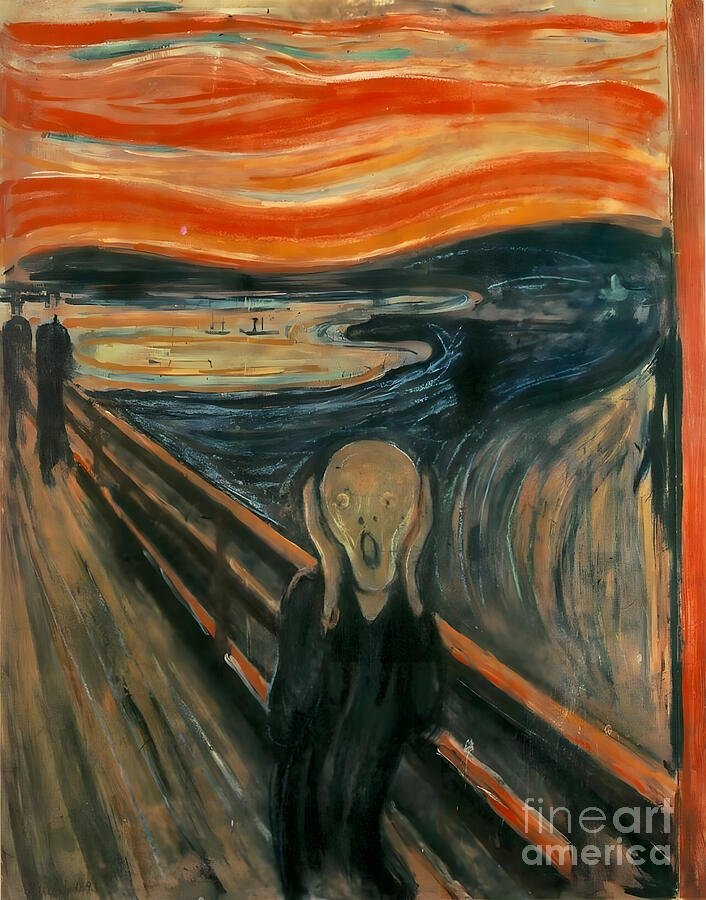
A figure with a skull-like head stands on a bridge, hands pressed to its face, mouth open in a perfect O. Behind it, the sky burns in waves of red and orange, the fjord curls away in dark blue, and two figures walk on as if nothing were happening. Edvard Munch painted The Scream in 1893, and it has become the most famous image of anxiety ever made. But almost everything people think they know about it is slightly wrong, starting with the scream itself.
🖼️ Get this painting as a print →
Artist: Edvard Munch (1863–1944), Norwegian painter
Title: The Scream (Norwegian Skrik; first shown in Germany as Der Schrei der Natur, “The Scream of Nature”)
Date: 1893
Medium: Oil, tempera, pastel and crayon on cardboard, 91 × 73.5 cm
Collection: National Museum, Oslo
Notable fact: Munch made several versions: two in 1893, a pastel and a lithograph in 1895, and a tempera painting around 1910.
What you actually see
The picture is built on a few strong lines. A road with a wooden railing cuts diagonally from the right edge towards the left, and the figure stands at the bottom of it, so close to us that its body is cut off by the lower edge of the picture. Its head is bald and almost fleshless, with hollow eyes and nostrils, and its whole body seems to bend in the same long curves as the landscape behind it. Further back along the railing, two dark figures in hats walk calmly away. On the fjord below, two small boats float on the water. Above everything, the sky is painted in thick bands of orange and blood red that swirl like the water beneath them.
Nothing in the picture is quite solid. The railing is straight and hard, but the figure, the fjord and the sky all ripple together, as if the same shock were passing through all of them. That is exactly what Munch was trying to paint.
Myth one: the figure is screaming
Look again at the hands. They are not around a mouth that shouts, but pressed against the sides of the head, over the ears. Munch described the moment in a diary entry headed “Nice 22 January 1892”: he was walking along a road with two friends at sunset when the sky suddenly turned blood red; he stopped, leaned on the railing, exhausted, while his friends walked on, and he sensed a scream passing through nature. In a later version of the text he wrote of “an infinite scream passing through nature”.
So the scream does not come from the figure. It comes from the world around it, and the figure is trying to shut it out. That is why the painting’s first German title was The Scream of Nature. The two friends in the background, who notice nothing, make the experience even lonelier.
A real place above Oslo
The setting is not invented. Scholars identify the road as a path on the Ekeberg hill, which looks down over the city then called Kristiania, today Oslo, and over the Oslofjord with the island of Hovedøya. The view is still recognisable, and visitors climb the hill to stand where Munch stood. The first version of the painting was shown in 1893 as part of a series Munch called The Frieze of Life, a cycle of pictures about love, anxiety and death.
Myth two: the red sky was pure imagination
The blood-red sky has its own debate. One theory links it to the eruption of Krakatoa in 1883, whose ash turned sunsets red across the world for months. Another points to nacreous clouds, the shimmering “mother-of-pearl” clouds that can appear at Norway’s latitude. Many art historians answer that Munch was not trying to record the weather at all. Whatever he saw that evening, he painted the sky as he felt it, and the colour belongs to the emotion rather than to meteorology.
Not one Scream, but several
Munch returned to the image again and again. There is a pastel of 1893, often considered the earliest version, and the painting of the same year in the National Museum, which was the first one shown in public. In 1895 he made another pastel and a lithograph printed in black and white; only a few dozen impressions were pulled before the printer reused the stone. Around 1910 he painted a further version in tempera, now in the Munch Museum.
The 1895 pastel is the only version in private hands. In May 2012 it sold at Sotheby’s in New York for about 119.9 million dollars, at the time the highest price ever paid for a work of art at auction.
“Could only have been painted by a madman!”
In the upper left corner of the National Museum version, a tiny pencil inscription reads, in Norwegian, “Could only have been painted by a madman!” It was first noticed in 1904 and for decades was thought to be the work of a vandal. In 2021 the museum announced that infrared photography and a comparison with Munch’s letters and diaries showed the handwriting was his own. The curators believe he wrote it around 1895, after the painting was shown in Kristiania and a young medical student questioned his sanity in public. It was not graffiti, then, but the painter answering his critics with bitter irony.
Stolen twice
Fame made The Scream a target. On 12 February 1994, the day the Winter Olympics opened in Lillehammer, two men broke through a window of the National Gallery in Oslo and took the 1893 painting in about fifty seconds, leaving a note that read “Thousand thanks for the bad security!” It was recovered undamaged on 7 May 1994. Ten years later, on 22 August 2004, masked gunmen stole the 1910 version and Munch’s Madonna from the Munch Museum in broad daylight. Both were recovered in August 2006, the Scream with damage from moisture in its lower left corner.
Why it still matters
Munch painted a single moment of panic, but he painted it in a way anyone can recognise: the world suddenly feels too loud, too bright and too close, and nobody else seems to notice. That is why the image keeps being copied, parodied and turned into posters, masks and emoji. Behind all of them is a small painting on cardboard, made by a man who knew exactly what he was doing, and who even signed his own diagnosis in the corner. For more of the stories behind famous pictures, see Pirner’s Somnambulant, a sleepwalker on the edge of the void, Goya’s Saturn Devouring His Son and Van Gogh’s Starry Night, another sky that moves.
Hang Munch’s Scream — the blood-red sky, the fjord and the figure on the bridge — as a print, canvas or poster from the Sapiens Verbum print shop.
 Choose your size and frame →
Printed and shipped by Fine Art America · 30-day money-back guarantee
Munch’s Scream reimagined as an Art Nouveau vintage art poster by Sapiens Verbum.
 Shop the vintage poster →
See the vintage poster collection →
Shop the vintage poster →
See the vintage poster collection →
The Scream is one of the thirty pictures in our book The 30 Most Famous Paintings in the History of Art: The Myths They Hide, the History They Reveal. Each chapter takes one painting, the myth around it and the history behind it. On Kindle, in paperback, in hardcover and as an audiobook.
Get the book →See all 30 paintings →
💬 Over to you: When you look at The Scream, do you see someone screaming, or someone trying not to hear? Tell us in the comments.
Sources
Wikipedia — The Scream
Smithsonian Magazine — Who wrote the cryptic graffiti on The Scream? (2021)
History.com — The Scream recovered (7 May 1994)
NPR — The Scream fetches highest price ever for a work of art (2012)
Comments
Post a Comment