

Somnambulant by Maximilian Pirner: The Sleepwalker on the Ledge (1878)
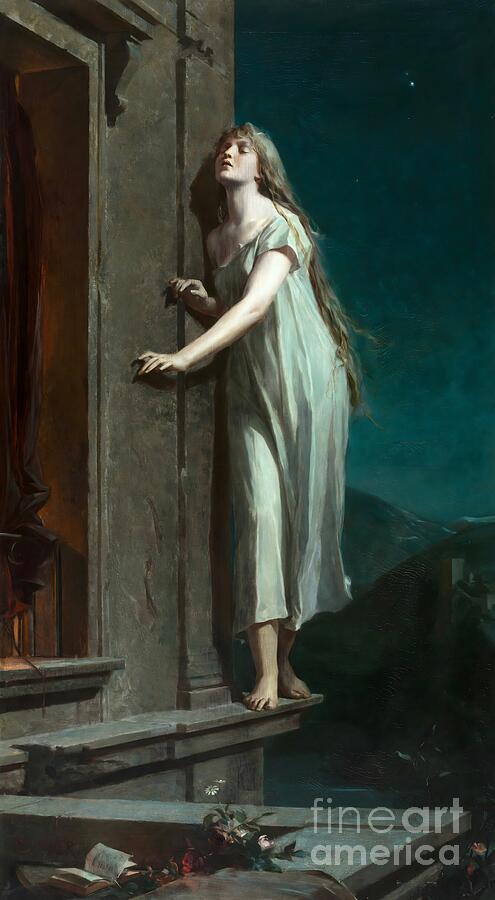
A young woman in a white nightgown stands barefoot on a narrow stone ledge, high above the ground, at night. Behind her, a window glows with warm lamplight; in front of her there is nothing but dark air, distant hills and a single star. Her eyes are closed and her face is turned up, calm, almost blissful. She does not know where she is. Maximilian Pirner painted Somnambulant in 1878, at twenty-four, while he was still a student in Vienna, and it is one of the strangest and most quietly frightening pictures of the nineteenth century.
🖼️ Get this painting as a print →
Artist: Maximilian Pirner (1854–1924), Czech painter
Title: Somnambulant (also known as The Sleepwalker)
Date: 1878
Medium: Oil on canvas, 157 × 87 cm
Collection: National Gallery Prague, Collection of 19th Century Art and Classical Modernism (inv. O 13893)
Notable fact: Painted while Pirner was a student at the Vienna Academy of Fine Arts.
A body asleep, a body in danger
The canvas is tall and narrow, almost twice as high as it is wide, and Pirner uses that shape to make us feel the height. The wall of the house rises like a cliff on the left. The ledge the girl stands on is only a little wider than her feet, and below it another ledge drops away into darkness. Her bare feet are at the very edge of the stone. Her hands are pressed flat against the wall, as if she were feeling her way along it, but her eyes are shut. Her long fair hair falls loose down her back and lifts slightly in the night air.
Everything in the picture is split in two. On one side, the open window and its red curtain glow with the orange light of a lamp: the warm, safe world of the room she has left. On the other, the sky is a deep, cold blue, with dark hills on the horizon and one bright star. The girl stands exactly on the border between the two, touched by the cold light of the night on one side and the lamp on the other.
The details that tell the story
Look down to the bottom of the picture. On the lower ledge lie an open book and a few scattered flowers. Pirner does not explain them, but they suggest an evening that ended abruptly: someone was reading by the window, and the flowers have fallen or been dropped. Whatever happened in the room, the girl has walked out of it without waking.
Her expression is the most unsettling detail of all. There is no fear in her face. Her head is tilted back, her lips slightly parted, as if she were listening to music or looking at something wonderful. The danger exists only for us, the viewers, who can see the drop she cannot. That is the tension that holds the picture together: we want to call out to her, and we know that waking a sleepwalker suddenly on a ledge might be the worst thing to do.
Why sleepwalkers fascinated the nineteenth century
Pirner was not the first to be drawn to the subject. The sleepwalker was a favourite figure of the Romantic imagination. In Vincenzo Bellini’s opera La sonnambula, first performed in Milan in 1831, the innocent Amina is disgraced after she is found asleep in a stranger’s room at the village inn, where she had wandered without waking; her innocence comes to light only when the villagers see her sleepwalking again, high above them at the mill. Long before that, Shakespeare had given the stage its most famous sleepwalker in Lady Macbeth, who wanders at night rubbing her hands and confesses in her sleep what she would never say awake.
For nineteenth-century audiences, sleepwalking sat at the meeting point of medicine, mystery and morality. The sleeper is unconscious and therefore innocent, yet she moves, acts and goes where she should not. That is why the subject suited painters so well: it allowed them to show a young woman exposed, vulnerable and in danger, while keeping her pure. Pirner’s girl belongs to this tradition, but he strips away the opera plot and leaves only the essential image: a sleeping body on the edge of the void.
Maximilian Pirner: from Vienna to Symbolism
Pirner was born in 1854 in Sušice, in southern Bohemia, and studied at the Academy of Fine Arts in Prague from 1872 to 1874. He then moved to the Vienna Academy, where he studied from 1875 to 1879 under his fellow Bohemian Josef Matyáš Trenkwald, and stayed in Vienna until 1887. Somnambulant comes from those student years. Later he returned to Prague, began teaching at the Academy and was named a professor there in 1896. He was a member of the Vienna Secession and is associated with the Mánes Union of Fine Arts.
His mature work turned towards myth, allegory and the macabre: Medusa (1891), Daemon Love (1893), Allegory of Death (1895) and Hecate (1901). The National Gallery Prague holds many of his paintings, including The End of All Things – Finis and Fairies by the Brook. Critics of his day were divided: one praised his “mastery of the sinuous line”, another called him an over-sophisticated mystic. Seen today, Somnambulant already contains the whole programme of Czech Symbolism: night, dream, a woman between two worlds, and a danger that is felt rather than shown. Pirner died in Prague in 1924.
A hidden masterpiece
Outside the Czech Republic, Pirner’s name is almost unknown, and this painting is rarely reproduced. It deserves better. Few pictures manage to be so beautiful and so tense at the same time, and few make the viewer so aware of their own helplessness. If you like paintings that hover between dream and nightmare, look at Ludwik Stasiak’s Allegory of Satan, Arnold Böcklin’s Isle of the Dead and John Collier’s Sleeping Beauty, and explore more forgotten pictures on our page of hidden masterpieces.
Hang Pirner’s Somnambulant — the narrow ledge, the glowing window, the sleeper between two worlds — as a print, canvas or poster from the Sapiens Verbum print shop.
 Choose your size and frame →
Printed and shipped by Fine Art America · 30-day money-back guarantee
💬 Over to you: If you saw her on that ledge, would you call out to wake her, or stay silent and hope she walks back inside? Tell us in the comments.
Sources
National Gallery Prague — Max Pirner, Somnambulant (O 13893)
Wikipedia — Maximilian Pirner
Flame Tree — La sonnambula by Vincenzo Bellini
Sapiens Verbum — Somnambulant, Maximilian Pirner
Comments
Post a Comment