
The Nightmare by Henry Fuseli: The Demon, the Horse and the Sleeper (1781)
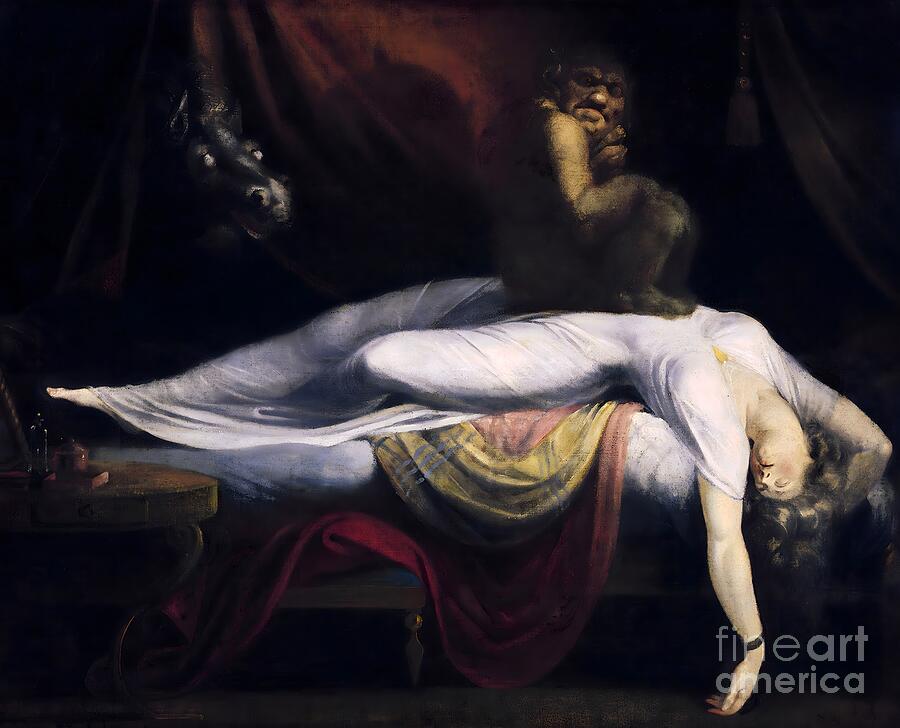
A young woman lies across a bed, deep asleep, her head and arm hanging over the edge as if she had fainted. On her chest squats a small, hairy demon, chin in hand, staring straight out at us. Behind the red curtain, a horse with blank, glowing eyes pushes its head into the room. Henry Fuseli painted The Nightmare in 1781, and when it was shown in London the following year it made him famous almost overnight. It is still one of the strangest pictures ever to become a household image.
🖼️ Get this painting as a print →
Artist: Henry Fuseli (Johann Heinrich Füssli, 1741–1825), Swiss painter active in London
Title: The Nightmare
Date: 1781
Medium: Oil on canvas, 101.7 × 127.1 cm
Collection: Detroit Institute of Arts (55.5.A)
Notable fact: First shown at the Royal Academy in 1782; Fuseli painted at least three more versions.
What you see
The composition is built like a stage. The sleeper lies diagonally across the bed in a white gown that glows against the darkness, her body twisted, her head thrown back over the edge of the mattress and one arm hanging down to the floor. Her pose is not restful: it is the pose of someone who has been overcome. On her chest crouches the demon, an incubus, heavy and squat, resting its chin on its hand with an expression somewhere between boredom and menace. It does not look at her. It looks at us.
From the left, through a gap in the red curtains, appears the head of a horse. Its eyes are pale and empty, its nostrils flared. On a small table beside the bed stand a few bottles and a book, ordinary things in an ordinary bedroom, which only makes the intruders more disturbing. The light falls almost entirely on the woman, so that everything else, the demon, the horse and the folds of the curtains, seems to emerge from the shadows of her own sleep.
A pun with a horse
Why a horse? The English word “nightmare” has nothing to do with female horses. It comes from mare, an old Germanic and Scandinavian name for a spirit that sat on sleepers’ chests and suffocated them. In folk belief, the weight on the chest was the demon; the terrifying dream it brought was its “ride”. Fuseli, who wrote and thought in both German and English, painted the word literally: he gave the night-mare the demon on the chest and the mare through the curtain. The joke is serious, though. In one image he combines old folklore with what anyone who has woken in panic will recognise: the feeling of being pinned down and unable to move.
A sensation at the Royal Academy
Fuseli was born in Zürich in 1741 and took holy orders as a young man before turning to art. After eight years in Italy he returned to London in 1779, where he had so far exhibited without much success. The Nightmare changed that. Shown at the Royal Academy in 1782, it provoked horrified fascination among critics and visitors. Fuseli sold the canvas for twenty guineas, but the real money came from the print: an engraving by Thomas Burke, published in January 1783, circulated widely and earned the publisher John Raphael Smith more than five hundred pounds. The image spread far beyond the exhibition rooms. It had become what we would now call a viral picture.
A face on the back of the canvas
The painting has a secret on its reverse: an unfinished portrait of a young woman. Some scholars have suggested that she is Anna Landolt, a young woman from Zürich whom Fuseli is said to have loved. The art historian H. W. Janson went further and read the whole picture as a private fantasy: the sleeper as Anna, the demon on her chest as Fuseli himself. It is an attractive theory, but only a theory. What is certain is that Fuseli returned to the subject again and again; the most important later version, painted in 1790–91, is in the Goethe House in Frankfurt.
From Frankenstein to Freud
The image soon escaped the art world. Readers of Mary Shelley’s Frankenstein (1818) have long noticed how closely the scene in which Victor finds his murdered bride, lying lifeless across the bed with her head hanging down, recalls Fuseli’s sleeper; Mary Shelley’s mother, Mary Wollstonecraft, had once pursued Fuseli with determination. And in the 1920s, a print of The Nightmare hung in Sigmund Freud’s apartment in Vienna, as both the Detroit Institute of Arts and visitors’ accounts record. A painting about a dream, owned by the man who wrote The Interpretation of Dreams: it is hard to imagine a better home for it.
Why it still matters
Most eighteenth-century paintings tell us what people looked like. The Nightmare tries to show what something felt like from the inside: the weight, the paralysis, the sense of being watched. That is why it looks so modern, and why it influenced Romantic painters, Gothic novelists and, much later, horror films. For more pictures that hover between sleep and danger, see Maximilian Pirner’s Somnambulant, Edvard Munch’s The Scream and Goya’s Saturn Devouring His Son.
Hang Fuseli’s Nightmare — the sleeper, the demon and the pale-eyed horse — as a print, canvas or poster from the Sapiens Verbum print shop.
 Choose your size and frame →
Printed and shipped by Fine Art America · 30-day money-back guarantee
Fuseli’s Nightmare reimagined as an Art Deco vintage art poster by Sapiens Verbum.
 Shop the vintage poster →
See the vintage poster collection →
Shop the vintage poster →
See the vintage poster collection →
The Nightmare is one of the thirty pictures in our book The 30 Most Famous Paintings in the History of Art: The Myths They Hide, the History They Reveal. Each chapter takes one painting, the myth around it and the history behind it. On Kindle, in paperback, in hardcover and as an audiobook.
Get the book →See all 30 paintings →
💬 Over to you: Which detail unsettles you most: the demon on her chest, the horse in the curtains, or the way the demon looks straight at you? Tell us in the comments.
Sources
Detroit Institute of Arts — Henry Fuseli, The Nightmare (55.5.A)
Wikipedia — The Nightmare
Wikipedia — Henry Fuseli
Comments
Post a Comment