
Flower Beds in Holland by Van Gogh: Colour Before the Sunflowers (c. 1883)
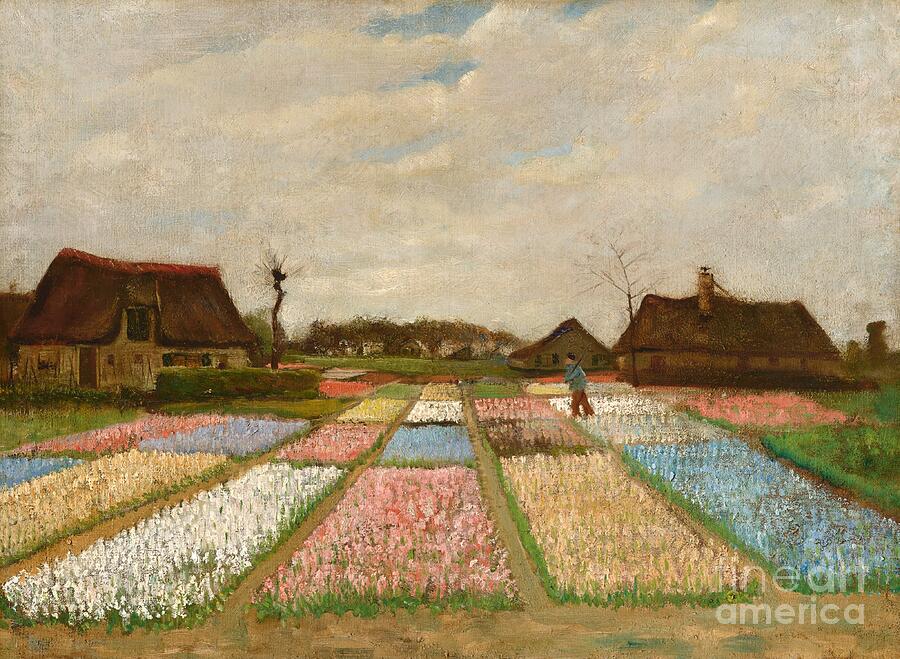
Strips of colour run toward a line of thatched roofs: white, pink, butter yellow, pale blue, laid side by side like lengths of cloth set out to dry. One man walks between them. Above, a cream-grey Dutch sky fills the upper half of the canvas. Vincent van Gogh’s Flower Beds in Holland (c. 1883) is not the Van Gogh most people picture — it is tidy, quiet, almost polite — and it was made years before Paris and Arles, while he was still teaching himself to paint in The Hague. Look closely and you can watch a beginner use a hard-won discipline, perspective, to hold down the thing he could not yet fully control: colour.
Artist: Vincent van Gogh (1853–1890)
Date: c. 1883 (his Hague years; often placed in spring 1883)
Medium: Oil on canvas on wood (48.9 × 66 cm / 19 1/4 × 26 in.)
Collection: National Gallery of Art, Washington, D.C. (1983.1.21; Collection of Mr. and Mrs. Paul Mellon)
Notable fact: First exhibited in Rotterdam in 1904 as Tulpenland (“Tulip Land”), although the flowers are usually identified as hyacinths; catalogued as F 186 / JH 361
🖼️ Get this painting as a print →
Strips of Colour and One Walking Figure
Start at the bottom edge. The beds begin almost at your feet, each one a single colour: white, then pink, then a pale straw yellow, then a cool blue on the right. Narrow earth paths separate them and run back toward the middle of the picture, where they seem to meet just in front of a small house. The National Gallery of Art’s own description compares the effect to a patchwork quilt, and that is exactly how it reads from a distance. Up close, the flowers are not drawn one by one. They are short, loose, parallel touches of paint that turn into texture rather than botany.
Behind the field, the horizon sits close to halfway up the canvas. Dark brown cottages with tall thatched roofs close it off on both sides; two bare trees twist up into the clouds. One man, the only figure, crosses the beds on the right with something over his shoulder. He is small enough to give the field its scale and anonymous enough not to turn it into a story.
A Perspective Lesson in Bloom
Everything in the composition leans on those converging paths. That is not an accident of the motif. In his first Hague years Van Gogh worked hard at perspective: an uncle’s commission for drawings of city views gave him, as the Van Gogh Museum puts it, a chance to develop his perspective skills, and in August 1882 he had a blacksmith fit iron spikes to the legs of his perspective frame, explaining to Theo that “on the beach or in a meadow or a field you have a view as if through a window” (letter 254). A field of rectangular bulb beds is a perspective exercise that nature has already laid out for you.
What the frame could not settle was colour. Hague School painting, the art Van Gogh admired around him, was largely a matter of grey skies, muted greens and tonal harmony. Here the sky and the cottages obey that sober key, but the beds do not. Pink and blue sit side by side at full strength in the foreground. The picture is a small negotiation between the dark Dutch landscape he was trained to see and the bright strips of colour actually growing in front of him.
The Hague, 1881–1883
Van Gogh settled in The Hague after a quarrel with his father at Christmas 1881. His cousin by marriage, the Hague School painter Anton Mauve, gave him lessons in watercolour and oil, and Van Gogh visited his studio almost daily until the two fell out. Early in 1882 he met Sien Hoornik, a former prostitute who was pregnant and already had a young daughter; she became his model and partner, and his family and Mauve were shocked (Van Gogh Museum).
Painting came slowly. In September 1882 he wrote to his brother Theo: “I don’t know myself how I paint. I sit with a white board before the spot that strikes me — I look at what’s before my eyes — I say to myself, this white board must become something” (letter 260). The following February, after “a couple of true spring days,” he described people of every sort crowding round a market trader who sold “crocuses, snowdrops, goatsbeard and other bulbs,” and concluded that “the poor and the painters have the sentiment of the weather and the changing seasons in common” (letter 310). The letter is not about this painting, but it shows how much a Dutch spring, and the bulbs that announce it, meant to him that year.
When Was It Painted?
The National Gallery of Art dates the canvas “c. 1883,” and the caution is useful. Several reference sources place it in April 1883, the month when Dutch hyacinth fields are in flower. Yet the Van Gogh Museum’s scholarly catalogue of his early paintings notes that after a burst of oil painting that began in August 1882, lack of money pushed him back to drawing, and that he did not return to the brush until late summer 1883, towards the end of his stay in The Hague. A spring field of blooming bulbs does not sit comfortably inside that timeline. The museum label leaves room for the question; so should we. What is not in doubt is the place in his development: an early, careful, Dutch picture, painted long before the colour revolution of Paris.
From a Breda Storeroom to Washington
The painting’s later life is almost a novel. According to the National Gallery of Art’s provenance record, it was probably among the works Van Gogh left behind at his family’s home in Nuenen when he departed abruptly for Antwerp in late 1885. In 1886 those works went with his mother and his sister Willemina to Breda, where they were stored with a carpenter, Adrianus Schrauwen. In 1902 Schrauwen, though not their legal owner, sold a group of them to the Couvreur brothers, dealers in old furniture in Breda. They passed quickly to the clothing dealer Kees Mouwen and Willem van Bakel, and in 1904 the Oldenzeel gallery in Rotterdam showed this canvas as Tulpenland.
In 1905 it was bought by Jan Smit of Alblasserdam, a shipowner who, the Van Gogh Museum notes, owned seven works by Van Gogh. At the sale of his estate in Amsterdam in 1919 it went to John Enthoven, son of the Van Gogh collector Lodewijk Enthoven. By 1954 it was with the dealer Willem Brinkman; it then crossed the Atlantic via the Frank Perls Gallery and M. Knoedler & Co., which sold it in January 1955 to Paul Mellon. It entered the National Gallery of Art in 1983 as part of the Collection of Mr. and Mrs. Paul Mellon.
How to Look, and Where to See It
Follow the central path from the bottom edge to the little house where the lines seem to meet; then let your eye drift left and right along the beds. Notice how the beds shrink and thin out as they recede: the broadest bands of white, pink and blue are the ones closest to you. Stop at the walking man, the only vertical mark among the horizontals, and then climb into the sky, where small patches of blue break through the clouds. The picture has travelled widely, from Monet in Holland at the Van Gogh Museum in 1986 to The Hague School and the Young Van Gogh at the Gemeentemuseum in The Hague in 2005, but its home is the National Gallery of Art in Washington, where at the time of writing it is listed as not on view. Check the museum’s page before you go.
For Van Gogh at the other end of his short career, read our essay on Green Wheat Fields, Auvers (1890), also from the Mellon collection in Washington, then The Starry Night (1889) and his Self-Portrait of 1889 at the Musée d’Orsay. And on Sapiens Verbum Daily: Van Gogh’s Long-Hidden Chestnut Trees Could Smash His Auction Record at Sotheby’s.
Seven years separate this field from the wheat of Auvers. In between come the dark peasant pictures of Nuenen, Paris, the sunflowers of Arles, and Saint-Rémy. Here, the colour is already in the ground, waiting in neat rows. It just has not reached the sky yet.
Sources: National Gallery of Art, Flower Beds in Holland (1983.1.21), including provenance and exhibition history; Van Gogh Museum, Vincent van Gogh Paintings, Vol. 1: Dutch Period 1881–1885 (collection catalogue); Van Gogh Museum, “First steps as an artist”; Vincent van Gogh: The Letters (letters 254, 260, 310).
Hang Van Gogh’s Flower Beds in Holland — hyacinth rows, thatched roofs and a wide Dutch sky — as a museum-quality print, canvas or poster from the Sapiens Verbum print shop.
 Shop This Print →See It on Canvas →
Museum image: NGA Open Access. Prints sold separately.
Comments
Post a Comment