Green Wheat Fields, Auvers by Van Gogh: A Landscape With Nothing But Wind (1890)
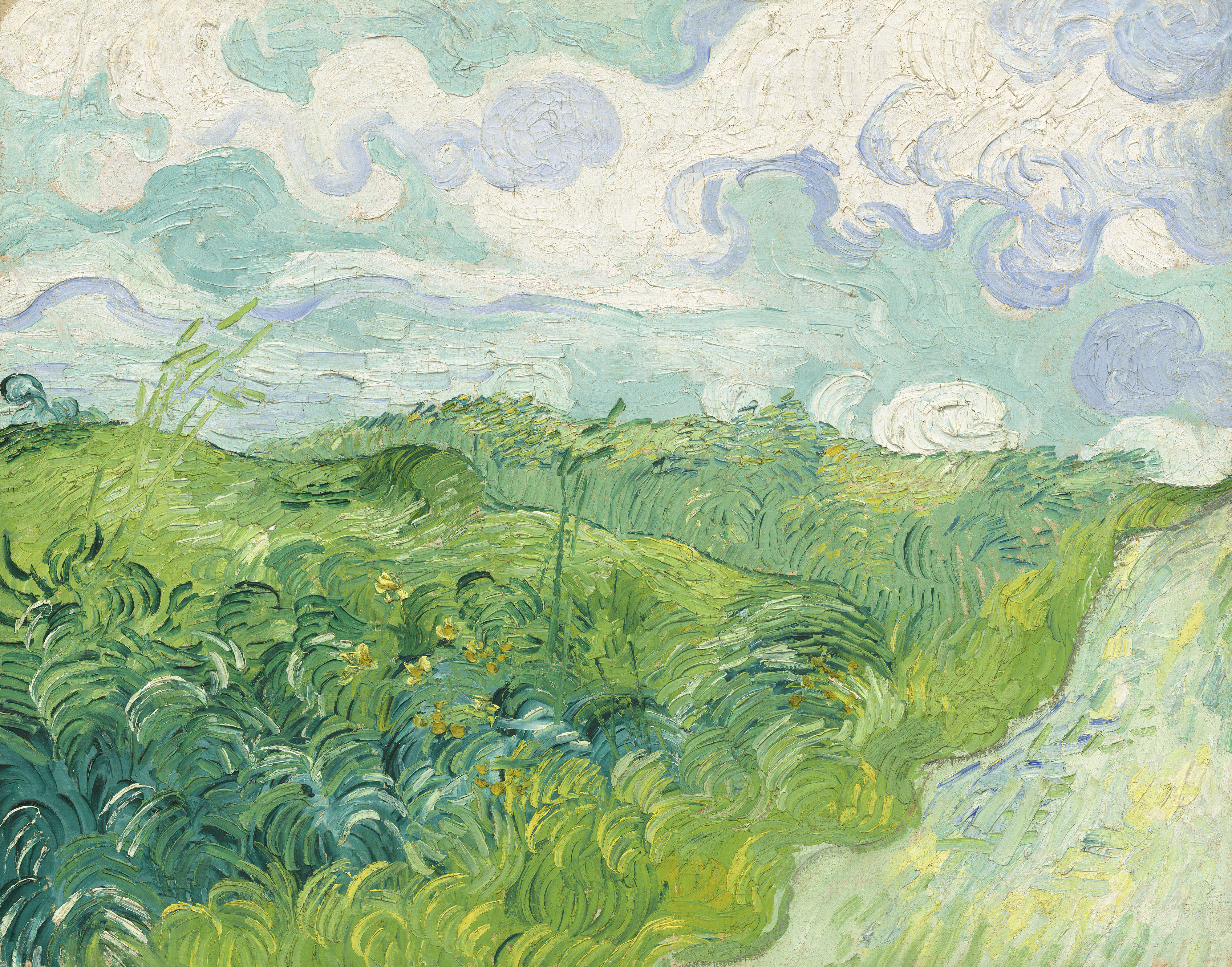
There is almost no story here - and that is the point. No farmer, no cart, no church steeple. Just a field of green wheat rising in waves, a pale dirt path slipping in from the lower right, and a sky full of soft, restless clouds. Vincent van Gogh painted Green Wheat Fields, Auvers in 1890, in the village north of Paris where he spent his last months. The canvas is "pure" landscape: nature under wind, thickened into paint.
Artist: Vincent van Gogh (1853-1890)
Date: 1890 (Auvers-sur-Oise, likely May)
Medium: Oil on canvas (28 1/2 x 36 in / 72.39 x 91.44 cm)
Collection: National Gallery of Art, Washington, D.C. (Paul Mellon Collection)
Notable fact: A "pure" landscape with no figures or buildings; entered the NGA in 2013 from the Mellon gift
What Fills Two-Thirds of the Canvas
Stand with the painting and the field takes over. Greens run from cool emerald to yellow-lime; short curved strokes stack into ridges that feel less like crop rows than like water in a storm. In the lower left, small yellow marks break through as wildflowers. The wheat is not waiting politely for harvest. It is already moving.
The Path That Barely Arrives
At the bottom right, a cream-and-tan road edges into the scene and climbs toward the horizon. It is the only human trace - and even that feels provisional, a pale ribbon the green could close over. Van Gogh gives you a way in, then lets the field argue louder than any destination.
Sky as Second Weather System
Above the wheat, clouds swirl in white, pale turquoise, and soft blue-violet. Their curves answer the curves below, so land and air share one rhythm. This is the same late language of motion you know from other Auvers and Saint-Remy skies: weather painted as feeling, not meteorology.
Auvers, 1890
Van Gogh arrived in Auvers-sur-Oise in May 1890 after Saint-Remy. In a few months he painted the church, the town hall, thatched houses - and also landscapes stripped of anecdote like this one. He died on 29 July 1890. Green Wheat Fields belongs to that compressed season of work: prolific, outdoor, and driven by the countryside around the village rather than by a single famous motif.
Why a Field Without People Still Feels Crowded
Remove the figures and the brushwork becomes the cast. Impasto ridges catch light; greens vibrate against one another; the path keeps a thin promise of travel. Look once for a quiet rural view. Look again for wind made visible - the thing Van Gogh could not leave out even when he left everything else behind.
Own This Painting
Hang Van Gogh's Auvers field - green wheat, a pale path, and a sky that will not sit still.
Related on @SapiensVerbum: a video essay on Van Gogh's Starry Night.


Comments
Post a Comment