
Evicted by Erik Henningsen: A Family Put Out in the Snow (1892)
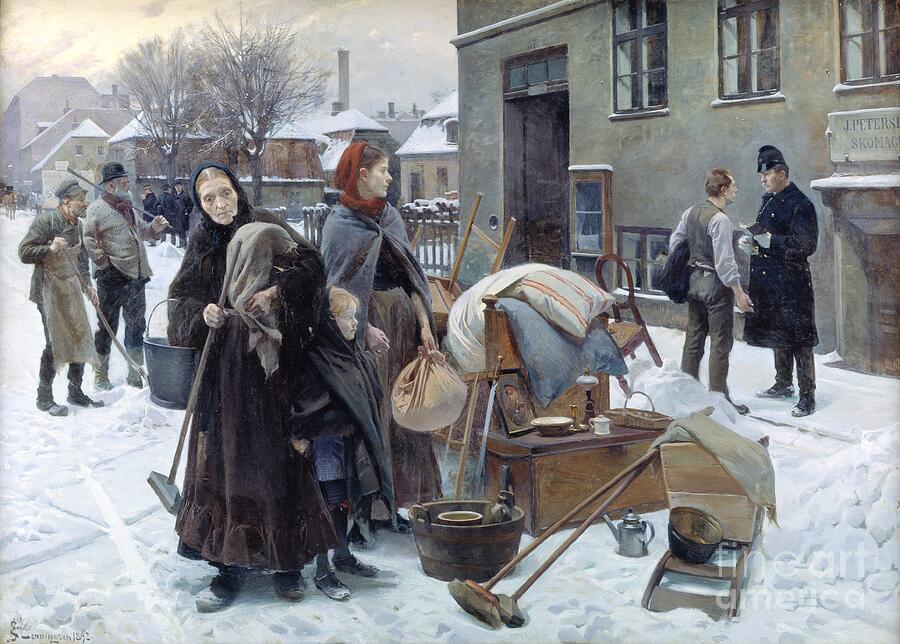
Everything a family owns fits on one patch of snow. A chest of drawers, a mattress and pillows, a chair, a washtub, a coffee pot, a framed picture propped against the pile. Three generations of women stand beside it in their shawls, while a few steps away the father, in shirtsleeves and waistcoat, pleads with a policeman who is reading from a sheet of paper. Erik Henningsen’s Evicted (Sat ud, 1892), now in the Statens Museum for Kunst in Copenhagen, is one of the great images of poverty in nineteenth-century European painting, and it was painted on a real Copenhagen street.
🖼️ Get this painting as a print →
Artist: Erik Henningsen (1855–1930)
Title: Sat ud (Evicted), also known as Evicted Tenants
Date: 1892 (signed and dated lower left)
Medium: Oil on canvas, 158 × 220.5 cm
Collection: Statens Museum for Kunst (SMK), Copenhagen, inv. KMS1454
Setting: Blågårdsgade, in the working-class district of Nørrebro, Copenhagen, in winter
A street, a family and a piece of paper
The scene is Blågårdsgade, in Nørrebro, the crowded working-class quarter that grew up outside Copenhagen’s old ramparts in the second half of the nineteenth century. It is winter. The sky is grey, the snow is trodden into slush, and the family’s life has been carried out of the building and set down on the pavement: bedding, a chest, a chair, kitchen things, a small sledge.
The grandmother stands in front in a black shawl, leaning on a broom, her face turned towards us. Behind her, the mother, in a red headscarf, holds a bundle tied in a cloth, and between them a little girl presses against her grandmother’s skirts. Nobody cries. That is what makes the picture so hard to look at: they are simply waiting, because there is nowhere else to go.
On the right, the father argues with a policeman in a long dark coat who holds the paper that decides everything. Above them hangs a shop sign for a shoemaker. On the left, two neighbours with shovels and a bucket have stopped clearing the snow to watch. They are not hostile. They are spectators, as we are.
Painting as reportage
The SMK describes Sat ud as a kind of contemporary reportage. In the 1870s the critic Georg Brandes had called on Danish writers to put the problems of their own time up for debate, and the period that followed is known as the Modern Breakthrough. Writers answered quickly. Few painters dared to show the great social conflicts of the day, and Henningsen was one of them.
His method is close to cinema. The canvas is more than two metres wide, the viewpoint is at eye level, as if we were standing on the same pavement, and the eye is pulled from the old woman’s face to the heap of furniture and on to the confrontation at the door. The aim was not to call for revolution but to make the comfortable public at the exhibitions feel what it meant to lose a home in a Danish winter. Look how carefully the objects are chosen: a picture in a frame and a coffee pot are enough to tell us that this was a home, not a slum.
The painter of the people nobody painted
Erik Henningsen trained at the Royal Danish Academy of Fine Arts from 1873 to 1877 and belonged to Bogstaveligheden, a circle of writers and artists who believed in social progress through realism and open debate. In the 1880s and 1890s he painted the unemployed, the legal helplessness of women and workers, children and the old. His Summum jus, summa injuria (1886), in the Hirschsprung Collection, tells the story of an infanticide committed by a young mother left without any support; A Wounded Worker (1895), also in the SMK, carries the same concern into the factory age. He received the Eckersberg Medal in 1890, two years before Sat ud.
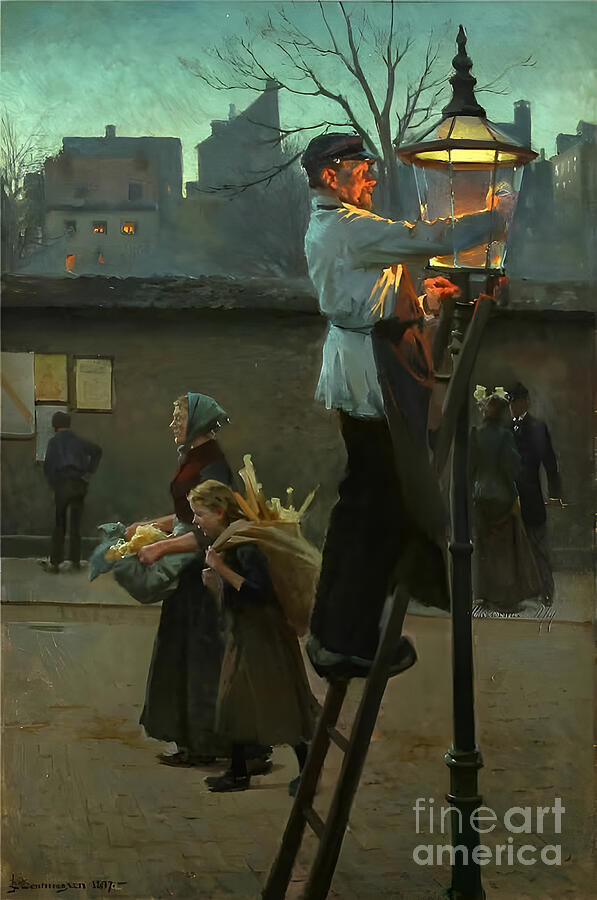
He also had a lighter hand. His street scenes of Copenhagen include The Lamplighter, and in 1900 he drew the famous thirsty man for a Tuborg poster, a figure that still appears on the brewery’s labels. Sat ud shows the other side of the same city.
Why it still hurts
Evictions are not a nineteenth-century subject. The painting works today because Henningsen refuses melodrama: no one faints, no villain twirls a moustache, and the policeman is just a man doing his job. The question the picture leaves us with is the one the SMK puts to its visitors: where will this family sleep tonight? Compare the silent grief of Shipwrecked by Joaquín Bárbara y Balza, painted only a few years later, or the long line of the wounded in Sargent’s Gassed.
Hang Erik Henningsen’s Evicted on your wall: a museum-quality print, canvas or poster of one of the most powerful images of Danish Realism, from the Sapiens Verbum print shop.
 Choose your size and frame →
Printed and shipped by Fine Art America · 30-day money-back guarantee
Where can you see it?
Sat ud belongs to the Statens Museum for Kunst, the National Gallery of Denmark, in Copenhagen, one of the key collections of Danish painting of the Modern Breakthrough. Check the museum’s website before your visit to see whether it is on display; the SMK has released the image as public domain on its open collection site. For more paintings by museum and period, browse Explore Art, or see what other readers hang at home in our best-selling art prints.
Sources
Statens Museum for Kunst, SMK Connect, “Sat ud – Maleri af Erik Henningsen” and SMK Open, KMS1454; Lex (Den Store Danske), “Erik Henningsen” and “Det moderne gennembruds maleri”; Wikipedia, “Erik Henningsen”.
Comments
Post a Comment