
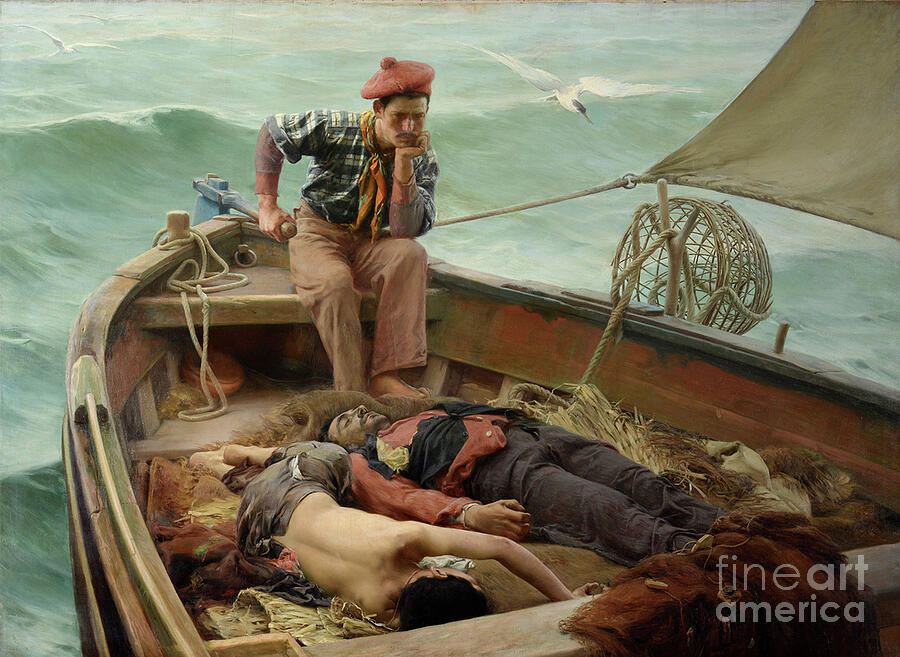
Shipwrecked (Náufragos) by Joaquín Bárbara y Balza: The Silence After the Storm (1896)
A small fishing boat rides a grey-green swell. In the bottom lie two drowned men among nets and straw, one face down with his bare back to the sky, the other on his back with his eyes closed. Above them sits the only survivor, in a red beret and checked shirt, his chin resting on his hand, staring at nothing. Gulls wheel over the waves. Shipwrecked (Náufragos), painted in 1896 by the Basque artist Joaquín Bárbara y Balza, is a shipwreck picture with no storm in it at all: only the silence after.
🖼️ Get this painting as a print →
Artist: Joaquín Bárbara y Balza (1867–1931)
Date: 1896
Medium: Oil on canvas, 184.7 × 253.4 cm
Collection: Museo del Prado (P007209), on deposit at the Museo de Bellas Artes de Alicante (MUBAG)
Context: Painted in Rome during the artist's state scholarship
What does the painting show?
The boat cuts diagonally across the canvas from the lower left, so we look down into it as if we were standing on the bow. The sea fills almost the whole background, its waves painted in cold greens and greys, and a patched sail closes the scene at the top right. Inside the boat everything is ordinary working gear: coils of rope, a wicker lobster pot, a heap of brown net in the corner, straw spread across the boards. Among these things lie the two dead men, still in their working clothes, one with his shirt torn away.
The survivor is the centre of the picture. He is not praying, weeping or calling for help. He leans forward with one hand on the gunwale and the other supporting his chin, and his eyes are fixed on a point beyond the frame. The Prado describes his expression as the strong dramatic accent of the composition: a man thinking about what has just happened, and perhaps about what he will have to say when he reaches the harbour.
Drama held in check
Bárbara painted the scene with the careful drawing of an academic training and with direct study of the sea, made during trips to the coast near Rome. The Prado's own commentary is frank about the result: it notes a uniform, rather muted tone and surfaces that can feel a little stiff, and it sees the picture as following the fashion for social realism rather than breaking new ground.
That restraint is also what makes the painting memorable. Compare it with Géricault's Raft of the Medusa, where bodies are piled into a pyramid of despair and hope, or Rembrandt's Christ in the Storm on the Sea of Galilee, all lightning and spray. Bárbara chooses the moment after the noise, and asks the viewer to supply the storm.
Social realism in the 1890s
In the last decade of the nineteenth century Spanish painters turned increasingly to the hard lives of working people, and the dangers of the sea were among their favourite themes. The best-known example is Sorolla's And They Still Say Fish Is Expensive! of 1894, also in the Prado, where an injured young fisherman is tended in the hold of a boat. Bárbara's canvas belongs to the same moment and shares its message: the fish on the market stall is paid for with lives. For a sunnier view of the same Mediterranean, see Sorolla's Children on the Beach.
Who was Joaquín Bárbara y Balza?
Bárbara was born in Llodio, in the Basque Country, in 1867, and trained at the Real Academia de Bellas Artes de San Fernando in Madrid. Like many promising Spanish artists of his generation he won a scholarship to study in Rome, and the large works that scholarship holders sent home were meant to prove their progress; Shipwrecked is one of them. He worked across landscapes, figure painting and studies of light, but his name faded after his death in Santander in 1931. A 2017 monograph called him a forgotten artist, and the painting itself has spent most of its life on loan to other institutions rather than on the Prado's walls.
Where can you see it today?
The painting entered the state collections in 1930, passed through the Museo de Arte Moderno in Madrid and now belongs to the Prado, which has deposited it at the Museo de Bellas Artes Gravina (MUBAG) in Alicante, a port city where its subject feels very much at home. Check the museum's website before you go, as deposits can move.
See Bárbara y Balza’s Shipwrecked framed on your wall: a museum-quality print, canvas or poster from the Sapiens Verbum print shop.
 Choose your size and frame →
Printed and shipped by Fine Art America · 30-day money-back guarantee
Watch the video essay (in Spanish) on @SapiensVerbum on YouTube.
Sources
Museo del Prado, "Shipwreck" (Náufragos), P007209; Wikipedia, "Joaquín Bárbara y Balza".
Comments
Post a Comment