Gassed by Sargent: The Blind March of World War I (1919)
Blindfolded soldiers form a human chain, each hand on the man ahead, moving through mustard-gas aftermath like a procession that has forgotten how to see. John Singer Sargent's Gassed (1919) is enormous and quiet at once - a society portraitist's eye turned on World War I's chemical wound, where the sky is still strangely luminous and the ground is full of bodies waiting.
Artist: John Singer Sargent (1856-1925)
Date: 1919
Medium: Oil on canvas
Collection: Imperial War Museum, London
Notable fact: Commissioned as a war memorial painting; depicts mustard-gas blinded troops after a Western Front attack
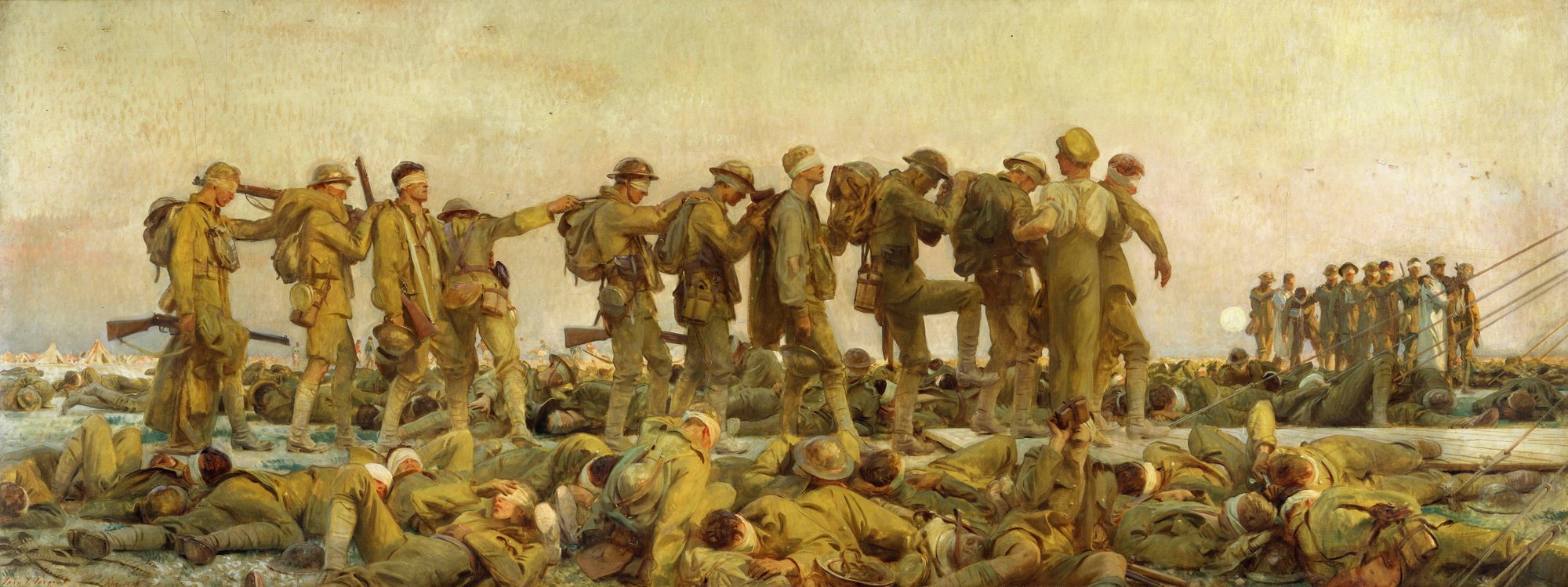
From Glamour to Triage
Sargent had made a career of silk, marble, and brilliant faces. The British War Memorials Committee sent him toward something else. Gassed keeps his clarity of grouping and light, then spends it on men whose eyes are wrapped and whose path is a rope of trust. Beauty becomes unbearable because it still works.
The Line as Narrative
The central frieze of walking wounded stretches across the wide canvas like a classical relief rewritten in puttees and khaki. Litter cases fill the foreground; another column echoes in the distance. Football continues far off under the same sky - ordinary life not erased, only made grotesque by contrast.
Mustard Gas Without Spectacle Smoke
There is little theatrical explosion. The horror is medical and social: temporary or lasting blindness, dependence, the shuffle forward. Sargent refuses recruiting-poster heroics. He paints aftermath - the part of war that outlives the bang.
Why the March Still Hurts
Gassed remains one of the war's essential images because it is almost gentle. Look once for the famous chain of the blind. Look again for everyone lying down who will not join it.
Watch the video essay on @SapiensVerbum on YouTube.


Comments
Post a Comment