Waterhouse's Women Who Break the Rule: Circe, Psyche, Shalott, and the Magic Circle
John William Waterhouse kept returning to the same kind of woman: the one who looks, opens, pours, or steps past the rule that was meant to keep her safe. Circe offers the cup. Circe tips poison into the pool. Psyche lifts the golden lid. The Lady of Shalott turns from the mirror to the window. A sorceress draws a ring of fire on the ground. Five paintings, one habit of mind - and five essays already on this site.
Artist: John William Waterhouse (1849-1917)
Theme: Forbidden looking, pouring, and opening
Paintings in this guide: Circe Offering the Cup to Odysseus (1891), Circe Invidiosa (1892), Psyche Opening the Golden Box (1903), The Lady of Shalott (1888), The Magic Circle (1886)
Notable fact: These are late Pre-Raphaelite canvases that treat myth and Tennyson as modern drama - one figure, one decisive gesture, almost no crowd
Why the Rule Breaks on Purpose
Waterhouse rarely paints obedience. He paints the second after curiosity wins - the hand on the cup, the lid ajar, the face turned toward the river. The canvas is not a sermon against women. It is a study of the moment when safety becomes unbearable. That is why these five still work as a set: different myths, same hinge.
Circe Offering the Cup (1891)
Odysseus sits low; Circe stands with the cup and the wand. Enchantment is hospitality with a price. Full essay: Circe Offering the Cup to Odysseus. Print: shop the Circe cup.
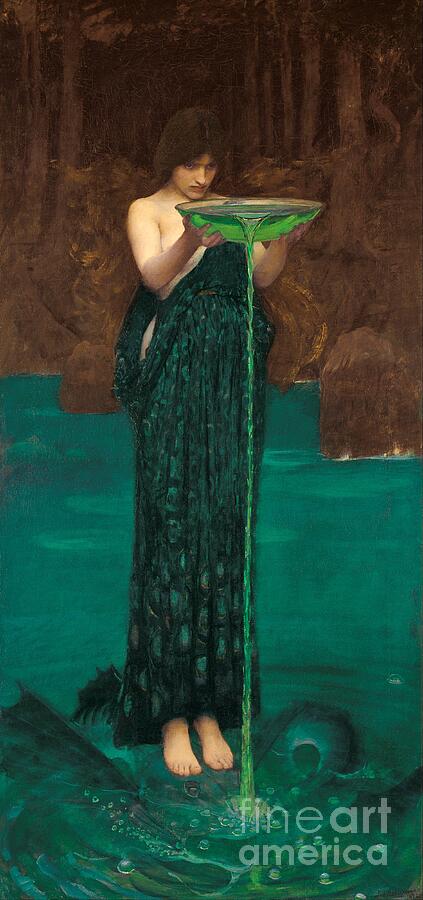
Circe Invidiosa (1892)
One year later, Circe alone over emerald water, pouring jealousy as poison. No Odysseus. The gesture is enough. Full essay: Circe Invidiosa. Print: shop Circe Invidiosa.
Psyche Opening the Golden Box (1903)
The myth says leave the lid shut. Psyche opens it anyway for a dose of beauty that turns out to be sleep. Full essay: Psyche Opening the Golden Box. Print: shop the golden box.
The Lady of Shalott (1888)
The curse is simple: look only at shadows in a mirror. She looks at Lancelot instead, and the river takes her. Full essay: The Lady of Shalott. Print: shop the Lady of Shalott.
The Magic Circle (1886)
A witch draws fire on the ground. The circle is a rule she makes herself - and a stage for looking. Full essay: The Magic Circle. Print: shop The Magic Circle.
How to Read Them as One Story
Start with the hand. Cup, poison, lid, loom-and-window, wand-and-fire: each painting freezes the instant before the world changes. Then open the individual essay for the myth, the museum, and the print. If you want the wider Pre-Raphaelite frame, see also Pre-Raphaelitism in Painting.
Own These Paintings
Browse Waterhouse prints - Circe, Psyche, Shalott, and the magic circle - in one collection.
Watch on @SapiensVerbum: Circe Invidiosa - jealousy poured into emerald water - and then follow the links above for the other four canvases.


Comments
Post a Comment