Circe Invidiosa by Waterhouse: Jealousy Poured into Emerald Water (1892)
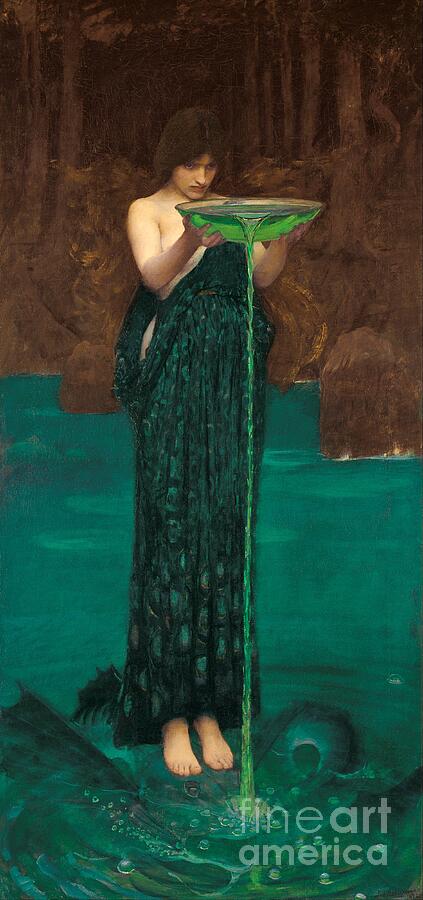
A tall woman leans forward over dark water and tips a bowl of acid-green liquid into the pool. Twisted foliage crowds the background; something shadowy already stirs at her feet. In John William Waterhouse's Circe Invidiosa (1892), witchcraft is not a spectacle of sparks. It is a quiet pour.
Artist: John William Waterhouse (1849-1917)
Date: 1892
Medium: Oil on canvas
Collection: Art Gallery of South Australia, Adelaide
Notable fact: Drawn from Ovid's Metamorphoses Book XIV - Circe poisoning the pool to turn rival Scylla into a monster
Ovid's Jealous Hour
The story comes from Book XIV of the Metamorphoses. Circe, expert in herbs and potions, poisons the water to transform her rival Scylla into a sea monster. Waterhouse chooses the act itself: Circe above the surface, venom bright against deep blue-green, altered shapes already beginning below. The title's invidiosa names the engine - envy.
Threat Without Melodrama
Her pale face, lowered head, and concentrated gaze do more work than any theatrical gesture. Color swirls around her like the potion's aura. Unlike a static salon nymph, this Circe feels mid-crime: elegant, resolved, and emotionally cold enough to frighten. Waterhouse's gift was to pull myth into feeling you can recognize - desire turning cruel.
Beauty as Warning
Pre-Raphaelite clarity of detail meets a darker mood. The painting asks how jealousy dresses itself as justice and how easily beauty can serve harm. Look once for the enchantress. Look again for the green that will not wash out.
Own This Painting
Hang Waterhouse's Circe - the emerald poison, the tilted head, and jealousy made liquid.
Watch the video essay on @SapiensVerbum on YouTube.


Comments
Post a Comment